
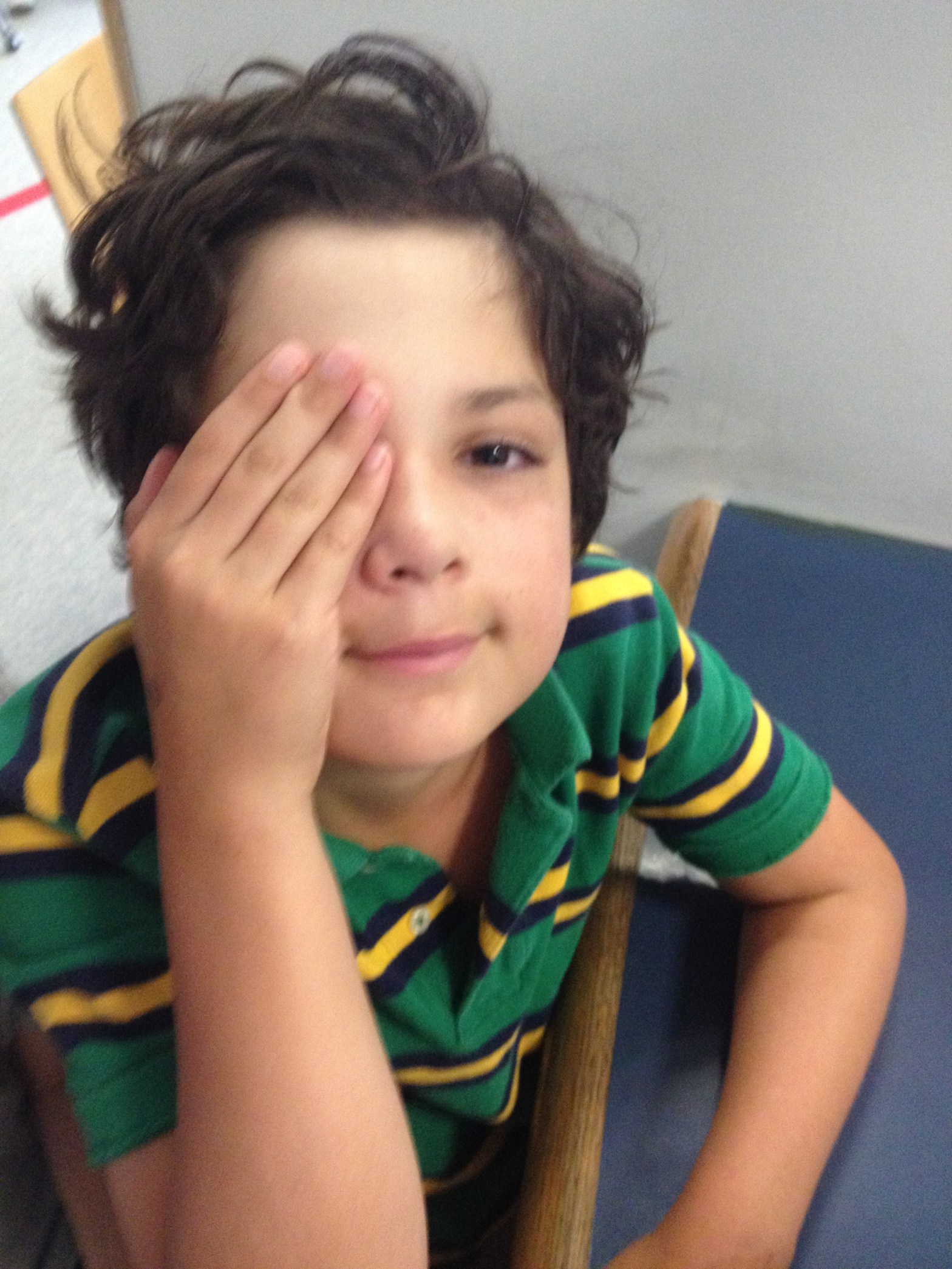


You know it’s going to be one of those days when one of the first tweets on vacation inquires about the closest hospital.
 Victor, one of my 11-year-olds, had something in his eye courtesy of a big gust of wind outside of Westminster Abby. He was complaining enough to let me flip his eyelid and irrigate his eye on the square in front of Big Ben. (I’m sure several people thought I was torturing him). Despite an extensive search and rinse mission no object or relief was to be found. I fretted about going to the hospital. It wasn’t the prospect of navigating a slightly foreign ER, but simply the prospect of the wait. While I am a staunch supporter of the British NHS in the back of my mind I envisioned a paralyzingly full emergency room and an agonizing 18 hour wait only to find he had nothing in his eye (the basic antechamber of Hell scenario). To ensure we really needed to go I gave Victor a choice between the emergency room and a toy store (Gunter’s 3rd rule), but he declined the toys so off we went to St. Thomas hospital, conveniently right over the bridge.
The hospital was on the aging side and a little drab, but clean and well-marked. I didn’t have to ask anyone for directions. We had to take a number to be registered, but waited less than 5 minutes. I gritted my teeth a bit in preparation for the we-are-not-from-the-UK conversation, but it wasn’t an issue at all. I offered my US insurance number for billing, but was told they didn’t need it. The clerk was, however, impressed with the fact that I flipped his eyelid and irrigated his eye before coming. “Well, you did all the right things,” and looking at his red and watering eye she smiled and said. “Looks like you are in the right place.”
Registration completed, we waited to be seen by the children’s part of the ER. A registrar (resident) did a quick triage within 5 minutes of our registering (also impressed with the eye irrigation) and then a nurse did his vitals and took a history. After that we waited less than 15 minutes for the registrar to do a formal assessment. He wanted ophthalmology to do the evaluation. I was a bit surprised the ER doc wouldn’t do it, but every facility is different and when they found out that Victor was born at 26 weeks and had retinopathy of prematurity they got a bit jumpy. Everyone does. I was ok with ophthalmology checking him out. What I have learned from years of medicine is don’t mess with the local order.
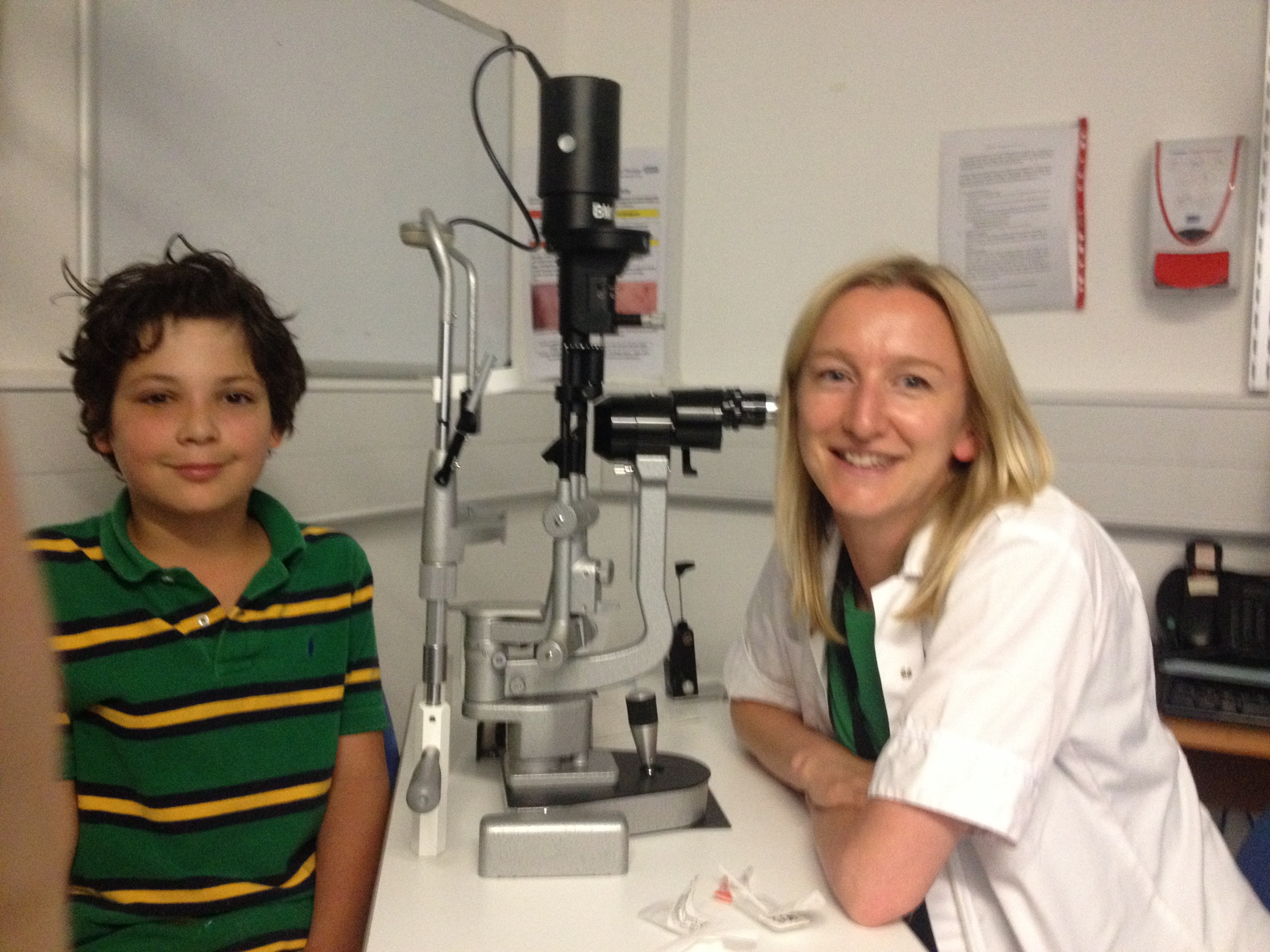
We were walked over to the urgent care clinic and were warned that the ophthalmology registrar was covering the whole hospital so it might be a while. This was our longest wait, about 20-30 minutes. She was very nice (also working on her PhD). Dr. Katie Williams (she gave me permission to use her name and her photo) diagnosed Victor with a corneal abrasion and easily snagged the offending speck of dirt wedged under his eyelid. Once removed Victor exclaimed, “It’s gone!,” and within a minute or two the redness cleared up. She put in antibiotic ointment and gave us a tube to use at home.
“So where do I pay?” I asked Dr. Williams.
The answer: you don’t. Perhaps they might bill us, she just wasn’t sure.
I was about as dumfounded at her answer as she was at my asking.
I protested that it wasn’t fair. We had used services and I was very prepared to pay. I also have insurance that covers emergencies when out of network, so I was pretty sure I would be reimbursed at least some of the visit. However, we were just sent away. They do have my address so it is possible I will get a bill in the mail.
I am very curious what similar care would have cost in the US. The saddest commentary of all is that it is really impossible to tell as billing practices are so bizarre and opaque. My guess is it would be a minimum of $1000 in America for cash (which is egregious). If I ever get a bill from the UK, I’ll post a follow-up. If anyone has had similar care in the US and received a bill please do post in the comments. You can remain anonymous if you like.
But what of this idea that national health care means DMV-purgatory worthy waits, Dementor-staffed death panels, Saxon-age medical equipment, and incompetent care? Well, I can tell you we had great care at St. Thomas and Dr. Williams was fantastic. The slit lamp wasn’t brand new, but it worked just fine. Sure it’s an N of one, but I’ve been to the ER more times than I can count with my other son and this was as smooth as the best care we’ve had in the United States.
We could have hit the ER at an opportune time, but to expand my N I’ve also asked many people about their medical care while I’ve been in the UK. Not one person wanted to abandon the NHS. I’ve heard of excellent care and some care that was lacking, but the bad care has nothing to do with the “national” part. Rather it was diagnostic errors or a full hospice unit, things that I hear about with the same incidence back in the world of commercial insurance. Take away the accents and I could easily have been listening to a group of Americans discussing their care. With one exception, no one in the UK is left wondering what the price will be or gets an egregious bill.
It makes you wonder exactly what frightens Americans about the NHS?
 Dr. Jen Gunter
There is a system of charges for non residents but emergency care is not covered by that neither is primary care, mental health, family planning (yes abortion gasp lol) and infectious diseases for obvious public health reasons. Only acute care caries charges for non UK residents.
I’m healthy and have no chronic health conditions.Two experiences: In the U.S. My health insurance has always been paid for by my employers, although a monthly amount is also taken from my paycheck to help pay for it. I discovered exactly how much when I left my job–it cost me $800 a month to continue my insurance coverage which was, coincidentally, the same amount I was receiving in unemployment benefits. I was permitted to retain the insurance only for 18 months, after which, I was on my own. Do the math and see how much that coverage cost me.
In the UK, my English family was in an automobile accident. Ambulance to the hospital, transfer to different hospital for one person, followed by plastic surgery; orthopedic surgery for another, plus two months in hospital. Because we were far from home, my sister and I were given a cottage to live in on the hospital grounds for a month. It wasn’t luxurious, but it was a godsend. Total cost of all the care received: 11 Pounds.
You went to one of the top research hospitals in the UK, in no way representative of hospitals across the country.
I had my first child at one of the top research hospitals in the UK, and it was a disaster. A great research hospital doesn’t necessarily have great patient care.
To the moderator – could you please delete my last name? I wasn’t aware it would post when I registered. Thank you!
Before my retirement, I was the consultant in administrative charge of a small A&E Dept among the ‘dreary steeples’ of Tyrone and Fermanagh.
The Associate Specialist who did most of the work had had several years’ experience in ophthalmology, and passed this onto others. Of course, the Dept had a slit lamp.
The care here would have been identical to that given at St Thomas’s — if anything, it would have been prompter.
I refute utterly your suggestion that only teaching hospitals in the NHS are up to scratch.
That’s Norn Ireland and is a hospital that caters for a handful of people. Most A&E departments that dont have massive funding because they are in strategic locations and are renowned teaching sites or ones out in the sticks that serve 10 people are representative.
Go to a general hospital in London or in an average size town and you will have the experience most people have.
(This is a reply to your reply; I can’t post it directly.)
Yes, and no; it’s more complicated than that. And Norn Iron is a rather different place from England.
Nevertheless; one major teaching hospital in Belfast was forced to close it’s A&E because it couldn’t get the staff.
In my locality, the well-functioning A&E Dept was turned into a ‘Minor Injuries Unit’, with serious cases going elsewhere. I also worked at ‘elsewhere’, and was fully aware of the delays in the A&E there; I also had the experience of trying to manage patients in beds in the corridors in the Dept. Sometimes, the place was so full that it was physically hard to move.
In the past, A&E Depts were called ‘Casualty’. This name came from ‘casual’ patients who walked in off the street; this system was greatly enlarged during WW2. At that time, if a GP saw a patient needing hospital admission, the patient was admitted directly to the ward. Later, rebranded A&E Depts became triage stations for all patients, whether admission was required or not — a sort of ’empire building’ if you like.
And today’s problems relate to all of this; people find it hard to get GP appointments, and GPs are overworked with numbers of patients, so the patient betakes themself to an A&E dept. (And A&E means ‘accident’ and [major] ’emergency’.) A hospital is thus the ‘lender of last resort’.
While it’s easy to describe the problems, it’s much harder to solve them. Far more medical and nursing staff are needed, even if this is called ‘shroud waving’, and that needs more money which the government in the UK is very unwilling to provide, despite what they say. Some, and I don’t think they are paranoid, see ‘death by a thousand cuts’ as the start of the slippery slope leading towards much fuller privatisation of the NHS than now exists. And the winners of this will be those with connections to private health care firms; The previous SoS, Mr Lansley is one such person. Jeremy *unt co-wrote a book a decade ago about privatising the NHS. (Yes, I did mean *unt, it’s not a typo.)
I’m very happy that you had such a great experience here. It makes me proud of our universal healthcare system and how well it works. We as a society firmly believe in accessible healthcare for everybody, and for good reason.
However, it is not at all reciprocal between here and the US. I would have to pay a small fortune for the equivalent service over there and even with expensive insurance I still have to co-pay.
Your son was in essence treated at my expense. British citizens’ tax money. I think it only fair that you insist on paying for the service received.
I twisted my ankle quite badly while visiting my son in Seattle earlier this year and needed to get it assessed and x-rays, etc. Fortunately I had purchased travel insurance before my trip. The exercise cost over $2,000 yet it would have cost nothing if it had happened in Australia, where I live. I love our socialised healthcare system here. Nobody goes bankrupt in Australia due to medical bills.
I am English, and unfortunately I had a miscarriage while on holiday in America. They over- treated me and refused to let me miscarry naturally and insisted on me having a d and c amongst other things, all the while criticising the NHS. I was billed $5000 dollars for the privilege. Three years later, I had another a miscarriage in the uk. I phoned the early pregnancy unit at my hospital and explained what was happening and asked to be left to miscarry naturally. They respected my wishes and gave me follow up advice and what to look out for etc etc all free to me on the NHS. My first experience of this event was harrowing and traumatic and left me with PTSD (I’m pretty sure), however my second experience couldn’t have been more opposite. I love the NHS.
I am very sorry for your loss. You may have been overtreated for two reasons. First, doctors and hospitals make more money when they give more treatment. More importantly, though, they’re afraid of being sued. So they overtreat to avoid being accused of negligence. I am appalled that they would not allow you to miscarry naturally. They were practicing “defensive medicine” to avoid being sued, rather than *caring* for you as a person. That’s a very sad part of our system.
Our girl had a suspected broken wrist on Saturday night at 9.45. I called the no emergency helpline, spoke to a lovely lady who took all the details. Could be a long wait for a call back so she went and badgered her supervisor til she could speak to them. Best go to A&E. We got there twenty minutes later and she had called ahead so they already had the details, no need to go through it all again. Waited less than 30 mins for triage. Nurse was certain there was no break, er doc could confirm if there was tendon damage, likely to be a two hour wait (it was Saturday night after all!). We decided now that a break had probably been ruled out, we would go home and come back if anything changed. The thing that took longest was travelling there and back, And that was on a Saturday night!
– http://www.nhs.uk/NHSEngland/AboutNHSservices/uk-visitors/Pages/access-services-in-England.aspx
All Children Under the age of 16 in the UK (regardless of resident status) are entitled to free NHS treatment.
Children under 16, and young people aged 16, 17 and 18 in full-time education*
You get free:
NHS prescriptions
NHS dental treatment for any course of treatment that starts before your 18th birthday or, if you are in full-time education, your 19th birthday
NHS sight tests
NHS wigs and fabric supports
You also:
Get help towards the cost of glasses or contact lenses
May get help towards the cost of repair or replacement of glasses or contact lenses
May get help with travel costs for NHS treatment.
Well thats ok then Pity its not reciprocated, would Dr Gunter treat someone for free?
Yes the NHS is a remarkable organisation but cannot treat the world for free. If the good Dr was able and willing to pay she should have or at very least made a donation.
Absolutely agree and any other non National Health contributors. Makes me wild after worked for over 40yrs.
It’s not so bad, the kid is only 11 years old. I have always worked and paid my share. Not quite 40 years, but I’m only 34. I don’t mind kiddies getting free treatment. Compared to what is cost in the U.S. It probably seemed like they got away with robbery. But I think not. If that day out at the hospital would have cost $1000 in the U.S it would only cost $300 here,due to how much more efficient we are. And the doctors and nurses would have been there anyway. So as long as nobody had to do overtime because of this one child. The actual cost was negligible. And the money Dr Gunter spent here in V.A.T alone probably more than covered it. So if we get a visitor from the U.S and he or she does not use our healthcare system (like in 95% cases) we are making a profit.
It’s not treating the world for free. It’s treating the small number of people who have an accident.
You want to let them die rather than treat them? The cost of the coroner, and the mortuary would outweigh a few minutes of a doctors time, the pence that an xray costs and some generic antibiotic cream. I dont think the total cost of that care would be more than £20 it’d cost them more than that to collect it.
Tony: Tourists in the UK have paid landing fees, VAT on almost everything they buy, possibly an additional hotel tax, road fuel duty for the transport they use etc. They’ll pay an air passenger charge when they fly back. It ought to be enough to fund emergency treatment.
I’m sure Dr Gunter is bright enough to have located St. Thomas’s charity, but here’s the URL anyway: Guy’s and St. Thomas’ Charity: Homepage https://www.gsttcharity.org.uk/ . I hope they take credit/debit cards or have a US bank account, because bank charges on dollar cheques in UK are murder!
Hi there so do we when we fly to the states , they still want you to pay
While a Student in England I was a victim of a horrific car accident. I was rushed to St. Bartholomew hospital (the oldest hospital in London, I believe) 5.3 minutes before the car I had been in blew up. At St. Bartholomews I received amazing care with a huge dose of love. I had a severe concussion, a total of 14 fractures in both legs, dislocated vertabrae, deep cuts and abrasions all over my body and face as well as partial scalping. They stiched me up, popped everything into place, plastered me up and were by my bedside 24/7 for a month. They helped me study for my A level exams, they talked with me about anything and everything, they helped me heal physically and mentally. The pain was excruciating, the fear of my future overwhelming. They healed me. All these years later, I am happy to report I’ve had a good life and have many more years to come. Not I, nor my international US insurance, was ever billed for ANYTHING ! Can you imagine the bill I’d still be paying off if it had been in the States?!?
Not exactly similar but a sprained my ankle in new York state last May. €3000 (about $3600) was what my insurance was billed for 2 xrays and one tab of zofran plus 2 mins of the doc’s time. I’m a GP myself and thought that was abolutely scandalous.
You’re so right, it’s absolutely scandalous, your insurance company being charged money which bears no relation to the service you got, and if we all have to pay insurance, we pay for it in the end. British friend of mine took child to doc in US for ear infection, didn’t object to doctor’s charge but just flatly refused to pay the £200 charge for the antibiotics which she knew cost around £5. She was an NHS nurse and was fully insured. She just refused to let them charge her insurers that money, and they did back down.
Famously, BUPA refused to pay £200 for a tub of talc the hospital billed them for. It was a BUPA hospital.
Just wondered if the US government are worried about unemployment from nationalised care? Years ago read an article (I’m an accountant, sorry) that said as much money was spent on the administration of the US health system as the entire NHS….
Agree with others, hospitals should bill overseas visitors, but cost of chasing unpaid invoices and belief of medical staff in free service means they rarely are. Donations are welcome.
I’m a Brit and very proud of our NHS. We all know it is creaking under pressure from increasing population and decreasing resource. I’ve also lived in the western USA for several years and experienced healthcare there. Both systems have advantages and disadvantages but I’d opt for a national system any time.
I think I’d summarise the two systems thus: the US healthcare system is at its strongest when everybody’s sick; the UK healthcare system works best when everybody’s healthy.
Myself and my son have had plenty trips to the ER nothin city and rural and I have never waited more than about 40mins to be seen. And to be fair, that was more minor injuries so nothing emergent.
I am very proud to now work for NHS Scotland. All our goal ever is or has been; patient care.
People like to denigrate my fellow colleagues but let me tell you, if you had to put up with half the nonsense they did; you wouldn’t last two minutes in the job.
Is it perfect? No. Healthcare can never be perfected. It changes too quickly, too often.
My colleagues don’t live to make you wait for hours in and A&E but people need to realise; you have been triaged for a reason. That reason is to determine whether, if something emergent comes in, you can wait without it impacting on your health. One of the biggest problems in A&Es is people attending with no emergent conditions, when they should attend a minor ailments centre or the GP.
We have an outstanding service, whatever may be said, and we have patients not clients. People are not frightened to come to hospital or GP for fear of the bill. People can safely be treated and medicated without wondering how long it will take them to pay it off. People should no be slave to healthcare. Healthcare is a universal right. With a little taken off my wages every month I know that if I break my leg, am in a car accident, fall down the stairs; I can get and ambulance, be triaged, seen by a doctor, go through a battery of tests, be given medication, stay overnight in hospital and be discharged without ever seeing a bill. I can go home in the knowledge that I have nothing to worry about.
I wish more countries would adopt this system. People shouldn’t be avoiding their health over money. People should die because they cannnot afford medication. It simply should never happen.
I am very pleased you enjoyed our wonderful free NHS. We do pay for it via a tax called National Insurance around 15% both employers and employees pay on. I imagine at some point you will get a bill. They NHS are suppose to making non UK/EU citizens pay for our services. But whether you do actually receive the bill time will tell. Our NHS is struggling financially due to Government cutbacks and high wages of men in suits. All Brits are very proud of their NHS and we are desperately trying to protect it from being privatised.
My sister has worked for the NHS for over 30 years.
Actually the NHS is mostly funded by general taxation, National Insurance only pays a small part. Eligibility for NHS treatment has nothing to do with how much NI a patient has paid in, tho before the NHS, National Insurance DID cover free medical treatment to people who’d paid in – male workers mainly – women rarely paid enough in, and children weren’t covered at all. All hail the NHS. http://www.kingsfund.org.uk/projects/nhs-in-a-nutshell/how-nhs-funded
You won’t get a bill, its covered in our taxes. Its perfectly acceptable for tourists to use in an emergency, as your situation was. The NHS is great, the management of it not so much. I feel thats why some doctors leave, better pay and working hours abroad.
What frightens me is our government running a National system as their”rules” with Medicare and Medicaid make no sense most times and cause patients to not get adequate care – too much and too little – making docs do work arounds. PS – I’m a pediatrician in a small town, solo private practice, level 3 medical home with 55% Medicaid
Had a similar experience in the UK when my then 6 year old son got a painful ear infection. Off to hospital – Emergency Setvices. He was looked at within 10 minutes, given a shot of antibiotic, given antibiotic tablets (10 day supply), treated with gentleness, kindness and professionalism. I’m and out in 35 minutes and when we offered up our insurance information to pay for the services and the medications, we were told there was no charge. Even though we were foreigners (Americans) in the UK – no charge. We could do the same here, our insurance and pharmaceutical industries just will not allow it… And they have spent hundreds of millions fighting universal care. Here in the USA it’s about big business and their profits – ALWAYS about the money. Always.
@NHSmillions on twitter, many many users of the service telling their stories.
I promote our NHS Scotland at any opportunity I have, it’s one of the many reasons why I voted YES in the referendum.
I do know that in Scotland we take your details and generally send a bill on but I’m not sure how that is dealt with at the hospital at the time..
Yes our NHS has some issues, but what major company throughout the world doesn’t. Cant please everyone, even when they pay buttons or even nothing (those unemployed) but I LOVE it. And do not want to lose it.
As for moving to Australia, us Scots move for the weather, the job is a perk, living under Westminster rule isn’t all that great, especially when they are managing NHSEngland and Wales into privatisation.
I am an American living in the UK for about two years now. A British friend of mine made the comment after I was complaining about someone jumping the queue (cutting in front of me in line) for carpal tunnel surgery (while we were all waiting in the hospital in our gowns 🙂 ) that we don’t pay in money for the NHS services, but we do pay in time. Everything takes aaaaaaaages to happen. I waited for eight months for this surgery when I’m the US I would have probably had it within two weeks of deciding it was needed. Everything just takes a lot longer. And it’s not free. We all pay for it with our taxes. It’s just free at the point of delivery.
You could have had your carpal tunnel treatment more or less immediately if you were prepared to pay privately, but private medicine costs a lot more because of the inefficiencies involved in the extra admin and profit required by insurance companies and medical providers. You do have to wait a little longer for non-essential treatment because the NHS runs at full capacity (and then some) which makes it highly efficient financially if not quite so effective seen by the patient waiting for non-urgent treatment. I feel your impatience but I bet you weren’t even once tempted to nip back to the US to get your op done there.
As a UK taxpayer I find it grossly incompetent that St Thomas failed to bill their American customer for the care they gave his son. I appreciate that they get paid anyhow so that explains why they can’t be bothered but there is no reason at all that they should pose as the International Health Service.
A&E care is free to all at the point of need regardless of nationality.
Emergency treatment is free throughout the EU and Europe in general for everyone including visitors – can you imagine what the admin cost to the NHS would be if they had to break down notional costs of the treatment St Thomas’s gave this family? Much cheaper just to deal with it. Had the patient needed further treatment the family would have been liable for charges. Fast, cheap, efficient, effective.
I am English and well used to the mostly-wonderful NHS (it has its problems as does any country’s healthcare) and also lived in the US for 17 years so have experienced the US system which is excellent (again, not without some problems) but you do have to pay.
Anyway, my son was visiting from the US and within 24 hours of arriving had chest pains. We took him to the Accident and Emergency (A&E ot ER) in Worcester. The nurse said there was no way he was having heart problems because he was a fit 17 year old. They did a test and I have never seen such quick action once they diagnosed a potential heart attack (very quickly assessed).
He was quickly wheeled into a trauma room and assessed as well as being given initial medication. The doctors decided they did not have the right facilities so he was to be transferred to Queen Elizabeth in Birmingham.
I went with him in a white knuckle ride in an ambulance (I was in the front and am sure they never got my fingernail grip marks from the dashboard) to transfer him.
He then spent three days in a Coronary Care Unit and was given the all clear – turns out it was an infection giving false heart attack symptoms.
When my ex-wife (a nurse in the US) asked what the bill was, expecting a new mortgage to be required, was amazed when the doctor scoffed and said “his Dad is English so he is too, no bill”.
Wonderful care from the doctors and nurses throughout the process and Andrew was treated wonderfully.
Here is hoping we never get rid of it.
Oh, and as for the US, I had great care when I had my knee repaired from a rugby injury at the Hospital for Special Surgery in Mew York but thankfully had 100% coverage or would probably still be paying for it.
The NHS is not free (as some people misguidedly think) but it is, in my opinion, worth every penny of tax we pay!
Last year my wife suffered a cardiac arrest in her sleep. Her shaking was so violent it woke both me and our 3y/o daughter (who had sneaked into our bed in the night) and I had to keep her alive as best I could with CPR while we waited for an ambulance. It arrived inside 5-10 minutes, but she was so far gone (prior to me waking and beginning CPR) that it took 4 shots of adrenalin and 3 defibs just to maintain a really faint pulse. All credit to the paramedics who transferred her to the ambulance and then spent half an hour working to get her breathing spontaneously again. It was only then that they took her up to the local hospital’s A+E where she was immediately intubated, ventilated and sedated to stabilise her condition in resus in order to receive a CT scan, an MRI scan, be diagnosed and then moved into the Critical Care Unit. Then she was hooked up to a vent and at least 6 computerised IVs and arterial lines and nasogastric tube were inserted. She went on to spend a month in coma under constant care of a team of registrars, nurses, CCU consultants and specialists from other teams – dieticians, neurologists, cardiologists, physiotherapists, radiologists, anaesthetists and the list goes on and on.
Despite the professional consensus being that she was beyond recovery the whole team were reticent to withdraw care and allowed her to continue at her own pace with the result that she eventually defied expectations and regained consciousness. She suffered severe hypoxic damage to the parietal and occipital lobes in her brain and lost all vision, most movement and had her short term memory recall seriously affected. This, combined with a month in coma had left all her muscle mass atrophied so she as unable to even sit up unaided. She was transferred a short time later to cardiology to focus on that aspect of her care where she remained for a further month, during which she underwent a surgery to fit an implantable cardioverter defibrillator (ICV) to mitigate any future incidences. Once the cardio team were happy with her condition she transferred to a smaller hospital, closer to home, while she waited for a room in a specialist neurological rehabilitaion centre attached to another hospital. Even during this time her care and rehab continued with the Occupational Therapists (OT) and Physiotherapists beginning their work to teach her to sit up, stand, walk and feed herself again. After a short time here she moved to the rehab centre where she remained resident for 9 months with more intensive Physio and OT sessions. Throughout the whole journey she has been visited by other teams of specialists – dietary, speech/language therapists, opthamologists, cardio (following up) and remained under a consultant neurologist who specialised in rehabilitation. When she was discharged from hospital her care transferred to our local authority and the OT community team who continue to visit, set goals and work towards them. We have been provided with a wheelchair, DAB radio, bath seat, perching stool for use in front of the washbasin, had handrails fitted in the house and had the outside access to the house modified. She’s also attended outpatient clinics for opthamology, cardiology (check-ups on the ICV) and GP to review her meds. The local pharmacy delivers her prescriptions to our home and her condition (registered blind) means that even these don’t come with the usual small prescription charge.
Total bill (at point of use) to date = zero. Of course, I have paid into the system through general taxation, but there’s absolutely no way that private health insurance would have covered all of the costs incurred throughout her treatment. Just sitting down and trying to count the number of people who have been directly involved in her care from the moment I dialled 999 to now boggles the mind. The NHS is an amazing service. It saved my wife’s, and mother of my daughter’s life. It continues to give her a life back and won’t stop until she’s gone as far as she possibly can in recovery. The only treatment not covered by the NHS (and it’s a shame, as it really works!) was HBOT which is run fairly locally by a charity and which we had to pay for personally. But I can’t begrudge this one additional treatment not being available on the NHS, because they have provided us with so much already.
And for this reason I will always defend the NHS against its detractors and attackers. It’s a world class healthcare system that delivers much better value to the end user in terms of personal financial cost and relative quality of care than many private systems.
In the US, a health crisis like almost certainly would have led to a “medical bankruptcy” for most families, which in turn sets folks on a path to financial ruin and homelessness. It’s truly dystopic. People live in fear of illness, hanging on to horrible jobs they hate because they can’t lose their insurance. Our labor is basically extorted through fear of dying without healthcare.
And, there’s another side to our system in the US, that no one talks about, and that’s how difficult it is to heal in a healthcare economy of that’s marked by scarcity. If you don’t have the money to pay for services you *might* find treatment if you’re diligent and extremely lucky, but you’re treated like you don’t deserve treatment, which takes a huge toll psychologically on the patient. And even then, your treatment will likely be spotty — and people let you know that you’re there by their good graces. I know someone who died b/c his cancer medicine was cut off for a few months due to bickering with his insurer. His illness couldn’t accommodate the lapse in treatment.
I didn’t have insurance until my mid-30s, and was accustomed to being treated as an outsider in the health care system. Then I contracted an infection in my spine which led to months spent in a hospital. Most of that time was spent without a diagnosis. I was told I “must have AIDS,” and suspected of malingering because they couldn’t find a source for the pain that creating intense spasms in my back (osteomyelitis at L1, L2 was the cause). Once I was diagnosed there was even a sense that I didn’t deserve treatment because this is a disease that usually only hits drug users, so they didn’t want to treat my pain. Despite it all, there wasn’t a day I woke up thinking “thank god I finally have insurance,” because without it I would have been kicked out of the system, the infection would have taken over, and I would have died. The whole process took from May until December, and during that time, once I was diagnosed, I needed constant IV antibiotics. Any break in that regimen would have killed me. I didn’t have the energy to feed myself and I couldn’t walk, so I surely didn’t have the ability to fight with administrators about how to get the medical care I needed.
In Florida alone, six people die every day because they lack insurance. That’s 2,190 a year, in one state alone.
Some very sobering words there, I hope us Brits take note and fight to preserve our wonderful NHS. As for Americans that are reading this, please don’t believe the propaganda you are fed and fight too for have a system that provides for everyone as a matter of human right.
I’m an American born NHS Accident and Emergency doctor (ED Resident). Your experience at our hospitals is fantastic and one I find, happily, as standard. I would please ask you to make a donation to St Thomas Hospital. Overseas visitors are not entitled to free care in the NHS; we will always provide emergency care but our NHS is crumbling under the weight of finance and this is one way you could please show your gratitude.
The doctor who treated you was entirely wrong about payment for overseas visitors, and it would benefit future patients such as yourself to have the NHS in place.
Please make this financial payment-for-treatment-received to hospital in question.
Hi Dr A,
Whilst I understand the sentiment behind you asking for a donation, I wanted to let you know that it is you who is wrong, not the doctor who treated Victor.
Rightly or wrongly, given the state of NHS finances, regardless of your country of origin ALL EMERGENCY CARE is free to everyone in the NHS. Only had Victor needed non emergent follow up care would there be a charge.
Current guidance can be seen here https://www.gov.uk/government/publications/guidance-on-overseas-visitors-hospital-charging-regulations.
I have a friend that is Canadian born (to US parents) grew up in the states, served as a medic in the US forces. Has travelled the world as a medic is married to a US woman nurse. Lives near the Canadian border, both at times cross o er to use the Canadian health service. Both will tell you it’s a mess and a socialist haven and the US is better off without it!!
Parts of the Canadian system are a mess, but it works. And what we have is 4,000 times better than anything Americans have. If it’s such an overall mess. Why would anyone come across the border to avail themselves of our service? Would it be because we have world class doctors? Maybe the world class research and development? Would it be the cost, because the doctors who stay in Canada aren’t greedy, money grubbers afraid of getting sued every time they treat a patient. We have a great, if somewhat faulty system.
If it’s such a mess and the US is better off without it (presumably meaning the US system is better) why do they go to the trouble of crossing the border to make use of it? Why not stay at home and make use of the superior service?
is it by any chance because they cannot afford to do so?
Having been an A &E nurse for 8 years and then moving to the US 13 years ago I have a slightly different persoectitive. The NHS is fabulous, in the US physicians are so concerned about malpractice suits they spend a lot of time and consequently money on extra tests (to cover all the bases). Additionally as a nurse in the south of England I earn less than a nursing assistant in the US. A newly graduated nurse where I work in the US earns >$30 an hour that is double that of a new nurse in the UK. Is it any wonder healthcare costs so much in the US?
I hope the UK protects its national treasure it really is a gem!!
So glad you had such a positive experience. Whilst on honeymoon in Florida some 23 years ago, my husband was taken ill with gastroenteritis. As it was only the second day, I thought he was taking the vow of “in sickness and health” to the extreme as his temp was really high and I did wonder if we would be going home together! I took him to the local doctors via a cab, both of us really worried. The first thing I was asked for was a credit card, before they asked his name or enquire as to the problem. 😟 I am so very grateful for our NHS.
You won’t get a bill. It’s free at the point of delivery. For everyone. For now. 😊
I am really pleased that you got excellent care from our NHS for free at that too!
Unfortunately for us poor minions the story is quite different 99% of the time!
2 year 4 month wait for a child mental health assessment for my now 9 year old, the same 9 year old is on a 22 week waiting list to see a neurologist after an MRI scan found multiple cysts on her brain(This is my child & I have to sit back & wait with pure worry over what is happening to her brain)
3 accident & emergency visits over 3 weeks for my very sick 2 year old granddaughter after being told she was misbehaving resulted in an eventual diagnosis of diabetes insipidus.
My then 19 year old daughter discharged from accident & emergency after displaying stroke like symptoms & vertigo because a CT scan showed nothing! Fast forward another week & she lost her memory, a full 9 weeks after initial symptoms diagnosed with a rare disease (Susac Syndrome) she’s 23 now & has brain damage & is disabled!
Now I’m aware of others who have had positive experiences but the negative experiences far outweigh the good, I feel our NHS has a lack of care because the staff are so overworked, Great Britain is bursting at the seams & the NHS has took full force of this! In the meantime we are suffering from a lack of care & extremely long waiting lists..
I’m really sorry that your experiences have been bad, but it’s not because GB is “bursting at the seams” – it’s because the NHS is critically underfunded. And THAT is a political choice by a government intent on strangling social healthcare to death.
Totally agree. Scotland does not have the same levels of immigration as England, but its NHS has nany of the same problems, Child mental health is not only underfunded, but suffers from a lack of available qualified staff. In my area that has really been helped by the appoinment of a new child psychologist. She’s Polish.
Great article good job she wasn’t visiting west Yorkshire it would have been a different experience. Especially Dewsbury .
The NHS is a fabulous institution and should never be privatised. My only experience of emergency health care in the US was when I had a bad reaction to insect bites. Attended a PromptCare clinic and was seen very quickly but only after I’d paid the $200 upfront fee. I was prescribed a course of steroids which I was dreading finding out the cost of however this was only $7. But all in all a costly 20 minutes! That same summer (2010) my friends in the US were very interested in how the NHS worked but we’re largely not interested in paying for others care who “didn’t take care of themselves”. Thats not really the case with the NHS (though some may disagree!) and it didn’t matter to them that it would likely be way less expensive than their current insurance.
The NHS is invaluable in GB and because we have a good system we have really cheap private hospital plans too. I belong to Benenden health £8.49 a month and the if a waiting list on the NHS is a bit long then Benenden will do it….they also give you £1,400 to cover any specialist (up to £5,000) for separate illnesses.
Couple of years ago I had a lump in my mouth…they agreed to pay to have it removed at our local Nuffield in Woodindean.
As they have to compete with the NHS it’s really cheap!
I have had many dealings with the NHS too….and by having very low cost medicine it takes the strain off the NHS lists.
Your really cheap “private” insurance is a mirage. It’s only possible to offer a product that cheap because of the way that privatised health care leverages NHS resources. If all health care in the UK went over to the American model you’d be out campaigning against the high price of health care.
Pretty sure she covered that in her comment.
I know this post is a little old, but I only just found it.
I’ve seen a small portion of the US anti-NHS stuff – what I’ve read online, and what has been reported here, so I can well believe an American coming here would be expecting mud huts and rusty re-used needles. They never mention the fact that the UK has a higher life expectancy than the US, or that (despite the cliche) people in the UK have better teeth than people in the US, statistically.
But I have to say, as a Briton, I love the NHS. It’s one of the greatest things this country has ever done.
I’m quite firmly in the category of people who simply couldn’t afford healthcare if it weren’t for the NHS. I couldn’t pay independently, and I don’t think I could afford the insurance. And I’m self employed, so no employee benefits.
Over my lifetime, I’ve been treated for seizures I had as a kid (2 weeks in hospital each time, once nearly over Christmas, which the nurses managed to make feel like an adventure), for innumerable coughs, colds, etc, dental treatment, and I’m currently being treated for ptsd. Yes there are problems – there are waiting lists, and it can be tricky getting a GP appointment, but it’s still probably the best thing about the UK.
I was brought up by my Nana, and she used to regularly tell me stories about pre-NHS life. Specifically about her mother, dying at 48, unable to afford any treatment other than pain relief – and that only because she washed the doctor’s shirts to pay his bills. There are plenty of people who’d be in that situation again here, if it weren’t for the NHS.
To add to that, my mother-in-law had a stroke at the end of last year. the ambulance was there in minutes (and they live in the middle of nowhere). She was rushed to a specialist stroke care unit, then a few weeks later transferred to a specialist stroke rehabilitation unit. She’s at home now, and has been for some months, but she still gets regular treatment sessions, regular sessions of speech therapy, and regular physio. Her care has been outstanding at every stage. And it has all been NHS.
Put it this way, I might very well be prepared to fight to the death to defend the NHS. And almost everyone I know feels the same.
My daughter recently had a serious accident in Mexico. I’m from Britain but live in Canada which also has universal health care. The first thing I was asked as my daughter lay critically I’ll was for my credit card to pay a deposit for care and insurance. I remember watching Michael Moores “sicko” where he compared health care systems. I worked for the NHS and am so proud of it. I think if you have the means to pay for care then you should, but ultimately everyone should have a basic right to access health care.
“if you have the means to pay for care then you should”, is a dangerous sentiment used in connection with the NHS. Government and business are keen to destroy it and intend to make those who have the means to pay do so. The fact is that everyone working in the UK already pays into the funding for NHS. There are multiple problems with the NHS in it’s current shape and a good deal of them are down to fragmentation and imposition of a totally synthetic Market process and associated levels of expensive non-medical tiers management.
I know from my experience in international business that when you add a “value” chain to any service or commodity the cost goes up in proportion to the number of entities taking their margin.
It strikes me as insane that anyone in the UK would think that moving to a model more like that found in the USA would deliver better service at lower (or par) cost.
Government has managed to persuade some of the population that the NHS is broken and needs to be replaced, but starving it of cash in order to break it was probably the plan and Government should be called to account for not properly funding the service and for hampering it with needless layers bureaucrats.
In the UK those who have the means are paying, but what they’re essentially getting is access to the same senior staff who sell their spare time to private Health Care entities like BUPA. The reality is that apart from having quicker access to diagnostics and nicer hotel services the standard of care is dependant on the standard of practitioners available to NHS users. Effectively BUPA and their ilk allow you to jump the NHS queue. In the event of any complications it’s not unknown for these folks to have to transfer patients to their nearest NHS facility for further treatment.
The US system is broken. Face it, the whole world is broken. Almost anything you can think of someone in politics is claiming is broken.
Looks to me like the NHS is better than the US system. At that it costs one hell of a lot less. In the US they agonize over what such a system would cost the government. What they need to look at is what it costs the country. One way or another it’s paid for, you just pay less.
“Starving it of cash in order to break it” sounds exactly like the way government treats public education in America.
This was in the context of a visitor using the NHS,what us wrong with asking for their insurance by the admin staff at the front desk nothing to do with medics who treat.
Immediate and necessary is free through the NHS no matter what your nationality,you won’t be billed. We are ultra proud of our health service despite its many flaws g
‘Emergency’ care is free to all in the UK regardless of country of residence as is care for HİV and Tuberculosis. İf you needed follow up there might have been a charge but anything through a&e is free. İt is a fantastic system although not perfect and despite the government and media trying to destroy it the staff and service is mostly first class.
There wouldn’t have been a charge for any follow-up. All care is free under the NHS.
Not quite. You must be resident for non-emergency care.
You have to be have been legally resident here for 6 months before you are entitled to free treatment. If you need followup care after A&E you have to get it back home for pay for it here. On return from overseas my husband and I weren’t entitled to free care (except emergency care) even though we are British citizens born and raised here, and paying NI and income tax for many years. For that reason his company paid for our health insurance. We think that’s fair enough.
Fabulous fabulously written Dr. Gunter . All these years later , did you ever get a bill ?!
No!
And there in lies the major problem , you should have paid ,it should free at point of use for Britons ,not for the rest of the world
Tony, don’t embarrass yourself. I work for the NHS and providing this level of care for a little boy is nothing.
Not embarrassed at all so did I, therein lies the fault thinking it all costs nothing everytime the NHS dies anything it costs money. The hospital administrators should follow up for oayment for treatment received or obtain the insurance details. This happens in most other countries , I would not go on holiday to Spain just relying on my EH11 card and neither would you.
It would probably have cost the NHS as much to create the bill as the treatment cost. Remember, they don’t do it for patients as a matter of course.
As an American who has lived in the UK for 14 years I love the NHS – I have had nothing but good treatment any time I have had surgery and the last time I was in I told them I wanted to be in control of all of the medications that I brought in with me so that my normal medicine regime was not disturbed and they were very accommodating and I just had to tell them what I took and at what time so it could be recorded xxx
I was in Florida once and got infected from a spider. It costed me $350 to visit the hospital and find out that it was nothing. I had bought some travel insurance for the first time, as this was a trip to US and I knew there is no free emergency medical service. I tried to claim this money back and was asked to prove that this amount could not be covered by my primary insurance! I tried to explain that people don’t use private insurances in the UK because we have the NHS and don’t need private insurances. They were not prepared to accept this. In the end they asked me to write a detailed letter and certify in the American Consulate. I had to pay $50 for the certification.
I took my mother who was visiting me from India. She needed to see GP and she was so relieved with her pain in 24 hours ,she is still blessing the doctor. It didn’t cost of anything.
Foreigners are supposed to pay because they do not pay taxes into the British system but often do not get charged.
Touch wood, I’ve never had to visit a hospital in the UK. But I did end up in an ER in Washington State, just outside of Seattle, about 11 years ago. Nothing at all to complain about regarding the facility or quality of care (I was in and out in about 40 mins), but that near-midnight panic attack cost me nearly US$800.
Compare that to an ER visit I had in Taipei eight or so years ago for a broken rib. With no insurance, I paid a measly $1,200-some Taiwan dollars (about US$40), including X-rays and four days’ pain meds. After returning a few days later with my National Health Insurance card, I was refunded all of that save for NT$300 odd.
I can’t speak for NHS, but after more than a decade in a country where affordable, high-quality health care is given to everyone, I have little desire to put my family through moving back to and living in the very broken United States.
Just to point out that NO ONE pays for emergency treatment on the NHS, including foreign visitors. As much as the Tories would like to do it we’ve not yet descended to that inhumanity.
Reblogged this on Carolyn O' Connell and commented:
Heartwarming story that shows we”re very lucky to have the N.H.S.
I am Italian. Our national health system is certainly less glorious than NHS but I am proud of it. I appreciate many aspects of the American society but I simply cannot understand how one of the richest countries of the world can tolerate 50 million citizens without real coverage. I appreciated a lot efforts made by the Clinton and Obama. It gives hope to many poor people.
Americans are constantly told that the NHS doesn’t work, the doctors aren’t paid enough, the service is bad, the treatments ineffective. It’s all propaganda and an outright lie.
I’m part of a support group for people with a debilitating illness. The American users are all in serious financial problems due to the American system and yet they still insist they wouldn’t want an equivalent of the NHS . They told me it wouldn’t be fair to doctors to be paid so little – I told them they’re not, GPs tend to earn around £100k. They said that’s not enough when they have hundreds of thousands in student loads – I had to explain that, in the UK, they don’t.
The thing is, as someone with a chronic illness, I’ve had serious issues with the NHS – it’s not the waiting, it’s the attitude of doctors I’ve had issues with. It took me 10 years to get diagnosed with a condition that affects 1 in 10 women and has pretty obvious symptoms. Then I found out that the average diagnosis time in the US is just as long. Turns out your care isn’t better just because you’re paying for it.
$1000 for a little eye problem and a tube of antibiotic cream?! Holy sh*t! Never been happier to be British!
Lots of people cwandering why so many in the US think the NHS is a bad thing – that’s easy, they’re told it is every day by those controlling govt and media who have large investments in the money-making machine that is US healthcare !!!! Which is exactly what the Tories want here too !!!
Actually, I distrust the NHS because of my own experiences in the UK. When I was in hospital, things happened that would get an American hospital shut down. The staff blamed the abysmal care on lack of funding, but actually, the nurses I dealt with were uncaring and incompetent. That’s an attitude problem, not a money problem. I had such a bad experience that I moved back to the USA. When I told my doctor about my experience in the NHS hospital, she couldn’t believe care was so poor in a first-world country.
I’m British living in US and I just broke my wrist. The ER and the operation would have been free at home, and completed by equally qualified people in the same timeframe. I’m terrified waiting for the bill!
Reading the article I am not surprised at all that you had a fantastic care provided by NHS! I live in the UK and I work in a hospital. Yes people complain but not about the service just sometimes long waits which is probably max 5hrs for a free care but don’t people complain about everything? We are very very very greatful for the nhs and very proud. Our DRs are happy to their job and never heard them complaining about wages. After watching a documentary called “Sicko” I honestly couldn’t Even IMAGINE how horrible would be to live in America !! You have to pay An awful amount of money for treatments that your government should provide!!! You get ripped off left right and centre on insurance that still charges you a heck lot of money and you pay extra charges. I reallllly feel awful on people in America. And couldn’t be happier with the fantastic NHS that we have!
Unfortunately, the likelihood is you will get a bill in the post after a few months. I THINK it is a standard charge of a few thousand pounds but I may be wrong.
I only know this because the South African mother of one of my British consultants received a bill for the services she received while visiting her daughter. The bill came a few months after. Another friend who is a GP received bill for the care his Malaysian father received while again, visiting him here in the UK.
Although, you may get lucky and not get a bill.
All the best with you.
MG
This visit will not be charged as it is classed as an emergency visit, with no admission or follow up required.
Emergency care in the uk is free.
This is just uninformed nonsense. We’re a charge applied it would be of the order of £100 – £150 max. But as observed throughout thus thread very few units charge for minor A&E attendances.
Completely untrue. As this blogger didn’t even have to leave her name or address she can’t be charged, and the nominal charge for this treatment would be in the 10s of £s, except that all emergency treatment is free. Had her child been admitted as an inpatient, she would have been liable to pay as did the South African and Malaysian patients, and not always them. NHS medics treat first and bill later – the fact that your colleagues were medics and likely insured probably made it worth the NHS pursue the claim. Really, they do not pursue uninsured patients, and they do not charge in emergencies, ever.
I’m facinated by this post. We are from the US, currently living in Germany and my daughter is in school in the UK. We LOVE the German healthcare system which sounds similar to the NHS. My son has been diagnosed with Type 1 Diabetes (while we lived in the US). In the US, we had great health insurance. He was able to get his new pump the same calendar year he was diagnosed… this helped minimize our costs since we had maxed our out of pocket with his hospital stay. In Germany, virtually everything that is a prescription is free for children under 18. No problems with insulin, test strips, etc. The only thing we have been told he cannot have is a CGM. My daughter also ruptured her ACL and no problems or costs for doctor visits, MRI, surgery. The only cost we had was 10 euros per night for her hospital visit. I can’t imaging how much we would have spent in the US… even with ‘good’ insurance. The only thing I’m not sure about in the NHS is care for Type 1 diabetes. I just read a study that talked about life expectancy for diabetes in the UK is less than in other developed countries and I believe in the UK they have less access to pumps and other technology. I just don’t know for sure, but it is disturbing that life expectancy for Type 1 diabetics is shorter in the UK,
My husband and I are 26 years old with a 3 year old daughter. AFTER taxes, we barely bring home 40k. “Obamacare” forces us to have insurance, says we fall under the poverty line, but make too much money for any government help. If we get private insurance (neither of our jobs offer insurance), it will cost over $800 per month to be on a plan that doesn’t have a rediculous deductible. We are better off paying the fine and crossing our fingers everyone stays healthy! I don’t care what anyone says, there is no such thing as free health care.
We live in Australia and when on holiday in the Uk, my then 11 year old experienced chest pain. Having previously had open heart surgery I was anxious. Although she had been fully cleared years before, I was worried that air travel may have had an impact.
We went to a hospital in London and were seen immediately, ecg was done as well as a thorough investigation. We were in and out within 90 minutes, there was a play area within the room we were treated in, which was fabulous for me 7 year old as I was there alone
Even though I’m one of those people who still believes that the Supreme Court got it wrong on Obamacare, it should be obvious to everyone by now that Obamacare’s WORST feature is that it is the worst of both worlds. If you’re going to have a mostly-free-market health system as we used to have in this country, fine; you just need a reasonable “safety net” for those unable to afford it, and otherwise it works well. If you’re going to have a completely public health system like the NHS, fine; like the UK’s, it should work well once it shakes the bugs out. But the system we currently have means that most people are now paying 100% of the costs of their health care (because they never meet their ever-increasing deductibles), PLUS they pay an ever-increasing insurance premium.
It seems to me that Obamacare was crafted to convince everyone that a fully-public health care system would be better than the status quo. Which, today, is obviously true.
Had a slightly different experience. Got an infected toe with diabetes didn’t want to mess around . antibiotics are not OTC med in the UK. So had to see M D. However I was absolutely vehement I was going to pay. The hard part was finding out where to go. Fortunately the neighbor to the house we were sitting was a RN and got me a phone number for a private clinic. 50 GBP including the RX later I was out the door. I had a similar accident 6 months later. My out of pocket costs WITH health insurance were close to the same $ with co pays, lab costs( seriously?!?!) And deductibles. The UK is trying desperately to recoup foreign tourist medical costs but the NHS is fighting it. They don’t want the hassles.
Try this:
What is the National Insurance in the UK (pension contributions + Health Insurance) It is basically 28% of salary before tax. The total pension paid by the state in the UK comes to about 500 GBP per month. Say ratio of working time to retired time is something along the lines of 2.5:1. This means 200GBP of national insurance per month goes into pensions. If your cost to employer is 2500 GBP/month (still below avg for UK) you pay around 450 GBP in National Insurance per month. Well, this is clearly more than most insurance plans in the US.
Waiting times for non-emergency care are not acceptable by most. Try getting a follow up on that eye.
In the UK, National Insurance contributions are compulsory. For an employee, earning a “decent” or “average” salary or wage the contribution is 12%, for the employer 13.8%. The calculations are of immense complexity, the contributions do not rise in parallel with rises in income tax; the employer may have to pay extra for “benefits in kind” such as a company car. Different, though similar, rules apply for the self-employed.
NI contributions, despite the name, are quite simply an addition to income tax, though the perception of a rate of basic income tax of 20% is very different from a rate of 32% which is the reality.
NI contributions, at least in theory, fund pensions, sickness and incapacity benefits, unemployment benefits and others. Trying to calculate what part actually funds the NHS is next to impossible. The NHS, overall, costs each member of the scheme very much less than most other places in the western world, especially the US.
Total bullshit. I’m aware of no mechanism that allows the computation of how much NHI contribution goes into pension provision an how much goes into health care. Add to this that NHI is levied on a percentage basis (which is capped) on employee and employer contributions. You make a great job of pretending to be fact based but Neale t to mention that you pulled numbers out of the air to support your specious opinion. Suspect you are some sort of republican anti socialised healthcare fascist stalking this rather old thread.
Total bullshit. I’m aware of no mechanism that allows the computation of how much NHI contribution goes into pension provision an how much goes into health care. Add to this that NHI is levied on a percentage basis (which is capped) on employee and employer contributions. You make a great job of pretending to be fact based but Neale t to mention that you pulled numbers out of the air to support your specious opinion. Suspect you are some sort of republican anti socialised healthcare fascist stalking this rather old thread.
Sorry – my comment refuting the tax burdens on individuals was intended for QWERTY, comments by KORHOMME are even more lucid and competent than mine and totally refute QWERTY’s assertion that the UK model of health provision costs more than the US.
Total bullshit. I’m aware of no mechanism that allows the computation of how much NHI contribution goes into pension provision an how much goes into health care. Add to this that NHI is levied on a percentage basis (which is capped) on employee and employer contributions. You make a great job of pretending to be fact based but Neale t to mention that you pulled numbers out of the air to support your specious opinion. Suspect you are some sort of republican anti socialised healthcare fascist stalking this rather old thread.
Thanks for your explanation! I’ve tried to reply to QWERTY.
1. As above, the NI contributions are taken from official sources.
2. If NI was once a hypothecated tax, that hasn’t been the case for a long time. Even Gideon Osborne has considered combining NI and Income Tax. (The Road Fund Tax seems to have been the first such hypothecated tax to be incorporated into general government revenue; this was done by Winston Churchill, in the 1920s.)
3. According to World Bank data, health service provision is 17.7% of US GDP; in the UK it is 9.6%
see here:
http://data.worldbank.org/indicator/SH.XPD.TOTL.ZS
National Insurance is a tax on all working people which qualifies the payers for a low state pension and certain limited unemployment benefits and that is all, and most welfare payments to pensioners and unemployed are not paid out via the National Insurance scheme anyway National Insurance contributions have always had zero to do with access to the National Health Service which is free to every UK citizen whatever income tax or National insurance they have paid.
It IS an unfair tax because it falls heaviest on poorest workers as there is an lowish upper ceiling after which no worker pays any more no matter how much they earn. So the really high percentages quoted here are for people on the minimum wage.
High earners pay a tiny proportion of their income on National Insurance.
Which has nothing whatsoever to do with NHS.
Totally incorrect. National Insurance has nothing whatsoever to do with the National Health Service, and hasn’t since since the NHS came into being – before that National Insurance did pay for free health care for workers, which left out all children, most women and unemployed. Since the NHS came into being all UK residents get healthcare out of general taxation. Now Natiional Insurance pays only for the shrinking Old Age Pension which is so poor that people solely reliant on it have to have means tested benefits to make it liveable, and gives unemployed workers around £70 per week for 28 weeks. Point is that so called National Insurance is a high tax for low earners and gives little benefits. Thankfully, our NHS provision is not dependent on you NI contributions.
Your experience is typical. We had to take an american friend’s boy to the local hospital after he fell off my daughter’s bike at our house. He was seen quickly, given a lot of time, had nothing wrong with him and was charged nothing.
If you need emergency care, the NHS charges nothing and asks no questions. They are trying to crack down on health tourism, though. People are flying in and trying to get free surgery for existing conditions.
My Turkish neighbours, who are long time residents in the UK and business owners, had their parents staying for six months. About two months into the visit the father had some sort of heart incident. He staid in hospital for 4 days and my neighbours were sent a bill for £2,000. So you can’t be sure your care will be free. However, I think most Americans would consider 4 days in hospital with heart monitoring and testing for £2,000 a real bargain.
My husband is a high earner. His national insurance contributions are cheaper for us than paying for private insurance in the USA, PLUS his contributions cover other people who aren’t as fortunate. My children never go to school with classmates sent in with earaches, bronchitis, etc. That matters to us too.
I interned for a month at St. Thomas’s when I was a pharmacy student. I was pregnant at the time and caught an awful cold on the flight over which lingered for quite some time and eventually I meandered down to get checked out and make sure it wasn’t anything more severe. Everyone has to go through A&E triage and then if it’s less severe they send you to the urgent care side. That was the case with me and I saw a doc (I think maybe an advanced-practice nurse actually) who said, yep, it’s a cold, you can take Tylenol, and that was pretty much it. I never saw a bill either. It was just a stupid cold and if I hadn’t been pregnant I probably wouldn’t have bothered, but my experience was pretty much the same as yours in that it was efficient and easy and I didn’t have to pay a thing.
Now granted, I did see some things on the ward there that I found to be a little hair-raising, but on the other hand, I think there are probably still some more backwards US hospitals that do the same things.
Very pleased, but not surprised, that you had an exellent experience with the NHS! We are hugely proud that the NHS matches the expertise and standards of anything world wide! I have used the services in the UK, US, Australia, throughtout Europe and elsewhere! All have been equally as good! It was only in the US that I have been required to pay! Enjoy the rest of your visit!
I enjoyed reading your post and found it very accurate for how good the service can be. I am a UK resident and have a chronic condition that has seen me spend a years worth of my life in hospital out of the last 4 years of my life and the NHS does have serious issues, some of which are sadly due to the National part.
There are the normal problems you’d expect like getting a grumpy head nurse and junior Dr’s is a recipe for disaster (this particular recipe left me in the critical care section of A&E for 4 hours and it wasn’t until the arrival of my sister a Dr herself that I was seen. At the time I was fevered tacky cardiac and dehydrated with a perforated colon). That’ll probably happen anywhere but is caused by poor management. Again an anywhere issue.
The major issues all stem from how much the politicians muck the system around, talk about competitiveness whilst building monopolies and whilst we don’t get a bill personally the political atmosphere has meant hospitals care more about cost than caring. I don’t think the USA has it right (especially the poorly written laws for Obamacare) but if you were to introduce State health systems free from Washington control I’d be willing to bet you’d see something good. Ours needs to be county run with budgets handed out from the central on a population age/size basis. But that’s just me!
I live in the UK and have always taken the NHS for granted. Recently I had a trip to the ER in New York. I had bad food poisoning and needed IV fluids. I was there for 6 hours, most of which was spent waiting for a doctor – the treatment I needed was fairly straight forward. There seemed to be more armed police than there were medical staff, however I cannot fault how good they were when I did see them. My bill came to $1600 which I had to pay there and then. I had a discussion with the doctor who said if she was going to get sick on holiday, England or France would be where she would want to be! I have to say I totally agree.
I have never had to wait to get emergency treatment for my children, never have to worry if I can afford it, I just do the best for them.
Sorry your little boy was in hospital but pleased you had a good experience of our fantastic national health system. It my be creaking a bit under strain, but it is something to be proud of.
A lot of emphasis is placed on the bad practices of the NHS in the media. It’s sensationalised. Mainly because most media outlets are commercial entities that see investments into private healthcare another means to profit. So they demonize they NHS. Also recently American lobby groups have been found to fund fake pro NHS rights groups (http://vimeo.com/18907486). We also have common purpose losers (look them up) inside the NHS opening the backdoor for private companies to infest the NHS. When it comes down to it private healthcare will never equate to the best care because the guiding principle is profit with as little service as possible. A national health service only has one profit margin, to provide the best care they can. I know which one I would choose.
I am an Anglicised American (32 years in the UK now) and I have NEVER had a bad experience with the NHS. Any problems people talk about tend to revolve around middle management issues, and never ever the care or treatment. In fact it seems that the more we try to mirror the US model the more problems rear their heads.
It’s great to see that most of the comments here are pro-NHS. I have nothing but praise for the NHS, one of the wonders of the world. Of course there are abuses and of course, it fails at times but it’s still fantastic that there is UHC. Note that it is not ‘free’ as the current government is constantly implying; it is free at the ‘point of use’. If there are abuses then we must stop them, if there is waste let’s stop it – the solution is not to dismantle the NHS and sell it off, surely? It’s obvious that today, governments of whichever political colour, are hell bent on privatising the NHS – a clear indication that most politicians with power are owned by corporate capital. (Better informed people than I have already commented on how doctors and health care services are being strong armed into privatisation by the use of various devious tropes)
I have lived in other parts of the world and if you have no money there you’re dead in the water; healthcare is for the well off alone. To lose the NHS as we know it would be deep folly.
UHC makes sense even from a Capitalist perspective as a healthy population is a more productive one. Besides, its ethos is rooted in compassionate, humane Christian and Humanist traditions which are at the foundations of our society.
My wife has Parkinsons and my son has Chron’s Disease, both of which are incurable conditions which have to be managed. Without the NHS I could not afford to pay for their care, excellent or not.
Thank you Dr Gunter for highlighting your positive experience with our NHS.
Iam an nhs nurse however in 2012 I visited Florida with my 2 children. During our visit my 18mth old with known asthma became poorly in trying to get a gp I was informed due to his age he had to see a paediatrician x I went to local hospital (which had valet parking !!) had a warm welcome on arrival dispite my son vomiting everywhere x we were taken to a side room with frosted glass that I could flip on and off, a 42inch TV, own bathroom and a seperate door to a different corridor x I was amazed ! Treatment was good he got nebulisers and steroids and was kept for 4hrs. During this time I had to find insurance numbers and fill in documents. After this we were taken out the other door where we could pay for treatment, total being $1,900 !! Of which we had to pay half of that before we left (credit card). Luckily I had insurance who reimbursed me when I got home, however it made me very grateful of our NHS. Although it has it’s faults and failings I know when I have been ill or my kids and your really worried you don’t have to have a penny in your pocket to receive treatment x this in the uk we sadly take for granted, and when we privatise it will be a very sad day x
The NHS is amazing, I’ve used it a lot with one of my kids, relentless A&E admissions until we got diagnosed & under control and I’m eternally grateful that we didn’t have to pay a gargantuan bill for the excellent treatment we received, nor for the regular medicines required as all under 16s get free prescriptions. In fact, we visited the US during this period of poor health absolutely terrified that we may have to go to an ER and be billed a gargantuan sum, fortunately we got through without illness. The problems with the NHS come from woeful underinvestment and bureaucracy which are political and administrative issues. No-one here wants to lose the NHS, I want our taxes to be used more effectively to improve and preserve this service. A health service free at the point of need, what an awesome thing. I’m so pleased that your son got good treatment from the NHS whilst you were here, many thanks for sharing your thought and experiences on here.
Thank you for kind words about our NHS. I’m a Registered Mental Health Nurse in Wales where our devolved government control healthcare. Whilst the overall picture isn’t as bright as the corner that you saw in London we still have a system that is free at the point of delivery. Yes it’s underfunded, yes it’s understaffed, yes we’re all stressed to the max, sometimes. But in the end we get paid to care for others and in some cases (mine included) that means we’re getting paid to do something we’d do for free. We have the best job in the world and sometimes we have to do that job in less than perfect conditions. It’s far from perfect but one of my training mentors told me that I’d learn to work with the system I inherit and she was right.
The penultimate thing I want to say is this. I write fiction too and my perfect life would be split between nursing and writing. That’s what nursing means to me. Part of that is because I work for the NHS, I see what I do as public service. I wouldn’t feel the same if I was filling the coffers of a consortium.
As I’d say to the medics I meet at work when they’ve done something I liked or that needed doing…Thanks Doc.
Lovely post, Jay. We are all truly grateful for the wonderful service you and your colleagues give us and so sorry that we can’t seem to persuade our gov to provide proper funding. I don’t know any citizen who feels differently.
Hi, nice article. Yes waits can sometimes. Es get long, but kids and frail are usually prioritised, and triage also gives impression of activity while waiting, most industries do it.
But a wee bit of a wait is no big deal considering from splinter removal to heart transplant it only costs me 200 sterling a month, some pay more some less based on income.
I have had 3 ops, 2 sinus and one knee probably about 18000 sterling, no Co pay or extras and it was carried out in a private hospital under contract to the NEW.
Waitingood sometimes is annoying, but which of your readers would love a wee wait for reduced payments, no exclusions for pre existing.
Also on the question of billing. ER treatment is usually not billed. Immediate and necessary is offered to everyone, and as a tax payer I have no issue with helping those in distress.
However after stable and crises is over, any further standard treatment, repeat visits may be billed If the cost of chasing it isn’t more than the bill.
Reblogged this on Conversations I Wish I Had.
While on holiday in the UK 2005, I suffered appendicitis; I was fortunate to be in London when the symptoms became acute enough for me to seek medical attention. I was taken by ambulance to St. Mary’s early on a Sunday morning, and underwent surgery that afternoon. I was the second non-citizen to arrive that morning for the same complaint, and there were fewer staff on the weekend. Perhaps as a result of that unremarkable delay, my appendix had ruptured, so (a) the less invasive laparascopic approach was no longer viable and (b) I would need to stay a week in hospital to receive antibiotics. As a US citizen, the NHS did not bother with my insurance info, but they did take a credit card. A flat fee was charged to my account for each night of my stay. The total cost for ambulance, ER care and tests, surgery, and post-op stay (6 nights) was around US$8500. Although the hospital facilities were not the most modern, I have no complaints about the quality of care that I received, and there’s no way I could have received a similar level of care in the US for anywhere close to that cost.
This Republican has absolutely no issue with gov’t-provided universal health care.
I no longer live in the mainland UK and fall outside of the NHS. In October 2012 I suffered a massive heart attack and was taken to the local hospital. There is no cardiology department to speak of and they are unable to offer angioplasty. I received a clot busting drug to open a severely blocked artery, “died” and was resuscitated. Overnight I was kept in the Intensive Care Unit and arrangements were made to charter a medical flight to the UK for treatment at a specialist hospital in Southampton. I arrived in Southampton in the evening and assessed by a Professor and a Consultant Cardiologist. My condition was now stable and now considered non-urgent so I was placed on the list for an angioplasty and stent procedure. The next morning at 10:30am I was being operated on and the stent was inserted with no problems. During the next 48hours I was seen by the Professor, the Senior Consultant and a Registrar. I also received visits from a rehabilitation nurse, a pharmacist, a specialist cardiac nurse who carried out and ultrasound of my heart as well as several 12 lead ECG’s. I was asked if a flight to take me back to the island where I live should be arrange, but I elected to stay a few days, together with my wife at her sisters on the south coast. We made our own arrangements to fly home after a weekend of recuperation. My bill for all of this treatment and flights? Zero, nada, nothing……. The island on which I live also operates an NHS type healthcare service, not quite as comprehensive as the NHS, but very close to it. On arriving home I continue to receive treatment and checkups for free. I have no medical insurance,why would I? It isn’t needed. There was no waiting, no drama, just some questions as to who I was, where I lived and what had happened. The quality of care I received was exceptional from the tea lady to the Professor of Cardiology. I did not have to pay for the flight to the UK and if my wife was able to have travelled with me she would also have done so for free. She did fly out a few hours after me as she is a carer she had to arrange cover for herself.
This fear of the NHS is being fed by self interest and ignorance. The UK healthcare system may not be perfect, but I have not had to sell my house to pay for my treatment, nor am I crippled by the need for a loan to pay the bills.
I should also point out that I also have a daughter that was born 15 weeks prematurely and she also received treatment both on island and in the Special Care Baby Unit at the Princess Anne Hospital in Southampton. Nearly 6 months in hospital, flights etc and no bill. She also received incredible care from highly trained and highly motivated health care professionals and is now a perfectly healthy 22 years of age.
What would we have done without universal healthcare? Put her in a shoe box in the corner of the room to die or sell our home to cover the costs?
If citizens of the USA believe we have to beg the local commissar for treatment and he/she then selects who and when we will be treated you are sadly mistaken. The medical professionals make the decisions on what treatments are required and they are generally unfettered by the cost.
I for one am proud to live in the UK and where the vast majority of people are proud to have a National Health Service that is free to all at the point of use.
Reblogged this on The world through my eyes and commented:
A great post from an American on the experiences of the NHS.
I visited a doctor in Lake Tahoe recently with very painful gastritis/oesophagitis. I had to wait an hour to be seen by what I assume was the US equivalent of a healthcare assistant and then another hour to see a nurse practitioner. She examined me, wrote me a prescription and sent me on my way. The consultation cost $200 and the medication $70. I’m still waiting on my travel insurance company to cough up! The most it would have cost me back home was the standard prescription charge (£7.20 I believe, I have a prepayment card so not sure of exact amount currently).
My experience in the USA only made me more grateful for the service the NHS provides to me and everybody. We will pretty much scrape anybody up off the road and treat them without worrying about how they can pay us! I’m not suggesting the care was in anyway substandard but the whole money thing completely threw me. It was pretty much one of the first things the receptionist asked me, how did I intend to pay?!
Nothing is perfect and the NHS certainly has it’s flaws but I’m proud to work for them (I’m a cardiac radiographer) and proud that they will treat anyone whether they live on the streets or live in a mansion.
Not meaning to highlight the role of optometrists (and being one) in the uk – but they would’ve been able to do all of this (minus the issuing of antibiotics – but you can buy some broad spectrum drops OTC) still at no charge.
I would have gone to an optometrist but being a tourist I really had no idea how to find healthcare on a Sunday!I tweeted my issue and location and several helpful folks told me I was just across the bridge from St. Thomas, so there we went.
Jen, we were on a Bahamian cruise out of Charleston, SC last week, when we had a spookily similar case – even down to the speck of dirt in my 4 year old daughter’s eye. We’d docked and gone walkabout in Nassau when Ruby got a piece of wood in her eye from the dust around a local guy who was carving in the market there. We were reliant on the onboard doc and had a very similar experience. For the record, I’m a British ex-pat, living in Canada. I’m very proud of the NHS.
Oh and it cost us $207 US.
Whilst I am pleased that you had a good experience in an NHS hospital, being a Londoner means that I can tell you that your good experience was mainly down to the fact that you were seen at what is considered to be one of the best hospitals in the world. St Thomas’ is the leading hospital for research on many different diseases. In particular, Lupus.
Should you have been seen at a different hospital, certainly one out of town, you probably would have had to wait hours. And it was lucky that it was something that was easy to diagnose. When doctors qualify, if they want to put a London hospital down as their first choice there is a whole different procedure for applying. It is very competitive and only the best student doctors get placed at these hospitals. Therefore, outlying hospitals get the doctors that didn’t make the grade for London. I can’t speak for other cities in the UK but it certainly means that of I’m taken ill in the home counties, I’m gonna drive into a London A&E to be treated.
There are plenty of people that don’t know about this and are perfectly happy to go to their local hospital outside of London. Good luck to them. However, I have been misdiagnosed EVERY time I’ve been to one of these suburban hospitals. So even insisted that my baby was born in St Thomas’.
Whilst I will defend the NHS because if it wasn’t for that, I my poor health would have cost me a fortune over the years and I’m pretty sure I would never have seen a pregnancy all the way through without St Thomas’ (I have APS). As my Pulmonary Embolus was put down to Plurisy at my local hospital outside of London. And my bloodshot eye, and body covered in bruises was put down to removing a contact lense i correctly rather than ITP, which was eventually diagnosed at, yes you guessed it, St Thomas’.
Don’t even get my started on the GP referral system.
So yes, the NHS is a wonderful thing but it depends where you go.
We Brits are just as frightened of the US private health system as you are of the NHS..
What sort of barbaric society would ask for money, after helping out a child in medical need ?
I work for the NHS is the emergency department.
And i quite frankly love it.
Most doctors who leave so leave for better pay – but, hey – you not in a caring industry to make millions.
We do have times where some minor injuries (who should have gone to a minor injuries unit) waiting for 3/4 hours in an ER but – hey, it gets busy, there are emergencies.
Again, in love working for the NHS
As a NHS worker (for almost 16 years now) I am so pleased and proud to read your post. The NHS is often criticised both here in the UK and from overseas so it is lovely to get some positive feedback. Despite it’s failings, which in my opinion is largely due to increasing financial pressures, lack of investment and interference from our present government, I still strongly believe in the original ethos of free cradle to grave health care for all. I could’ve have easily chosen a career which paid me more or moved into private healthcare but I, like most NHS workers, feel that we are providing an invaluable service which is one of the best healthcare systems in the world. It is a completely alien concept for us Brits to imagine a system by which decisions to provide the best clinical care are determined by our insurance or financial status. Unfortunately, some people from overseas do take advantage of our free system. I have personally seen patients travel to the UK for the sole purpose of receiving free treatment. However, we treat all people the same regardless of their nationality. I recognise that this was not the case in your experience and I’m so glad that you were able to access our services with no fuss during your vacation. I’m glad that you received the appropriate care so promptly and that the staff were so helpful. I hope you don’t get billed for your care! Thanks again for your positive feedback. It reinforces why I’m doing my job and makes me incredibly proud! Sarah (Physiotherapist from Huddersfield).
Reblogged this on Damientg.
Thank you
Blog fantastic
Good luck
……………..
http://www.8ii.in
March to Save the NHS this Saturday 6 September
https://you.38degrees.org.uk/events/join-the-people-s-march-for-the-nhs-20
My experience of the National Health Service: My mother, my sister and I were in a terrible car accident years ago while vacationing from our home in the US. We were picked up by ambulance and taken first for emergency treatment, then to a regular hospital. A plastic surgeon repaired my sister’s face wound; my mother had excellent orthopedic care for a broken hip and leg, and spent several weeks in traction. Since we were far from home, my sister and I were given a cottage to live in on the hospital grounds (complete with maid service and meals in the hospital cafeteria if we wanted them) so we could visit my mom twice a day. Total cost: $10 for the ambulance ride.
What the hell is so scary??
Well the nhs is socialist. It’s a beautiful example of the redistribution of wealth, and the best health system in the world . Maybe socialism isn’t that scary?
I am a US citizen living in the UK for 17 years. My brother came over for our wedding and then went to London for a fee days. When we met him in London turns out he had food poisoning from a meal the previous night. My husband (English) took him to the hospital where he was admitted and kept in overnight as he was dehydrated. To this day no bill has been sent. That was in 1997.
I can’t imagine that Dr. Gunter anticipated that she would initiate such a volume of divided opinion on the NHS simply by expressing her gratitude (I didn’t find it condescending at all). It seems to me, reading through all these comments, and myself being well informed with regard to the NHS, that the concept as developed by Nye Bevan on the three basic principles of:
a. that it meet the needs of everyone
b. that it be free at the point of delivery
c. that it be based on clinical need, not ability to pay
is still a strongly held belief in the UK. Of course this is threatened as our population increases through rising birth rates and immigration as well as an ageing population. The NHS is ostensibly funded through National Insurance contributions – though these days it cannot function purely on that tax. We have problems to solve in the NHS, and maybe the model needs to be rethought for the 21st century, perhaps co-pay and a more rapid rise of the private sector is on the horizon, but for the time being citizens of the UK, who are the primary beneficiaries of the NHS, enjoy free healthcare – and before attacking the system as broken we should look elsewhere at other models that are based primarily on the ability to pay. Dr Gunter – I am truly glad that you had a positive experience of the NHS, and hope that you will use your experience as a counter argument to those in the US that would use the NHS in a negative light to object to Obamacare.
The problems we are having with the NHS now are not social in nature, but contractual and political.
Yes, we have an ageing population (we don’t have rising birth rates – that’s WHY we have an ageing population – the demographic of the old becomes more dominant as the demographic of the young contracts).
But the key hammer blows to the NHS are the billions we are wasting on PFI contracts, the administration of the internal market, and the “efficiency” savings it is supposed to make (despite being among the most efficient healthcare system of all the G7 nations, we spend 9.3% of GDP.. the US spends 15%).
It is being perniciously underfunded in order that it will fail, to give the incumbent government an excuse to privatize it. It’s currently very very good value. Thinking that this will continue when the private sector gets it’s paws into the pie and carves out a slice for it’s profit margin is wishful thinking. They’ve already washed their hands of their obligation to provide healthcare (using the Health and Social Care Act 2012, which declares that the government no longer has this obligation), in order to make what they are doing legal.
We need to vote them out, and make it very clear to the opposition that their stay in government is dependent on them reversing these changes and restoring the NHS into the hands of the people who bought and paid for it, not the people who bought and paid for their political campaigning.
Dear drbarnowl,
Thanks for your interesting reply to my comment. I am afraid we will have to agree to disagree on some points, on others I am in agreement with you.
I think we have both grossly oversimplified the statistics around population growth, this is a blog after all not a scientific review. However for the purposes of clarity, in the last census the birth rate was recorded as being on the increase, the fact that the populations survival rate over the ages of 65, and 80 (the latter is used in several statistical analyses) is rising more rapidly than the birth rate is why we have an ageing population. There are of course a multitude of factors that complicate these analyses including net immigration figures – but that would take too long to discuss in detail here. The point is that the NHS is under strained at all points – that is why there is a shortage of midwives, health visitors and carers for the elderly. That is why there are attempts to keep care in the community – and the boundaries between the NHS and social care system are becoming ever more blurred. This latter point was a topic much discussed at The Kings Fund recently – a conversation that I was a party to.
So to me, and many other commentators on the NHS, that all indicates that the challenges our system faces are a combination of social, political and financial (including contractual) – we agree in part there. Part of the issue must surely be the constant use of the NHS as a political football – the previous government must take some blame for the current state of affairs having allowed a growth in the managerial staff at the expense of front line staff. But to suggest that a new administration should reverse everything that the current one has done just continues the vicious circle. You will no doubt suggest that I am naive, but I still maintain that the NHS must be developed and managed independent of politicians – their constant tinkering leads us down one blind alley after another.
On PFI I agree with you entirely – it was lauded to be the way forward. It has been a spectacular failure. I am certainly not advocating that healthcare in the UK heads down a two tier system of NHS and private – although that already exists for those that choose it, but we cannot simply put our heads in the sand a deny that we have a funding crisis. So then it IS back to politics, which party will raise income tax or NI contributions sufficiently to fund the NHS? Given the population dynamics that we both mentioned already is that even possible?
Much to debate, and many complexities to this debate. I’d certainly enjoy further conversation with you on these topics. Maybe you will attend a Kings Fund meeting soon and contribute to the discussion of the issues?
We are totally blessed to have the NHS here in the UK. For the service we receive I really cannot complain whatsoever. My young son has had eye and food allergy problems since birth and the NHS staff have been so efficient, helpful and clearly well trained that it has made our life so much easier. And we’ve never had to pay a single penny extra at all. Literally hours worth of service in return for paying our taxes. I can only hope that we can keep the NHS and that the same opportunities can be found in the US.
I cannot realistically read the 700 plus comments so far but I am nurse in primary care / doctor’s surgery and I think the free NHS is great. However, my take on the situation in the UK as to why the free NHS is struggling and overloaded is multifactorial. Yes, also, many of the staff like myself do provide care on good will.
I am a senior nurse working within limited facilities, and a “chosen” career I enjoy, but although I respect the utopia is to provide “what the patient wants”, the reality is there are no expansion of nurses to provide those demands and also I would have provide additional services at the reduction of my existing services.
The NHS and population also has a much greater supply of expensive drugs to treat even more conditions that the patients expects to be treated, we also have had a huge influx in past couple of decades by people who have British passports bringing in families who have no inclination to speak English.
If the above isn’t enough, we have a greater amount of alcohol and drug use where “the patient wants” to just attend “ER” after a good night!
We also have a change in ethos of who perceives ER (our A&E) is for the most basic treatment such as headaches and cut fingers because we now operate in a society who demand instant treatment somewhere if they cannot get an appointment with their doctor same day.
I have worked in a private hospital some years ago. The patients had great food choices and lovely curtains, BUT when I transferred to a run-down looking NHS hospital I realised the hospital with the curtains hanging on too few hooks and not so great food was where I trust my major heart surgery to be done should I ever need it.
You were lucky with the short waiting time. In my experience that is not usual. I lived in London 20 years. When my dentist could not extract some teeth she arranged for me to go to hospital. I waited 3 years. The first wait was 6 months, then the appointment was cancelled and delayed a further 6 months. That kept happening. When I finally saw the dentist she told me that they used to have a system where forms were filled to confirm entitlement to treatment, but Blair’s govt abandoned the process and told them they had to treat everyone, no questions asked.
When I contracted poly myalgia rheumatica the waiting time to see a consultant was 9 months. Fortunately I had some private insurance through work so I saw the consultant in a few weeks. He told me that if people with poly myalgia (a type of arthritic paralysis) are not seen quickly they can end up with permanent disability .
The timeliness of NHS dental services have been a problem for a number of years. Successive governments have tried to push it towards the private sector in one way to do this is to allow waiting times to rise. This is a consequence of government policy and not the fault of the NHS.
So far as your Giant Cell Arteritis goes.
1. It is clear that you didn’t actually try to get an appointment, your account is simply hearsay. You have private health cover and you used it.
2. I very much doubt that the routine waiting time to see a physician in your area is more than a few weeks. It is rare for waiting lists for medicine outpatients to be of any great length.
3. GCA is a sight and life threatening condition if ignored. However if GCA is suspected then a GP would start steroids immediately and/or refer urgently to secondary care. We receive such referrals quite frequently and these patients are usually seen the same day.
I – and I suspect most of the contributors to this thread – regard your contribution as nothing better than gratuitous sniping from someone who is in the privileged position of having private health cover.
Regarding the dental problem, as a result of the arthritic complaint I suffered a dry mouth which accelerated tooth decay. My dentist was both NHS and private so it was not a matter of paying for the treatment. The dentist thought the likelihood of the teeth disintegrating was so great that they needed to be removed in hospital who were equipped for such an actuality.
My poly myalgia presented unusually, mainly affecting my legs not shoulders and arms. My doctor, who was excellent, was quite miffed she had failed to identify the condition because of this. My GP herself informed me that the waiting time to see a consultant was around 9 months. Poly myalgia is not life threatening so has no priority.
My medical insurance was through my employer, the Royal Mail. It is a Beneden scheme open to everyone employed by the Civil Service, which cost then about £2 a week and enabled me to see a consultant right away up to the cover of £1000. The consultant was very expensive and I had a bill for £300 on top. It was worth it as otherwise the Royal Mail would have laid me off sick as I was barely able to do my work.
Waiting times in London are excessive. When I first started work with the Royal Mail, twenty years ago, our office cleaner was on a queue for heart by-pass surgery. He died of a heart attack before he was even scheduled for the operation. Perhaps you do not live in London or as a medical person you get fast tracked for treatment? I cannot believe any ordinary resident in London is unaware of the long waiting time to see a consultant for any medical condition.
Reblogged this on Citizens, not serfs.
I think this post is lovely, and Jen’s comments and opinions of the NHS made me smile. I received medical attention for a mosquito bite that had got infected in France. The treatment was painful, I was very young and it took a number of nurses and my parents to hold me down. After several days it continued to get worse so the hospital told me to go home immediately and seek medical attention at home. We did. Straight away the Royal United Hospital in Bath (my local hospital) diagnosed the infection as Impetigo and treated it accordingly. The treatment I had received in France had aggravated the infection even more, and by this time it had spread right across my body and around my back. The infection quickly healed and I was left with no scarring at all! This was the worst case the RUH had ever seen. But I will be forever greatful for the NHS as I’ve been to A&European more times than I can count. The bad reputation is more on a personal level. I have myself been let down and angered by some things that have happened (or not happened) to me but that is down to the doctors and nurses and paramedics involved rather than the NHS itself.
One reason that the US is scared of the NHS, is that those in power fear they will not be able to make any more money by parasitising sick people. But do not fear, when Cameron sells it all off like a cheap whore, you will be able to cream the British public for profit, just like you do in the USA.
You won’t be getting a bill. Even if the trust (organisation in-charge) of St. Thomas has the facility to create and send you a bill, I doubt any of the staff are aware of it.
The NHS can issue charges for certain things, such as getting a lift home in one when you’re too drunk a few too many times. Or for medical procedures which aren’t free. And essentially, it is meant to be free for the British taxpayer. However, for a number of reasons, one being responsibility to the hypicratic oath, the NHS cannot refuse anyone but diesn’t bother with the complications of who will pay.
As a tax paying Brit I am more than happy to cover the cost of your emergency care whilst on holiday in the UK – that might sound odd to some: But imagine this, if I run over a cyclist in my car do I take them to hospital or do I check if they’ve got credit first because it might be a better life choice for them to lay bleeding on the side of the road to avoid years of debt…
However. I do of course draw the line at non-ER services. For those please use your own tax dollars 😛
I lived in the UK for 10 years and am hardly a fan out of the NHS. The author declares that the only break downs in care come from clerical or human errors, not systemic failures. In my experience it was the system itself to blame for the poor care we received. At the top of the list was the fact that children in the UK are only treated by pediatricians if they are admitted to the hospital. This can be incredibly dangerous if your children have special needs, which both my children do. Within six months of returning to the US from England, my daughter was diagnosed with cancer. The diagnosis came after her pediatrician ordered a serious of tests because she wasn’t meeting certain developmental milestones. No one was tracking her development in the UK. Similarly, within a year of our return my son was diagnosed with autism. He has received a rigorous course of physical, speech and occupational therapies — all covered by our insurance — and as a result of the doctors catching it when they did, he is expected to be very high functioning. For obvious reasons, I prefer the US system. Much lower down on the list of complaints were cost — we spent more on taxes for the NHS in one year than we spent for a year being self-insured in the US — waiting lists for care and incredibly long wait times for set appointments. I know not everyone has such a good experience with their health care in the US. I wish people would understand that the NHS is far from perfect.
and to think that we get free medical care, free social care, free nursery from the age of 3, paid maternity leave, free college (well relatively free compared to the US), free culture (museums, concerts, etc.), media unbiased by commercial interests (and no commercials)…and the list goes on…AND UK taxes are only marginally higher than the US. In fact, if you live in a state like NY, by the time you pay Federal, State and City taxes, your tax bill will be even higher than in the UK.
One has to wonder why the US thinks it can’t afford decent healthcare…
I think you were lucky because it’s not at all unusual to wait many hours in A&E in the UK. Perhaps your child’s eye injury was assessed as critical, and you jumped the queue. However, from my experience, enjoying excellent and entirely free treatment is entirely normal at NHS hospitals.
FWIW, London actually has several minor injury clinics, including one at Guy’s Hospital, just a short taxi ride from Parliament Square. These clinics resemble A&E depts but tend to have much smaller waiting times (an hour in and out is not unusual) because they don’t deal with major traumas.
No system is ever perfect. I live in the UK but grew up in the USA and I’ve experienced USA, UK, German and Australian health services. I’ll take the UK any time, thanks! A few years back I had to deal with my mother’s health care in the USA and my father-in-law’s in the UK. My mother broke a hip at the age of 89. She was well cared for and due to her age there was little to pay for the emergency care, hospitalization and follow-up nursing care. The problem really hit when she decided to go to a ‘home’. She was diabetic, and for a while all was well, but then her sight deteriorated to the point where she could no longer read her meter, nor could she measure her insulin. Her carer checked her readings before allowing her to inject herself, until an inspector caught him at it. At that point the state (California) threatened to remove her from the home. From 8000 miles away I had to threaten lawyers to buy myself enough time to get to California and deal with it. I had to move her to a home that employed a nurse. But that meant that her insurance had to change, as it didn’t cover nursing ‘care’ for four injections per day. But if I changed the insurance, the new insurance didn’t cover many other things, including other medications. Gap insurance, I was told. But one package would cover some, but not other, medications. It nearly drove me insane trying to determine how to maximize the necessary coverage at a cost that my mother’s funds could actually cover (at which point I developed pneumonia but couldn’t get a doctor’s appointment because I wasn’t ‘registered’ with any provider, until my auntie sneaked me in to her provider, for which I was charged several 100$$ for the prescriptions, let alone an examination). With my father-in-law, nothing at all was required except for his GP to arrange a HOME VISIT from the gerontologist, who came out the next day and assessed him. Later when he went into a home when I could no longer manage his care, we paid for the home, but his medical care was entirely covered by the NHS. No forms. No questions. No problems. Yes, at times dealing with the NHS can require an assertive (and helpfully, an informed) attitude to the doctor and at times it can be frustrating. But I can’t imagine anything more like a nightmare than trying to navigate the US system, particularly if one has limited means.
I should have added to this the fact that on a number of occasions when my mother required tests, the tests were carried out, but then we were told that the results were “lost” and the tests had to be repeated. In one case, we had one set of tests and three repeats before the results were not “lost”. This was all funded by Medicare. I can only assume that either someone was astonishingly badly organised or else Medicare was being diddled for extra cash to the benefit of the medical care provider. And my poor mother had to suffer a second (third, fourth) visit to the provider, have more blood extracted, yet I’d be willing to bet that the original test results were still around, the second, third, and fourth samples were simply thrown away and the paperwork submitted to Medicare for payment.
I’m really pleased that this has been posted from an alien-to-the-NHS’ point of view. Our Conservative government are making cuts to the service and want to privatise our healthcare. There have been many petitions against this so it’s good to know that the same views are shared, and that people outside of the UK see the NHS as an example to learn from. Though I must be honest, even I was shocked when reading that a bill was requested! That simply does not happen, and thankfully for good reasons. Hands off our NHS Tories!
I am from the UK and my boyfriend lives in the States. I have one experience of US healthcare which I tell everyone when any talk of them privatising the NHS comes up.
I always buy health insurance when I travel abroad, and I was visiting my boyfriend in New York when I developed a bladder infection. I woke with a very painful bladder in the night and knew I must go to the hospital. We went to a local hospital that we were told was very good, and on arriving they did triage within about half an hour. I then had to wait. And wait I did. There weren’t too many people in the waiting room, but I must have waited for about four hours before they called me to a window so they could ask about my insurance. I told them I was from the UK and produced proof of the medical insurance I had purchased. I don’t know what would happen in this instance if you don’t have any insurance. I then waited for another hour or so before going into the ER. They gave me a urine test and I waited some more to see a doctor. I saw the doctor for five mins, he confirmed my bladder infection and that they’d get me a prescription and I’d be out of there in five mins time. I waited another hour before they came to see me with the prescription.
The prescription wasn’t expensive at about $10, so I bought that quite easily. It was about a week or so later that the bills appeared. My trip to the ER cost $1300 and a seperate bill arrived for the doctor I’d seen for five mins. Those five mins cost me upwards of $300.
Coming from a country where you don’t pay anything, the US healthcare system scares the hell out of me. I can’t fathom that in this day and age a country such as the US, does so little to look after it’s citizens fairly. I can’t imagine having coverage that only allows me to visit the doctor so many times a year, or that may not even cover me if I get really sick. The fact that such a high proportion of Americans loosing their homes and declaring bankruptcy is down to medical bills is shocking and appalling.
And what is at the heart of this? Making money. A system that the UK government is currently trying to implement in order to line their pockets, with so many of Tory politicians having vested interests in private healthcare firms. They are starving our NHS of money in order to make it fail, so they can say that privatisation will save it.
And what chance do the public have to do something about this? When the news do not even cover our marches and protests! When the government closes it’s ears and refuses to listen! We can only hope that the Tories get voted out next year and we can go back to making our country fair and just again, looking after our most weak and vulnerable.
Bear in mind you were at St. Thomas’ if you’d jumped on the tube (or taxi) to Moorfields the opthamology would have been even more impressive. I rocked up at Moorfields at 9:30am with a detached retina. By 2:30 I was operated on and by 6:30 I was in the car on the way home.
Two points. St Thomas’s Hospital has a major emergency department as it is one of the central London hospitals tasked with dealing with a disastrous event that might happen in central London. It’s also bang opposite the Westminster Village. If you ever want to go to an ER, this is the one you choose. You could arrive dead and they would revive you.
Secondly, there is no charge for emergency treatment in the UK. Full stop. You could owe the UK government £10M in taxes and you still would receive free treatment.
99% of NHS treatment is like what you experienced but the media never wants to talk about it. Headline “Boy receives prompt treatment for minor eye injury and leaves happy” doesn’t sell newspapers. They need to search out for the disasters to get everyone’s attention. If you have 60 million customers, you’re going to get some complaints. Combine the fact that you may be taking about a matter of life and death and people are going to be vociferous in their complaints. Sick people die. Whatever medical care they receive, they will probably still die. But in the UK, families will try to blame the NHS. They may also pursue legal action because they are aware that they might receive compensation.
Yes the NHS has it’s problems, but on the whole delivers a good level of care. Unfortunately it hasn’t a clue about funding. Yes, as a non UK citizen you should have been given a Bill (unless of course you were from the EU or another country which has reciprocal arrangements with the UK). That is why the NHS has a chronic money shortage problem!
Reblogged this on Consumer Advocacy Business Industry Research & Investigations (CABIRI) and commented:
Please realize America’s Top Big Pharma Corporations are Internationally owned who are killing and impacting millions of American Citizen lives. The Doctors, FDA, NIH, CDC and American Politicians are working hand in hand and care nothing about a human life. http://www.consumer2savlives.com
People are soo lucky in the uk!
Comparing 30 yrs in the UK and 20 years in the US – I have had stellar and abysmal care on both sides. That is between the individual doctors. In the US I have had refused and seen refused care based on ‘not the right medical coverage’. Including waiting 3 months for a doc appt due to misadministration, being told half way through $25K worth of treatment which we had battled 6 months to get approved that it now ‘wasn’t approved’, being made to walk out of a hospital with a fractured leg, and being turned away because of an outstanding 5 year old bill that the patient said they’d never received, despite the fact they said if the bill was resent to the correct address, they’d start making payments as finances permitted.
In the US, if someone getting medical coverage through their employer gets a serious health issue, the primary aim is to keep working to keep the coverage, or to pay the exorbitant COBRA charges. In the UK, the primary aim is to get well.
In both countries, police services, law courts, infrastructure, for example, are paid for by the population through income-based taxing and used as needed. As is health care in the UK… but not in the US.
Since I’m currently waiting to find out if my American girlfriend can join me in the UK, I’m guessing that this will reassure no end, as she has a few health issues
I’m going to answer that one for you. Unless she has a grandparent or more recent relative born in the UK, or you marry her first or she has a solid job offer, it’ll be a ‘no.’ Look at it externally…a foreigner with no British relatives, no job and health issues. It won’t happen. Especially if you met her on the internet. I suspect you did.
I am indeed marrying her. We are in the process of sorting out her fiance visa as we speak, have already checked the financial support threshold (which I do meet) and will be acquiring accommodation as soon as we get a date set.
Thank you for your concern anyway.
Her emergency care will be free immediately. Elective care is chargeable in the first six months of residence, after which it is normally free.
in the UK if you do go private and there are complications then they can, and do, have you taken to an NHS hospital – nuff said. I’d rather have people who can do the job rather than carpets and a swanky menu
Loren – how do you feel that the US system empowers ER docs to deal with drug seeking fakers better than NHS? Why do you think this problem is better here? With EMTALA if they succeed in tricking doctors they get their shot in the arm anyways and the hospital is left holding the bill. The broken insurance system in ERs is one of the major factors driving up prices for everyone else, and would be completely eliminated by a single-payer system.
This little comment of yours seems to reveal a more powerful interest in denying care to those you deem unworthy than in enabling care for those who’d otherwise go lacking…
It’s not that I think our system is any better at dealing with the drug seekers. I’m saying that since the nature of her son’s problem basically precluded either drug seeking or lazy behavior that they would be sure the issue was real.
What I’m trying to say is that her experience isn’t a measure of how valid the complaints against UHC are as it’s about a perfect example of what they get right.
The NHS does not charge for ER treatment, nor does it charge any EU National for any service, nor does it charge people who are legally resident here as students, etc. If also will provide long term treatment even for people who are not entitled when it comes to infectious diseases such as HIV or Hep B. It will charge for Non-EU nationals who come to the UK to be treated, and certainly would not provide some services that the NHS provides in general on an individual basis (such as organ transplant, plastic surgery, and so forth). It tries to charge when people fly into to London from places such as Nigeria or Ghana in order to have NHS treatment, but it treats first and asks questions later. It is notably unsuccessful in collecting such monies. It is not in the world view of medical staff in the NHS to think of asking for money.
Emergency Rooms (called Accident and Emergency here [ A&E ] ) can have long wait times, especially on Friday and Saturday nights, but that is a universal situation I believe.
As for the blog itself, thank you for taking the time to write a simple, clear, unambiguous description of what you experienced from NHS treatment. Apart from anything else, most blogs I come across as just about the negative things in life.
Also there is a very worrying trend to demonise the NHS, drum it down and generally try and change the publics opinion against the NHS.
For most people, thankfully the most they have to experience of the NHS is their GP or rather Doris on reception to make an appointment but all the times available are the most inconvenient to everyone (I believe there are support groups for those left traumatised, The Friends of Doris, not to be confused with the friends of Dorothy). But comparing that to the NHS as a whole is well, it’s like comparing a gnats fart to a hurricane. Even for the most flatulant of gnats and stone faced Doris.
There is this mythical carrot being dangled that “if we used private heath insurance” it would be cheaper (laughs hysterically) and it would for those who suffer nothing more in life than a stubbed toe and a paper cut. But for everyone else…
In truth we the Great British tax payer. We pay for it through central government NI, prescription charges and othe methods of funding which accounts have made up; part of the ‘free at the point of service’ evaluate someone quite wisly realised that being asked for you insurance details, bank details, credit rating when you are in casulty with a broken leg/arm or when your being informed that you have a lump is in itself traumatic and could cause other issues. Besides, have you ever asked someone who’s been given a pre op injection a question, you might just as well ask a “Tea Party” member if they still hang around with The Mad Hatter, you get the same blank expression, try it.
It is questionable that I could afford the costs and if I went for private cover. My premiums would finance a few drinks for some of the lower end of the banking sectors annual Yule do. And then there’s the medication. Apparently one of the box of pill costs over £1,000, kind of puts that perscrption charge into perspective. But they keep alive, healthily, in active gainful employment quite a nice amount above national average and I pay all my taxes. So I can see why that carrot looks tasty for some. The trade off is I don’t have kids, either by genetics/choise/or corrupted by (insert preferred group to persecute) actually I was born gay, always knew I was gay), I pay in part for the education of other peoples children. And accept that and all the other wonderious things my taxes went on because that’s part of the social contract we are apart of, it’s all part of the wonderful thing called “society”, it was reported as being a myth by a former PM who’s picture hangs on the wall of our current PM. There, staring like a harpy of myth.
The idea that the NHS is ‘only good for minor ailments’ is so profoundly arse-about-face as you can get.
You can be a fully paid up BUPA member but the minute it looks like the procedure with be complex or expensive they will refer the patent to the NHS as it’s equipped to deal with ‘big boy and girls toys’. In the example I can give, the patent had a calapsed lung which was out of BUPA’s league.
BTW, you do know that the Queen Elizabeth Hospital in Birmingham was where the injured or, as in far far too many cases seriously injured with multiple limbs in varying states on complete – the NHS too.
Now if course it could be as simple shattered limbs, missing limbs, severe PTS and other body trauma might in your world and on your scale minor and a relatively trivial item to treat. But I can assure you that as a biker who has more than his share ‘incidents’ and come round thinking “I don’t think I’ll be home for tea….. Is at all”, with a surprisingly large number of now ex-services men and women, a few passed through the QE’s care, I can say with hand on heart and in a statement that would stand up in court that “the NHS ‘only good for minor ailments'” is the biggest lie I have ever heard and should be treated (see what I did there, it’s Monday morning…) with the contemp it deserves and ANYONE making such claims should substantiate those claims.
AMEN!!!
I for one cannot thank the nhs enough for what they have done for me and my family, I was a premature baby (only by 2 weeks) and had jaundice when I was born (I know now its not very serious but 28 years ago it was a big deal), when I was 4 I fell over in a gravel car park and had a stone lodged in my knee, when I was 7 I fell over in the playground at my school and ended up with a massive gash in my other knee, when I was 8 I not only lost my gran to breast cancer but my mum’s uncle was diagnosed with terminal prostate cancer (he fought it for 15 years, had 3 heart attacks and yet died of old age), my grandpa had an angina attack not long after and had to undergo a triple heart bypass, my older sister suffers from ibs and astma, both my sisters have arthritis despite only being 24 and 30, I suffer with anxiety, hypothyroidism, dyspraxia (which my younger sister also has) and interstitial cystitis (a currently incurable bladder condition), I have also had surgery on my mouth, surgery on a broken toe and exploratory surgery and my dad has had surgery on varicose veins, all of which have been diagnosed and treated on the nhs, and I can be more grateful than a lot of other people as due to my hypothyroidism I qualify for a medical exemption certificate which means I don’t have to pay the nhs prescription charges for any of my medication (equating to 5 boxes every 4 weeks and 1 additional box every 24 weeks), this saves me approximately £40 every4 weeks, the only problem with the nhs is the way that the staff are treated
So you don’t like the NHS because children are seen by paediatricians?! Do you realise what a paediatrician is?! The clue is in “paedia.”
A child is not just seen by one type at all. They are initially seen by a paediatrician and will then be referred to a specialist.
And the fact that they didn’t spot the cancer or autism…how many diagnoses were there? What did you initially go in for? For example, if I had cancer and a bad leg and when in for the bad leg once, I wouldn’t be blaming them if they didn’t notice the cancer. I understand your assumable heartache but it just seems like you’re looking for someone to blame during a bad situation.
As a paediatrician and neonatologist working for the NHS in UK, thank you so much for this article. Bad stuff gets published and flung around all the time, it can be quite disheartening and depressing as a doctor, nurse and healthcare employee. I had heard junior doctors and nurses contemplating leaving the profession and had thought about it a few times myself, but then could not think of any other jobs that I would really love to do!
It always surprises me when visitors ask to pay for treatment. All under 16s care eligible under NHS is free. At the same time, it annoys me when people ask about free housing and benefits before even asking about their child (unfortunately, that happens too often). I am baffled when people get surprised that I work all night without sleep, on holidays and weekends. Healthcare is 24 hours, who else is going to look after you? Emergencies is not restricted to 9-5. On the other hand, I had some parents complain when they saw me eating an orange and talking on the phone through the window when they were waiting to be seen. Never mind that I was actually making a surgical referral on the phone or eating my first bite the whole shift whilst listening to my junior doctor presenting a case and writing notes at the same time. Although I had parents who goes above and beyond – one guy took it upon himself to get pizza for all the staff members every night his kid was admitted (a good few weeks) and even came back for Christmas and New Year.
I am
lucky enough that I enjoy my work and find that working with children is fun and rewarding. They like to share their chocolates and candies! Yes you have to deal with the parents too, but even the annoying ones are at least doing it because of their children so I’d rather they care than not. Compared to my colleagues in the States, Oz, Finland, Singapore, Malaysia… we get paid very little but work longer hours. They seem to get long stretches of leave that is unheard of here in the UK. Surf before work and sail on the weekends? How do you find the time, and the energy? They have allowances! Flown business and first class to conferences. I’m sure this is a handful or maybe, I just have really lucky friends, but wow!
So yes, NHS, like anything else, is a mix of good and bad – working on it or by using the system. I am glad your son had a good experience. We certainly aim to provide the best care possible and limit waiting time when we can. And if you’re a kid – no charge!!
I need to add an addendum to my comment: I actually have no idea who to refer patients to when they ask where to pay, not that I get asked that a lot. I’ve also been in situations where we have ‘tried’ to bill patients (for longer term care with non-eligible NHS patients) but never got the money. Since every UK resident is paying National Insurance but not all use it, and those who have paid hefty insurance premiums, have used the NHS and is paying out, how do we make this more efficient? We seem to be always short of funds for equipment and staff, and the media have finally caught on how much money has been spent on those who is not eligible for the NHS.
All that said, I do still think emergency care should be free for all. The last thing you should be thinking about when you’re truly ill is the medical bill. As a doctor, I would quite honestly feel a bit slimy handing out a bill. And no, I don’t include sniffles, flu, constipation and being intoxicated as emergencies.
Dear UK cousins, You all seem very flustered by the American negative comments and suspicions and you are determined to prove to them that NHS is wonderful, which it is. It is like beating your head on a brick wall, here in Canada Americans come across the border in droves to the point where our universal healthcare system is being stressed to the point of breaking. They lie and finagle and we treat them because a large portion of these patients are children needing routine vaccines or they are unemployed or working poor who need basic care that costs thousands in the US and they will just get sicker if we don’t – no one is turned away and yes we too are notoriously bad at collecting for non-emergency care on non-residents.
One of our doctors was invited to speak at a congressional investigation hearing into universal healthcare and unlike the doctors from Europe and Asia she was not caught off guard by the Senators rudeness or the paid propaganda lackey on the panel and schooled them. Some of the Senators were sincere but over-run by the ignorant and loud.
It is not about the greater good in America it is every man for themselves. They do not believe if you have a healthy well educated population you have a better country and society. I can not count the number of times I have heard an American say ‘Why should I pay for someone else?’ but those people are healthy and can afford their insurance at the moment and have no idea how close they are to one little illness bankrupting them.
I can not even imagine paying thousands of dollars over and above the cost of insurance for the birth of my son and I know I got better care than the average birth stay in a standard US hospital where they have infant mortality rates as high or higher than most third world countries.
Be proud that your healthcare system is one of the best in the world and a system to be aspired to, ours could learn from you but our shear size causes other issues. Be glad that you were not unfortunate enough to be born in the USA. But most of all stop trying to figure out our neighbours to the south, we gave up long ago. Any day now they will be claiming the sky is not blue only because the rest of the world says it is.
Dear a Europeans,
Please don’t be offended. Mericans don’t travel much. We have low expectations that are regularly exceeded. Pleasant surprise bursts out merican style. Sorry about the disruption. But take heart. Doesn’t take long to realize everything our political party fed us was a pack of lies. Yes, we are annoying but we can be taught.
I have used the NHS countless times and also had to use the American medical system as well. I have been diagnoised with two degenerative illnesses that are currebtly being managed by the NHS as they are not curable but the care I have had us second to none. My local GP is fantastic and I have been hospitalised four times in the last four years for my illnesses and been really well looked after. When I was hospitalised the second time I was taken for an ultrasound and there was a man brought down after me who was a lot sicker than I was and was asked if I would mind him going before me – asked not told or forced or moved back because of a relationship between the doctors and I didn’t mind at all it wasn’t like Iwas going anywhere. My sister has broken her coller bonevtwice and each time it has taken less than 5 hours to get her sorted and home again and one of those trips was at 3am in the morning. Both my parents have had major surgery and I have been treated for broken bones and concussions more times than I can count. The NHS is a brilliant system but nothing is perfect, you’ll get bad days and sometimes long waits – 6 hours at 1am when your friend falls of his skateboard and breaks his teeth and loses half his chin being a long one but then they had seven students brought in with severe to lethal levels of alcohol poisoning that night. We have walk in centres that don’t need an apointment for when you can’t see your gp and its urgent, night emergency services so that you don’t need to go to the hospital but can go to a gp with a minor problem even at night and a helpline that gives you advice on symptoms and when you need to go to the hospital instead of turning up and waiting for hours. It took the American system four hours to tell my sister she had tonsilitus whilst we were on holiday and cost my parents $1200 whereas it took my doctor five minutes to tell me I had it and £8.05 for the penicillin, well less than that as I have three month prescription fee of £29 that I pay to cover the cost of treatment drugs and inhalers on the NHS.
Similar experience for us when my husband had to go to an ER in Newcastle UK. No charge or later bill. Also true in New Zealand, when he had to go to a clinic to have a hand wound checked out. No charge.
First off it’s great that Victor got treated and recovered quickly. Hope it didn’t spoil your vacation too much.
Between my wife and I (and if you add in some friends and family the ‘N’ gets a little larger) we’ve experienced health care (emergency and scheduled) both sides of the Atlantic. The quality of treatment depends on the provider and the people one gets to see, not so much on the system. Far more often than not – thankfully – they’re excellent, both sides. No one takes up the responsibility for doing this stuff without a latent sense of empathy and care, I think, and for that we’re (the ‘lay’ consumers) very grateful.
But healthcare costs. A lot. The more the medics can do (drugs get better, procedures more complex) and the sicker we all get (longer life – more conditions) we’re going to be facing up the ramp wherever we are. When it comes down to it we’re human, we love those who mean something to us and we want the best for them. At the time we worry about the costs later.
One time, for me, the NHS refused to carry out a procedure that would make my life far more comfortable. This was probably because I was uncomfortable, not life threatened. I’d had the ‘run around’ for years. I made the decision to investigate the private option and paid cash to see (one of) the best in the field. That surgeon changed my life and his fee was worth every penny. And…. yes…. I haggled. And the very decent private healthcare provider knocked a little off the bill. Please be aware that there’s a lot of people in the UK (usually via an employment ‘perk’) who pay (on top of their taxes) for private healthcare. Some pay out of their own pocket, usually in desperation. It isn’t always better (same Doc in both private and NHS locations)……..sometimes it’s worse (My wife is a Medic and she was shocked by the filth in one private facility we visited my father in one time. It was no surprise he suffered with a post-op infection).
I think (although I’m not able to do the ‘Math(s)’ right now) US citizens tend to pay less tax than we do in Britain. Our cultures are also slightly different in terms of our acceptance or rejection of ‘commercialism’ (Dr Gunter alludes to this in the comment about the ‘kit’ I think – there’d be many in the NHS horrified that manufacturers provided equipment by way of marketing. My wife was told when she worked in the NHS that she could not attend training funded entirely by an expectant drug Co.) The kit in the US hospitals certainly looks impressive and if newer means better in many other fields (I don’t really want my old DOS pc back thanks, but it still works okay) it may offer more accuracy or deeper analysis. If that saves a life or improves a treatment it was worth having.
Maybe our experiences, thankfully good with both systems, are down to luck. The media likes shock tales of incompetence and economic starvation because it sells media. A state-run system has faults like a private system, and, tragically, there’ll be N<30 tales where stuff has gone wrong. I could write a story about how surprisingly good our experiences have been when in the US (our Brit friends were shocked that we weren't shown the credit card reader before my wife boarded the ambulance in the US).
What was interesting though was that our insurers haggled when paying the US hospital bill. We paid the deuctable and were reimbursed straight away. But our insurers took their time and only paid up about 60% of the amount they were invoiced for. Now that's interesting. What is the actual 'cost' of treatment in the US ? And if it's opportunistic profiteering when people are at their most vulnerable then it poses some serious moral questions. I'd have thought that for the US system to work effectively the providers and insurers should all be non-profit organisations and it surprises me that they're often not.
As one of the UK’s rural family doctors who has recently been squeezed out of the system by the big boys (corporate NHS trusts and corporate pharmacy employing cheap labour) I worry that this story is simply promoting the perception of the NHS it’s bosses and health ministers wish for us Brits to believe in while it is being dismantled.
Come on! This was a simple corneal abrasion/foreign body requiring little more that a drop of local anaesthetic (with, perhaps fluroscein stain to exclude an alternative cause) judicious use of a cotton bud with an otoscope acting as an illuminated magnifying glass to aid in detecting and removing that piece of grit – failing which a full examination of the eye with a cobalt slit lamp ophthalmoscope and/ or referral to the eye clinic located 50 miles away in the centre of town might have be appropriate.
This is TRIAGE and is what GPs have traditionally done.
Not quite as simple as a splinter of wood in the skin but it was hardly a life-threatening or sight-threatening emergency.
There is no such thing as a free lunch and someone must pay. In this case it is the Clinical Commissioning Group or taxpayer who, one way or another, will pay for this case of over-investigation all at specialist rates; It was provided at a centralised institution although it was something that could so easily have been done locally, rapidly, safely and cheaply in good old fashioned British General Practice.
Oh I forgot, we have not had a GP service in the UK for about 10 years.
At least the American system is openly capitalist, it is not bankrupt and is not politically driven in claiming to provide all things to all men.
As a system the NHS is morally and financially bankrupt. It cannot and it will not last but fear what is to replace it.
How long, I wonder, before we are invited to purchase shares in NHSco?
I’ve never been able to understand how anyone could truly trust the opinion of a doctor that is going to bill you. I’d always be thinking: a nice new shiny car comes out and I’d have to have three more unnecessary x-rays.
As well as being a surgeon I have a role in NHS information systems.
Non residents are not entitled to free care.
http://www.nhs.uk/chq/Pages/1086.aspx
Further detail at
Click to access ovs_visitors_guidance_oct13a.pdf
…..however in practice
1. The priority of all the staff is to look after the patient. Anyone presenting will have their personal details taken including normal place of residence (but not a credit card). This includes A&E (ER).
2. NHS hospitals are encouraged to chase up the billing of non-residents. Most of these are people from countries with whom we have reciprocal agreements and it is their government that pays all or most of the cost (e.g. The European Union member countries). Many hospitals have been lax about this (it is a long story, but the hospital gets paid by the local health commissioner whether or not they submit this information so not motivated, this is about to change) but there is a drive on to improve.
3. The more expensive the episode the more likely the hospital is to chase it up – e.g. If it is serious enough to get admitted.
4. Nevertheless many patients, especially those that have intentionally come to the UK knowing of their condition, or those who get ill but know the system, give false details and many invoices are returned “not at this address”.
5. The overhead of administering charging systems for a small minority of patients from non-reciprocal countries is high. So the return in financial terms that would be obtained by chasing up each ER attendance is low. So it doesn’t happen most of the time.
“$20 Harald” seems to be a proponent of the three shell trick with his GDP calculations. The facts of the matter are, as pointed out by others,
US spends twice the proportion of GDP on health care as we do, from a higher per capita GDP. This is real, a spend is a spend. It matters not whether it is directly from someone’s pocket, via insurance or taxation. It is the proportion of national income devoted to this end.
The result is poor (commonwealth fund report).
http://www.commonwealthfund.org/publications/fund-reports/2014/jun/mirror-mirror
The US spends a higher proportion of GDP on FEDERAL funded healthcare (Medicare, Medicaid, Veterans, public health) than the UK does for the whole NHS.
Harald can include me on the list of whom he owes $20. But I suspect that I have as much chance of seeing that as the money from the west African seen in clinic last week……..
I am a huge fan of the NHS and have never had a problem. My son broke his arm a couple of years back and we were seen, xrayed, diagnosed, casted and out of the hospital about 90 minutes after arriving. A friend went recently with her daughter with a similar injury, they were in and out in an hour.
The things that frightens Americans about an NHS style health service is the idea of a socialist system and the idea of paying for someone else’s bill.
Both concepts that are polar opposites of the American norm.
Reblogged this on All This Bleeding.
I was in England this summer and sprained my ankle. For me I would have had to pay on the spot, not sure how much, plus 50 pounds for X-rays, but I had health insurance through my study abroad program. Also, I was a student in England and all us international students had physicals done and given a card with the name of a doctor we could see. I don’t recall if this was free or part of the cost in my tuition.
I took a friend to the ER at a hospital in Scotland. He was seen immediately, got excellent care, and was told not to worry about paying because it would be more trouble than it’s worth to figure out the bill. I lived in the UK for 11 years and never had a problem with the health service.
If you never got your bill, you could find out how much it cost. All NHS charges are published online through the Department of Health (using a ‘tariff’ based system for most treatments) on an Excel spreadsheet. As I see it, putting NHS services out to tender is a flawed approach. Contracting skills are lacking and the monitoring of a service, regardless of how it is commissioned, is only as good as your contract monitoring skills. There’s a really good infographic comparing administrative costs of worldwide healthcare systems. The UK’s is most efficient because, unlike the US, the proportion of money spent on administering the system is low. That’s not to say the NHS can’t make further efficiencies, and it would be interesting to see how the UK and US public health indicators compare, especially when looking at different social groups.
I have read all of these posts and the stupidity contained within startles me. Your care is not free, far from it. Your taxes are sky high. From where do you think the gov’t is getting the money to pay for medical care for its citizens. I have never paid the outrageous rates for a root canal as was posted here. What planet are you living on? I will take the excellent care we receive here, the very latest and best equipment available for every condition known to medicine, highly trained doctors. If care is so bad how come doctors from other nations come here to complete their training. We do not have old antiquated diagnostic tools as was described used for the child who had a cinder in his eye. I have never been in an ER or medical office where the slit lamp could be described as “old”. Because the very latest equipment is available perhaps that is the reason for medicine to be so expensive. I’ll take our system and our doctors any day. You can have yours. I forgot to mention I am an American and grateful to have the system and superb care I have received through the years.
As I’m a physician I’ve got a pretty go idea of what is older equipment. The point is US hospitals (private ones) frequently get new equipment as a marketing tool. People think brand new equipment = good care, or many do. However, in most cases older equipment works just fine and there is no point in wasting the money just because there is a newer model. The comment was a way of pointing that out.
My son is a physician. I know what it takes to put a son through college and medical school. We paid all the bills as we didn’t want him to graduate with a huge loan to repay. I worked in hospitals for years as a medical/surgical sec’y and administrator of a large clinic. Nothing is free, not here and not in the UK. Replacing older equipment with new when advances are available that results in a better and more accurate diagnosis is certainly wise. As a physician you should understand that. And of course there is so much new equipment today not even imagined years ago. A good and modern hospital should have these available. This equipment costs millions of dollars. Someone has to pay the bill. I am grateful for the large hospital where I live and the ever expanding radiology dept. ,walking through there is an eye opener and I can’t even begin to imagine the total cost of it all. I have always heard complaints by the Brits about their outrageous taxes. If they didn’t pay in taxes they would get the bill when medical services are rendered. Insurance pays just a portion and patient pays the rest. It is that simple.I would rather pay for services received by me and not have a sky high tax bill all year that pays for others. We do pay a high price for welfare in this country.
Doris Johnson and many other Americans have commented on the high tax rates paid by Brits to fund (amongst other things) our NHS.
Whilst I would be happy to pay more in taxes for the security and societal benefit of the NHS, I was curious to see just how much more UK citizens are being taxed than US citizens (remembering that they then need to stump up for health insurance with their non-taxable income).
The following article calculated how much a high earner on a salary of $400,000 (£240,000) in 2013, with a mortgage of $1.2m (£750,000), would have left after all income tax rates and social security contributions.
They assume this person is married with two children, one of them aged under six.
United States – 60.45% (based on New York state tax)
United Kingdom -57.28% so only 3.17% worse off and no health insurance to pay.
For a single person on average salary with no children, in the USA marginal tax rate is 22.7%, UK 24.9%, higher yes, but only slightly higher.
It did seem to improve significantly for married couples with two children with USA only 10.4%, UK exactly the same as unmarried at 24.9%.
http://m.bbc.co.uk/news/magazine-26327114
Now I am probably oversimplifying but what strikes me is that in general both the very well off and many of the averagely waged in the UK do not pay extortionate taxation compared to Americans.
It’s obviously true that medical care has to be paid for one way or another. The benefit of paying through taxation is that it is fair to all (noone dies because they’re poor and uninsured) and it’s less scary for those who can afford it. How many middle class Americans are terrified that if they lost their job with employer-based health insurance, and couldn’t afford insurance, they would be in a mess if they or their families got sick? You know the answer.
Furthermore, as I previously commented, our healthcare system has been shown to be more efficient than the US one http://www.theguardian.com/society/2014/jun/17/nhs-health
The insurance-based system engenders waste and high prices for exactly the same care.
Finally, it’s a small point, but as far as I know, a working slit lamp that is a few years old can visualise the anterior chamber as well as a new one. When it needs replacing, it will be replaced.
If you thin the NHS is such a good thing it’ll disappoint you to learn it has already effectively been privatised in England. The secretary of state for health has formally abdicated responsibility to provide healthcare for all. All NHS services in England must be put out to tender. And now there is talk of introducing a fee to visit a GP.
Since I live in Scotland which has it’s own separate NHS (there’s no such thing as a UK wide NHS). I don’t have to deal with these changes yet. But our devolved governance can’t protect us forever since our budget is still ultimately set by Westminster.
But thank you for your positive appraisal of the NHS. It’s nice to read something positive when all we get in our news is the negative.
September 18th can’t come soon enough 😉
The UK NHS is a far better,more equitable and indeed cost efficient way of delivering Healthcare to it’s citizens.c
When I woke up with a high fever in a small town in Scotland we decided a professional opinion was justified. The biggest problem we encountered at the NHS clinic was the order of month and day in my birthdate. After a short consultation the doc and I agreed that a short course of antibiotic was reasonable. Back at the desk I was informed that my visit was “emergent” so there was no charge. And at the “Chemist” I found that prescriptions are free for anyone over 60.
How nice to see a positive write up of the NHS. Having worked for it for 25y I have to admit it has its failings, usually related to chronic (i.e. long term for the non-medical) care. We do have waiting lists for routine operations which has been used by the anti-Obama-care endlessly and in an inappropriate way. However, acute (i.e. of rapid onset and rapid need) care we do pretty well. Thank you.
As another transplanted American (12 years now!) I have had mostly good experiences with the NHS. There have been long A&E waits, there have been trips round the houses to get out of hours care. But my antenatal care and the birth of both my children in a lovely modern midwife led birthing unit, as well as follow up care (including a breast feeding advisor) was excellent and all free.
More importantly, we will never go back to the US (which we were planning on) because my son was diagnosed with severe haemophilia shortly after birth (no family history). He spent a month in NICU, has had two operations, numerous tests, several stays on the wards and all of this has cost us nothing. More than that, I just worked out the rough cost of his every other day life saving medication – about £218,000 a year. (And it used to be much more – at one point it was several thousands of pounds a day). That’s not including the ancillaries, check ups, and excellent care he receives from a top children’s hospital. Total cost to us? Nothing. Yes, good insurance in the US would cover some of that, but not all, and we would have to fight for it. He may have dual citizenship, but we’re not moving back while we’re responsible for his care.
As one of the UK’s rural family doctors who has recently been squeezed out of the system by the big boys (NHS corporate trusts and corporate pharmacy) I worry that this is simply promoting the perception of the NHS it’s bosses and health ministers wish for us Brits to believe in.
Come on! This was a simple corneal abrasion/foreign body requiring little more that a drop of local anaesthetic, (with, perhaps fluoroscein stain to exclude an alternative cause) judicious use of a cotton bud with an otoscope acting as an illuminated magnifying glass to aid in detecting and removing that piece of grit – failing which a full examination of the eye with a cobalt sllit lamp ophthalmoscope and/ or referral to the eye clinic located 50 miles away in the centre of town might be appropriate.
This is TRIAGE
Not quite as simple as a splinter of wood in the skin but it was hardly a life-threatening or sight threatening emergency.
There is no such thing as a free lunch and someone must pay. In this case it is the Clinical Commissioning Group who, one way or another, will pay for this case of over-investigation all at specialist rates and yet another example of the increasing trend for the British taxpayer to pay specialist fees at a centralised institution for something that could so easily have been done locally, rapidly, safely and cheaply in good old fashioned British General Practice.
Oh I forgot, we have not had a GP service in the UK for about 10 years.
At least the American system is openly capitalist and is not bankrupt in trying to provide all things to all men.
It cannot and it will not last!
I’ll tell you what frightens Americans (and conservatives): distribution of resources based purely on need, not ability to earn or pay, and the social and intellectual freedom it would give to everyone.
Well we ae bloody idiots allowing foreigners (by which I mean temporary visitors and non-residents) to obtain NHS treatments for free. We Brits and permenant residents get issued with a card with our NHS number on it to prove our entitlement to services but no one bothers to check them and I can’t understand why not. We are throwing money away and giving away services for free that we would have to pay for if the roles were reversed. I mean I wouldn’t mind if it was a reciprocal arrangemnt between nations but it isn’t.
I don’t think the NHS can afford.this. I have lived in South Africa an ld America and I always had to show my medical insurance card to get treatment and I got billed for the stuff that wasn’t covered and it was pricey.
Your story highlights the disparity. It’s not your fault though. It is our government’s fault. You offered to pay. We were stupid not to bill you. We contribute to the cost if healthcare through National Insurance contributions and taxes. In other countries without state funded healthcare you contribute toward healthcare through insurance premiums. It is unfair to hard working Brits that visitors/foreingers pay nothing for the care they receive here. That’s nothing personal to you. I’m glad your son’s eye was fixed but seriously we need to sort this kinda thing out or the NHS will be unsustainable.
We (two American ex-pats living in Germany) were spending a few days with friends in London when our daughter took a spill down their half-flight of concrete stairs. She didn’t pass out, didn’t vomit, didn’t show any classic signs of anything serious, but the bump that swelled up on her head was huge and ugly so we followed the flow-chart on the NHS site and ended up with “you’d better call the emergency number”. About 15 min. later an ambulance showed up, examined her, took us off to the hospital (all the while carefully — but clearly seeking to rule out child abuse/neglect — questioning us as to why we had a half-flight of concrete stairs, a toddler, and no baby gate: We explained we were visiting). By then it was clear we weren’t urgent — the lump was still there but she was running around happily. We waited maybe half an hour before being seen, and when we were seen the dr. ended up calling for a second opinion, since the goose-egg was right at the 5cm cut-off point above which they mandate a head scan. However, it was just small enough, she was showing and had shown no signs of internal trauma, and our flight back to Germany was that evening, so they sent us on our merry way.
We were never asked for our address, so even if they wanted to send us a bill, they wouldn’t be able to.
Canadian ex-pat optometrist here working in the education system in the US. Randomly came across this blog! Just a little comment on the “slit-lamp wasn’t brand new” comment: Not sure if you could actually tell that it wasn’t new, but this is a Haag-Streit slit-lamp, arguably the highest quality of slit-lamps out there and they are still designed to look that way (if judged based on appearance). The model shown isn’t the top of the line model but they all have the same quality of optics; this model simply just has less features. It still is very possible that it wasn’t ‘new’, but Haag-Streit slit-lamps definitely have a reputation of being products that will literally last an entire lifetime, so even if it wasn’t new, they’re using top of the line quality instruments. Another plus to your visit in my opinion! (I just realized this sounds almost like I’m marketing Haag-Streit. No affiliation! Just used plenty of different kinds over time and done lots of literature searching!)
Hi, I’m Brazilian and lived in London for 2 years. You won’t get a bill from NHS. The whole British heatlh care is based in free care for everyone. Brazil has the same system. However, in England it works because the government money for it actually gets to where it’s suposed to, whereas in Brazil the government steals for themselves (corruption).
I am interested to know among all the posters who love “free” health care, where they think the money to provide it comes from? If you pay tax, it comes from you so it’s not free. If you don’t pay tax? Well it comes from the people who do pay tax.
I am Canadian, but I had the same experience when my daughter was stung by a hornet on a beach in Wales. She quickly developed a reaction to the sting (for the first time ever). We rushed her to the local “cottage” hospital where she was treated. I offered my out of country medical insurance information, but was politely told it wasn’t necessary. We have never received a bill for the treatment. I always purchase out of country medical insurance, just in case…. And most certainly NEVER cross the border into the US without it.
Reblogged this on mrsbongle and commented:
A very interesting American perception of the NHS.
According to the NHS website, there is NO charge for walk-in A&E (ER) treatment, as long as you are not admitted for a stay in the hospital.
http://www.nhs.uk/NHSEngland/AboutNHSservices/uk-visitors/Pages/accessing-nhs-services.aspx
Anecdotal story to be sure. Glad you had a good experience, but like anything else, not every such experience is a positive one. I lived in the UK for 6 months back in 2000 and asked the locals how the health care system worked, in case I needed to use it during my stay. I’ll never forget what I was told: Let’s say you need heart surgery. It might take 6 months to get on the surgeon’s schedule, but you’ll be dead before then. But not to fear: they’ll be happy to “fit you in” next week… as long as you bypass the nationalized health care system and pay out of pocket. So now you had the worst of both worlds: higher taxes to pay for a health care system run by bureaucrats, plus you’re also paying for the service you need because you prefer not to die while waiting for your turn in the operating room. I think I’ll take the American private system, warts and all, thank you very much.
George, that’s not the reality – serious stuff gets picked up very quickly. I had a cause to get a heart scan last year and the whole thing was done within a couple of weeks on the NHS. And, in any case, compare like for like: in the UK you can chose to pay for full medical cover and bypass the system altogether – I do this (though elected to get my heart scan done on the NHS because it avoided me paying an insurance excess and was as quick) and pay, for fully comprehensive, top-level of cover just under GBP70/USD100 per month (me, male, late 30s, non-smoker). AFAIK, this is about a third or less of the typical price in the US from what friends living over there have told me. So, yes, in theory, I’m paying double (once in my taxes, once in my insurance premium); in practice, I’m getting equivalent healthcare cover for far far less. The main reason for this is the cost control that the NHS’s presence effects on the marketplace.
George, did you actually use the NHS at all? It seems that your big mistake was to ask the Brits what it was like, without understanding what we Brits are like! We moan and talk things down all the time, NHS – awful, until you actually need to use it then it is brilliant. Olympics – they are going to be awful, we will mess it up etc. and what were they like? Brilliant and generally acknowledged as the best ever. We talk things down in the same way that other nationalities big things up. NHS – it is OK and coming from a Brit, that is high praise indeed.
But you didn’t actually use the system? People in the UK like to moan about the NHS, but generally speaking, if it is an urgent surgery, it will be done promptly. Judging a system on people having a moan is hardly a scientific method. I’m sure the taxes I pay to cover the NHS are less than I would be paying in insurance premiums and copays to cover ridiculously inflated and opaque medical costs in the US ($500 for a Tylenol?). My mother had a double lung transplant in the US, so I know how much that care can cost (and she was lucky to have good, US govt backed insurance)
Healthcare in Britain is quite surreal. It’s also a little bit varied – I’ve had both long and short waits (at the same hospital, but on different occasions). You won’t get billed. I, and my fellow countrymen, have already paid for the treatment through our national insurance tax contributions. You’re welcome to it – I have to pay the tax whether it gets used or not. I hope you enjoy the rest of your visit.
I was born in the UK and lived there all of my life up until I was 21 (I’m now 22) before moving to the States. I just want to say how much I enjoyed your article on the NHS. Many people are so quick to critisise the NHS because of long waits and care that may be below the standard that they expected but your article goes to show that the NHS does get it right sometimes. As someone who was born on the NHS and grew up with the NHS, they have been there when I broke my arm, when I had extreme pain in my neck and when I had suspected meningitis and not to mention countless visits to my primary care doctor and all of this without having to pay a single penny (including transport to and from the hospital). I found your article enlightening and thank you for posting it. I’m glad your son is doing better!
You ask why Americans are so scared of the notion of an NHS. As a Brit who used to work in public health and hence had to know a lot about public policy, I suspect that you don’t need to look much further than the vested interests that make a lot of money out of the US not having an NHS.
No system is perfect but the big advantage of the NHS is that is is roughly the same all over the country and we don’t waste money on collecting payments because taking it out of tax is much more efficient.
If you want to look deeper the US seems to have no idea what social solidarity is, (though in parts of our right wing political parties I think there are folk who think it is a Polish trades union). From what we read in the peppers the US sometimes seems to be a place, not a country. They may all worship the same flag but they don’t seem to pull together. It seems like a place where selfish people congregate in order to shoot each other. The strange thing is that almost all the Americans I have met seem to be decent folk, but they seem to be powerless to make the country a better place because democracy appears to have been taken over by big money.
I am an American – everything you have said is accurate. Almost everything is a monopoly – our news stations are only owned by three different companies (so good luck getting unbiased coverage, and good luck helping people get along when what they’re getting is definitely biased and/or somewhat misinformed), and in almost every town in the US there’s only one option for internet (and the rates are ludicrous for what you get). The high initial cost of installing internet keeps any other business from trying (except Google, who is starting to give free internet at 5kbps upload – which sounds bad, until you realize my internet company charges $50 a month for even that). So when things are this bad with regular companies, you can imagine how terrible it is with politics. They did a few studies on it, and the USA is essentially an oligarchy now.
Dr Jen Gunter should be thankful “The Committee For UnAmerican Activities” is not still around or she would be disbarred (and probably hung, drawn, and quartered). I can imagine the scene, Dr Jen sitting before such a committee – “Have you ever received socialist health care, or know anyone who has received such care”?
I have no on the ground knowledge or experience of the USA, just perceptions. I perceive American citizens to be among the most brain washed people on this planet. Things have got so bad in your country that the word “socialism” is considered a curse word, not even worthy of discussion.
I’m off to the USA in December this year an having read all the comments, I’ll be double-checking my insurance details and taking all the necessary paperwork with me – just in case.
Thank you for the article which I read today in the Independent. I had cancer treatment last year in three Scottish NHS hospitals and every member of staff I met performed above or well above average, whether they were doctors, radiographers, nurses or the parking attendents in the cancer patients’ dedicated car park at the Western General in Edinburgh.
I’m a medical student at St Thomas’ hospital. To put you all straight, you wont get a bill. Healthcare in the UK is offered free at the point of delivery to everyone who walks through the door. We are very proud of that, and you are more than welcome. 🙂
And who pays? Cause someone does.
I’m a Canadian living in the UK. I took a nasty fall and went to the A&E with my passport in hand thinking I’d have to fill in a long list of forms and have a long wait. I waited for no more than 30 minutes, gave nearly no personal information (could have remained anonymous had I wanted), got very good care, and when I needed a follow up operation this was paid for through the NHS. I had a similar injury in Canada years ago and I sat in the ER for 8 hours and had to pay for the surgery I needed. I’m still very pleased with the Canadian healthcare system, but compared to the NHS, no contest.
I had a serious flare-up of iritis while in the UK years ago and went to Moorfields several times. I had to pay 5£ towards my medication- that’s it. Now I live in France and also have excellent health care. I pay about 800€ a year for supplementary comprehensive insurance which covers about everything, except cosmetic dental surgery like crowns and implants which is quite pricey.
I had an ultrasound in a Florida hospital once on holiday whilst pregnant. I was worried I’d lost my baby, so when in for my ultrasound the lady whispered to me “I’m not supposed to say anything but she or he is fine” and turned the monitor to me so I could see.
Then i waited for three hours in a room, but before telling me my results of the ultrasound they started to question me about payment. I am so grateful to the lady during the ultrasound because i can’t imagine how I’d have reacted at the attitude of “give us your money first then I’ll tell you if your baby is alive” if I’d have not already known.
Two months later i received a bill for $3800 which had been paid for by my insurance. I will never ever knock the nhs again, i had a horrible experience they also left a woman in the middle of reception wheel chair bound throwing up into a bucket on her own because they claimed there was no where to put her, maybe because they leave people in them for hours at a time to make the ridiculous payment seem more fair 😦
I had strep throat in New Zealand and it cost $425 for a 3 minute visit. My deductible on travel insurance is $450. I’m not arguing that this cost was unfair, however it is important to recognize that care is not free for non residents in national health systems.
Also, the NHS has a “4 hour rule” which means patients must be out of the ED within 4 hours. This is great for patient wait time, but means a fair number are admitted to overnight or one-day type units when perhaps they could have been discharged from the ED in say 4.5 hours….
If the UK is like NZ you make be covered under an accidents system where all accidental injuries (which includes suicide attempts, being drunk, overdoses, bee stings, and car wrecks) are paid for by the government (and in turn by an accident tax that all working people pay in the country). In that case, you will not be billed.
But imagine if the “accidents” listed above were all paid for by US tax payers….
I’m glad your son is ok and you was happy with the service. But I must admit it has hit a nerve that tourists don’t pay yet English tax payers like me do. This just proves that the governments claim of making people pay for health care if they do not live in Britain is absolute b*****ks.
There is constant debates about who is to blame for the NHS losing so much money. Why people get crappy care because hospitals don’t have money for new equipment, not enough nurses, life saving drugs are constantly denied because of the cost, etc. The elderly, smokers, obese and drinkers get blamed all the time. The government talks of making such people pay. Even though they are already paying. Yet it’s very clear who is really at fault here. Health tourists and hospitals themselves.
While reading this apart of me thinks it’s nice that you had a good experience while visiting. And another part of me is really p***ed off that non Brits get it for free. I’d just like to add in your case the hospital was to blame as you did offer to pay. And thank you for that. Many don’t.
I think you’re way off the mark here. You can’t possibly describe this scenario as ‘health tourism’ when a child gets something stuck in their eye – it’s just an incident that occurred and I for one am delighted, and deeply proud , that when a visitor to our country has a health complaint they are treated with the best possible care available.
I would hope that for a more serious complaint that would involve an overnight stay for example that yes the insurance claim would need to be processed but I would imagine by the time you’ve added all the extra bureaucracy that would be needed if we started charging every visitor for every minor complaint then the net gain in monetary terms would be negligible.
There is certainly room for the NHS to tighten its belt – for example I was given a pair of crutches recently to use, with no suggestion at all that I ought to return them when I was better – however in this instance I would far rather continue, where possible, continuing to prioritise the eyesight of the boy as opposed to harassing his father for money.
I have used A&E a few times over the last few years and I work in the NHS. When people go to A&E appropriately they will get great services eg cuts, abbrations, broken bones etc and I have rarely waited more than 30min before receiving treatment and frequently much less time than that. Its when people turn up with gallstone pain or nonspecific long term problems and think they will get a diagnosis that’s where the dissatisfaction starts. I spend hours of my week explaining to patients how to pick the right services to get a satisfactory service (they are in pain so it won’t be fun) to treat their problem. I think there needs to be quite a bit of education on the appropriateness of where/how to find treatment (often the GP or out of hours GP service is better for their conditon) and that I find is the bit that goes wrong. Our GP service has always been private (yes I know you probably didn’t expect that!) And its this provision that can be poor. They doctors have always been paid on a per item basis so there is little incentive on prevention not cure. GP’s the claim back from the CCG (used to be PCT) the money for your treatment. Some GP practices can be brilliant (like mine) and really engage with their patients and offer excellent care but others just seem to feel entitled to receive NHS payment and provide poor service.
Anyway, I’m glad your son had prompt and excellent treatment. Nothing ruins a holiday like unexpected injury (and, of course in america, a huge medical bill).
I used to work for the St Thomas hospital overseas visitors unit. By and large treatment inside the A&E Department is free (there are a few exceptions) regardless of whether you are a tourist or a resident. For all other areas of the hospital to qualify for free care you must be 1. Entitled to live in the UK, and 2. Actually living in the UK. There is a modestly complex policy document issued by the Department of Health to cover corner cases.
The unit uses a variety of methods to identify possibly chargeable patients, and then follows this up in each case with a personal interview and examination of identity documents. In some areas of the hospital we require all patients to provide identity documents and proof of residence at their appointment. This is focused on clinical specialties with a high rate of previously identified chargeable patients.
Non-payers are reported to the Home Office. No medical details are transferred, just the persons identifying details and the amount they owe. Such people are refused re-entry to the UK until the debt is cleared.
The tariff that NHS Hospitals can claim for an A&E attendance is not classified but is buried deeply in the Department of Health website. I also don’t know what the charges for overseas visitors are, but they are probably the same as the internal NHS Tariff, the tariff is designed to encourage quick, effective treatment, whilst discouraging the use of unnecessary diagnostic processes. i.e. you don’t do a CT for an eye injury. For the kind of visit described the Hospital trust would get considerably less than £200. Probably about £130.
Thank you for this great account. I also had great treatment for a scratched cornea in Washington DC once. The big difficulty for me wasn’t waiting, or the principle of paying for treatment in the US (I am British). It was handling the paperwork when I couldn’t see, and knowing that I wouldn’t be able to see unless I somehow managed to complete the paperwork.
As a UK resident (although originally from NZ) I have very mixed feelings about the NHS. My family has had occasion to use A&E three times in the past 10 years, twice for an asthma attack and once for post-operative haemorrhaging. The emergency care was superb in all three cases.
However day-to-day care is very poor. Over stretched GPs haven’t the time to see you properly and don’t really know you. Coming from NZ this shocked me. We pay to see the GP in NZ and this seems to ensure much better continuity of care and a far more personal approach. My maternity experience at the Radcliffe in Oxford 12 years ago still gives me the horrors – it was quite one of the worst experiences of my life (not, fortunately the emergency c-section, but the extremely poor aftercare and the filth on the maternity wards, which was like some third world country). In years following the birth of my child I have had two last- minute cancellations for operations, causing major disruption, and a failure to diagnose post-natal depression.
When the NHS works well, as it does with emergencies, it is a wonderful institution staffed by incredible people undertaking really challenging work. Sadly, more people experience the frustration and indignity of a day-to-day service that is stretched to its extreme and cannot function to fully support patients in the way that they need.
I’m a paeds nurse. Don’t think the NHS charges for kids emergency care. The NHS is most maligned but tbh we are good. Glad he’s ok and you all enjoyed your British holiday x
I have experienced the NHS over more than 50 years – as hospital in-patient, hospital out-patient, parent of infant patients, and with our spectacular GP surgery. They have treated visiting family members, friends from overseas etc. without ever considering payment.
It makes me cross when our NHS is so often maligned – we are incredibly fortunate in the UK that Aneurin Bevan was so determined to provide healthcare at the point of need for all UK citizens, regardless of ability to pay. That this continues so many decades later, and with a much higher aging population, is remarkable, and a tribute to the determination of the professionals and managers who work so hard to make it so.
Our friend from the USA visited us in England, this past summer, on the second day here, she fractured her ankle that required surgery, she needed screws and a metal plate. She had a few visits to the clinic for a dressing change. They did bill her and it cost $4100.00 . The care was excellent and she was very happy with the excellent care.
$4100 for surgery and the follow up is very cheap by US standards!!!
Wow! Not only 400 comments, but your article is reprinted in the Independent today:
http://www.independent.co.uk/life-style/health-and-families/features/crisis-what-crisis-a-visiting-californian-doctor-gives-the-nhs-a-rave-review-9672186.html
You won’t receive a bill. We don’t even have a system to bill you which is part of why our system is more cost effective- there’s no medical billing admin cost. If you feel you would like to pay feel free to donate to one of the organisations trying to save our NHS from current government’s attempt to privatise it, or to a US organisation trying to provide medical help to the poor, or directly to me who discovered the night before my emergency surgery that my travel insurance had quietly expired. I hope to never deal with medical bills again which is one reason I doubt I will ever live in my American motherland and will fight loudly for the NHS. X
I was a college student traveling around Europe and developed an ear ache. I was in London at the time. I actually thought it was a toothache. I went to a hospital that actually had a dental clinic. I was amazed at that first of all. They evaluated me and said it was not my teeth. They sent me to the regular emergency department. I did not wait long before seeing a doctor who diagnosed me with an ear infection. When I was discharged they asked me if I was working and I stated I was a student from Florida. They then filled my prescription right there and never asked me for any money. I was amazed.
It is so varied — I was treated in one hospital in London where I honestly feared for my life on one ward, and on another received the very highest standards of care. The NHS has grown to such a behemoth it is virtually unmanageable in term of consistency — except it’s capacity to produce hordes of managerial cadres who strip resource from frontline work. Like most Brits I love the NHS and fear for its future.
I feel the same about the Australian Medicare system, I am SO worried what the current gov is going to do to it in the name of saving a few dollars up front
I too had an experience just like this when I was in the UK years ago. I developed shingles while on vacation and the sores were around my eye. The A&E doctor quickly got me over to Moorefield’s Eye Hospital (an elite institution) and I was given an extensive inspection to make sure the virus had not attached to the nerves in my eye.
That was 2006, maybe their accounts receivable department is extremely slow, but I have never received a bill, and I got exceptional and focused (please mind the pun) care. I have been an advocate for their system ever since.
I am Australian and we have Medicare here which is similar to NHS. A couple of years ago I travelled to San Francisco for a vacation. I became I’ll with a sore throat on the flight to the US. By the time we arrived at our hotel I had deteriorated further with a full blown strep virus. It was so bad my throat had almost closed with swelling. I had to go straight to bed while my husband went to a pharmacy to get me something.
The virus got worse overnight with vomiting. The hotel did not have a Dr so we had to go to a hospital 10 blocks away. The emergency room was empty and I was seen within 10 minutes. I was diagnosed with Strep throat and given a Vicodin and shot of penicillin. I was then taken ro accounts and given a bill for some $1500 I was in shock, especially since I had to pay before leaving and they wouldn’t wait for my insurance to pay. I eventually got reimbursed but it put a dent in the vacation budget.
Vicodin? Seriously? For a sore throat? Strep even!!! I’ve had strep throat a few ties and Tylenol is the choice pain killer…not a narcotic. However, things may be a bit different here in Canada when it comes to prescribing narcotics; they don’t hand them out that easily I guess. I’ve never even had them after leaving a hosp after having surgery. And for this I’m glad.
While visiting in London once, my daughter developed a respiratory infection. We were scheduled to come home in the next couple of days, but she was so phlegmy she kept throwing up from the cough. I knew a flight would be horrible without medication. We went to a clinic and were seen in very good time. We were charged £50 but that included the visit and the medication. When we got home we submitted the receipt to our HMO and were reimburesed. I am originally from the UK and most of my family still lives there. From their experiences problems arise when you need a minor surgical procedure. My cousin had gallstones and had to wait 6 weeks to get in and have her gallbladder removed. My dad was diagnosed with gallstones about 35 years ago and by the time they sent him a referral for the surgery they were no longer bothering him so he never had the surgery. They can still be seen on recent ultrasounds. I had a gallbladder attack here in the USA and was in and out with surgery the same day. I don’t think our system is perfect, but neither is the NHS.
Hi, I just wanted to mention that there is a reason for the long referral time for certain procedures, and gallstone removal is one of these.
If you scanned the general public, you would fine lots of people with stones who have never experienced any symptoms. When patients do have symptoms, some episodes can and do resolve within the waiting period. This is because stones can pass spontaneously, or move and stop causing symptoms, depending on the size of stone, location, etc… There is always a risk even with minor surgery and if the stones have settled and aren’t causing any symptoms, there is really no medical reason to remove them. I think this is a key difference between the US and UK systems – I suspect that in the states the procedure would usually be performed anyway.
Other types of referral with different waiting lists can be made if surgery is more urgent, usually based on the severity of the episode, general health of the patient or any suspicion of associated infection.
The NHS has good and bad, but sometimes the things that seem to be frustrating actually have reasonable explanations.
As a tourist in the United Kingdom using our A and E services for an emergency is free, (apart from prescriptions but most people get away with that as the cost is smaller than trying to cover it). As a foreigner coming over to use our medical facilities it is not hence the out rage at people trying to come over use the A and E for things prior to there trip just for free care.
Because I have lived in UK since just 8 years now it’s difficult for me to judge NHS in one way or another. But from my current experience, and being a father of one (4 years old boy) born in UK I can say that I should be on stress therapy so far. Perhaps it’s my bad luck or just lots of bad days, but definitely can say that I’m not happy with NHS medical service at all. I’m not having bad feelings to people working there, just to level of their knowledge and simple understanding.
I’m from Poland (and have rough idea how people in US imagine my homeland) but the truth is that having a conversation about NHS with my close friend, paediatric in Krakow (Poland) I gave her so much thrill she had no felt since watching Psycho under duvet when she was 12.
I’m happy for your son being all right and you had found proper and free medical support. I can understand that in comparison to US paid service you fell amazed, and that’s great! But from my perspective I would expect from medical stuff at NHS rather proper level of knowledge and recognition instead of prescribing paracetamol for ALL symptoms and calling depression all states out of “normal”, don’t mentioning my child hospital thrill stories.
OK, at the end of the day I must admit, that I find people working in NHS supportive, friendly, and the fact its all free gives me a huge relief. More, I used to work for NHS (admin dept) for few years and got to know system a bit. And my conclusion is: level of knowledge and experience from Polish doctors merged with NHS finance and natural-born-british-friendly-attitude would won the Best Medical Service of The World Prize in no time.
Seeking medical attention should never be a financial decision.
That’s my thought too. I wouldn’t expect you to receive a bill. Your son needed emergency care at a time he was our guest, and nobody, especially a child, should have to worry about whether they can afford emergency care.
Look at this way, if he’d been laid up for a few days he wouldn’t be able to contribute to the British economy through the purchase of toys, fish and chips and London tat souvenirs 🙂
If you really feel you’d like to give something back for the care you received then the hospital you went to has a charity attached. They fund programmes that can’t always attract pharmaceutical support, and equipment (to replace things like that old lamp, it might work, but a new one might work even better…)
You can donate here: http://www.togetherwecan.org.uk
I hope you have a lovely holiday, and no more mishaps!
PS From a professional point of view you might also like to check out the Input Pain Management Unit at the hospital you were at. They put me back on my dancing feet after 7 years of chronic pain, they’re awesome!
The link is below, but it seems to be down. Gotta love the NHS huh? 😉
http://www.guysandstthomas.nhs.uk/our-services/pain/input/overview.aspx
Yes, but unfortunately this is not the law. The British government does not provide hospitality to visitors for any kind of medical treatment. If voters wanted to be hospitable, I guess we could start campaigning. As it is the British government has recently said it is getting tougher on not charging non-residents (which by the way includes UK citizens who live overseas) for NHS use. The real issue is that because billing is not really part of NHS culture, no-one knows about it and many people slip through the net. The real issue will not be that the treatment is free for visitors, but when billed, I am sure the bill will be less than US treatment. A single-oayer insurance scheme (which is in effect what one part of the NHS deal is – everyone pays into a common pot) holds down the costs by having a monopoly on payments A single payer system in the US would do the same (even if the medical industry itself was not nationalized). This is the real misdirection of the US debate. Single payer insurance does not mean nationalization of healthcare facilities. It just means a universal pot of money. Given the US already asks people to put money into common pots (and more or less without any real choice, since your employer decides), I think that single payer (perhaps administered at state level) should be politically possible.
As a human being I’m very glad to hear that Victor was ok and that you received top notch care at a great NHS hospital. However as a taxpayer and ex-NHS service manager I’m disappointed that no one in the hospital made any attempt to refer you to the overseas visitors unit which exists to ensure that your insurance company covers the cost of your treatment (for which I’m sure you pay pretty hefty premiums). While emergency care should never (and will never) be refused to someone who needs it, NHS Trusts are supposed to at least attempt to recover the costs of treating non-residents. However, this fact is usually known only by those of us who’ve had to manage a hospital department budget and there are zero incentives for staff (clinical or administrative) to pass on this information as they don’t want to be seen as uncaring by patients. It would be interesting to know whether the overseas visitors unit ever gets in touch. At the end of the day, if they don’t, it’s only your insurance company who stands to gain at the expense of the NHS.
I too work for the NHS, and am furious when people say that the NHS is a free service… people need to understand that EVERYONE in Britain pays for the NHS every month via their payslip (it’s called National Insurance) -regardless if they use the service or not. This is not the first time I’ve heard of people using our NHS whilst they are on holiday and being told they don’t have to pay. They should… we have to if we go abroad… in fact in Spain you have to pay cash BEFORE they will even look at you. Stories like this one only encourage the “hip operation holiday” we have heard of so often. I’m not saying visitors should not use the service at all, everyone should be able to receive healthcare when needed, but at least pay something towards it. People who have paid into the system all their lifes are now being told they cannot receive certain drugs or operations as the NHS cannot afford it…. I’m glad your son is ok, but you have also contributed to somebody else being refused treatment and not receiving care they need. I love and am very proud our NHS and don’t want to see it privatised, the hospitals need to ensure they take the insurance details of any visitors (especially as in this case they were willing to pay!)
Although I understand your desire to have generated a bit of revenue from this episode, we weren’t given a time or day of the visit and perhaps the overseas visitors unit was shut. As a tax payer I’m not in the least bit dismayed that no costs were recovered. All staff were working anyway and the cost to the NHS was little more than the cost of a tube of antibiotic ointment, local anaesthetic drop and cotton bud. Even in today’s cash strapped NHS I do not begrudge this £2 or so to a visitor who will have injected many orders of magnitude more into the local economy
Immediate and necessary emergency treatment is free to all in the UK regardless of where they come from. You are only charged for any on-going treatment once the emergency has been dealt with. In the case of Victor there would be no charge unless he required follow-up.
Totally agree. We hear a lot about the medical tourists who dodge paying for healthcare while in the UK, but what about visitors who end up using the NHS and are more than happy to pay but are never allowed to. It’s easier for staff on the ground to tell patients not to worry about it. Had a similar situation after a GP appointment while on an extended holiday in the UK. I tried to pay, explaining I had insurance etc, but there was no way to do it. The receptionist just waved me out. As you say, insurance companies are benefitting at the cost of the NHS, and the taxpayers who fund it
Frankly, we should treat visitors the way the author was treated. getting rid of the bureaucratic overhead that you appear to have represented would save us all money.
I have been to Hospital Emergency in the US twice on both sides of the country. Each instance was a minor laceration but I was shocked that I was charged between 600 and 1200 dollArs each time.
My wife and I moved back to the UK partially to avoid the fear of having your work linked to health care.
I love America but the Health care system is run as a business and that is just wrong. I also think it’s sad that American doctors try to ignore the cost vs care issue as it is a reality for injured or sick people who need help but don ‘t have thousands of dollars or insurance.
HI Jen
I’m a Brit who has been living in the US (California – not sure if that really counts as the US !) for 3 1/2 years. We’re heading back to the UK at the end of this year, and the lack of a functioning health-care system in the US is one of the main reasons. Whilst we’ve experienced good medical care in the US, it’s been at a price – over $10,000 for a complicated root canal and crown for me, and over $6500 for a D&C following a period of HMB for my wife. The real kick-in-the-teeth was when my wife was lying in bed at home bleeding, to get a phone call from the hospital the DAY BEFORE the D&C telling us that the insurance wouldn’t pay and would we like to pay on installments or cancel the procedure ! This is no way to treat a fellow human being.
Talking of which, whilst there are many aspects of public life that need a kick up the behind (useless postal service, inefficient banking system, lack of broadband, no public transport worth talking of, dire television, pathteically awful radio, gasbah and aloof politicians, rampant gun violence, etc, etc), it is the basic provision of health care that really sets the USA out as a second, not first world country. What is most surprising is that many more Americans claim to be religious; the basic tenant of which is to “do unto others as you would wish other yourself.” In other words, look after each other. But they don’t – they winge and carp about paying taxes, about “bad socialism” whilst sitting down and watching disgusting sights on TV such as the annual free treatment for the poor people of Oakland – this is the annaul bazaar where American citizens that can’t afford health care rely on charity handouts by doctors and you see people queue for hours to get simple things such as a filling done. REALLY ? Is THIS how you treat people in America ? And to make matters worse, instead of the TV news chastising your politicians for allowing that kind of third-world spectacle to take place, the reports impine over how “wonderful” it is that these “poor people” can be treated. Where is your national sense of shame ?????
I find it most bizarre that in a country that is far more irreligious than the US, we pride ourselves in national public services; of making sure that all, prince or pauper, are treated as we would wish ourselves to be treated. And I say that as a Socialist Atheist ! Ask any of my right-wing bible-bashing nutter neighbours here in the US what THEY think about that…..
I could go on for hours about how having insurance ties sick people to a job, the lack of paid sick days so that really quite ill people come into work, or the endless paperwork (I am still trying to prove to a debt collection agency that I have paid an $85 bill to visit a doctor 3 years ago) or the way that my son’s Scout troop “require” an annual medical (cost $250) before he is allowed to join in any games (and thereby precludes those in your society that cannot afford that kind of outlay). But I won’t.
So, I am glad that you found the kind of social care that is at the root of a civilised government to be so worthwhile. Across Europe, I think you’ll find similar levels of care.are a base expectation. Please tell your fellow Americans to demand that same for your society. I think you’ll find it turns you into a less cold, more cohesive society as well as simply treats people humanley.
I am a Brit who due to own stupidity, ( a rock climber!) and just existing have had to attend outpatients (ER) in Switzerland, Sweden, Spain and Germany. All the same as described in the article. We have E111 (or whatever its called now) to reimburse cross border work, but I have never had to use.
I have had one experience in California (I am old not accident prone) and whilst good, it was not swift and costs covered by my company. Again as an N of 1, the comparison was poor
Jen Hi,
I am pleased that you can appreciate the value of the NHS and the fact that it was there for you when you needed it. From the UK perspective, however, things are a little more complex.
It is a sad fact but precisely because the NHS has been labelled a free service is why in many people’s eyes it has diminished in value. Amongst the NHS’s fearsist critics are often those who receive the most out of it and because they don’t value them, patients are wasteful of NHS resources and staff steal supplies to sell on ebay, yes that happens. The governments answer to all this is to allow more and more private companies to supply services to the NHS so every thing from cleaning contracts to leasing of a whole hospital is supplied on a commercial basis, that is for profit. This we are told will be more efficient, even though evidence of this is hard to find.
But the NHS is not free it is paid for by the UK taxpayer and as the government spends more and more money on other things, the NHS budget is being cut. It is some what ironic that while your President strives to achieve affordable healthcare for all we are in danger of loosing ours.
Wow this proves all I have been fighting for my and this Nations pride and Joy NHS What alot of stupid Leaders
the USA Has and we seem to be getting the same type . I despair . People get clever and fight for HEALTH CARE FOR THE WORLD>
Yes, I am a UK citizen and would not swop having to find work in the USA that paid ‘benefits’ for anything. I think that to be ill and to fear the cost of your treatment might threaten your home and family must be awful. As someone who was healthy person all my life I was staggered when a lump in my throat turned out to be thyroid cancer. I had amazing, immediate clinical and surgical care at my local hospital, complete with a few stays in a brand new, state of the art, lead lined ensuite room when I had radioactive iodine treatments. I will have expensive blood tests and an appointment with a Head and Neck specialist consultant every six months for the rest of my life. No bill!
The professionalism of the nursing,radiologists and nuclear medicine staff was and is so high. The equipment, level of skills, research and ongoing training made me proud to be a part of this great NHS scheme. As the person above said, you could be penniless and still get what I received. The National Health Service is the greatest asset of our country and everyone paying in under their National Insurance contributions means we are all insured. Peace of mind – it is precious let’s make sure the private insurance companies don’t asset strip it!
At the risk of writing the longest reply to-date…. Some clarifications..
1) The $6500 for the D&C was the co-pay – the actual billed amount was more like $12,000. The argument was that the clinic was not an “in-network” provider so was subject to a higher co-pay on our insurance plan (for Brits, co-pay is the same as a car insurance policy excess – the amount you have to pay before insurance coughs up). We’re not poor – but $6500 is more than we pay for 3 flights back home each year and a half-decent hotel to boot.
2) A frient needs reconstructive leg surgery. She needs both knees replacing. Even with insurance, she could only afford to get one done a year due to the co-pay (which was HUGE !). So, last year she had her right knee replaced thinking she’d have her left knee replaced in 2015. However, the strain on her left ankle became so great due to the dodgy knee that now she needs her left ankle rebuilt ! So, the crass medical “system” has caused more suffering and more waste and expense. But that’s fine because more doctors, surgeons, insurance companies, etc, have made money out of her. Bonkers.
3) Side effects of this corrupt system are everywhere. People are much more scared to speak up and criticse at work – the times I hear “but if I loose my job, who will pay for my medical expenses ?!” Or the price and availability of basic OTC medicines – much more expensive and much more controlled than in the UK (e.g. paracetomol OTC here for 12, about $5-7. UK, £0.39 at Boots at Heathrow last week). Far fewer OTC because the drug companies WANT you to go to see a doctor (e.g. Zovirax cold-sore medicine not available OTC) because they can control what drugs are sold…. On a roughly monthly basis, we have company-wide emails with people asking advice of how to get help for payment of medical bills – the answer is usually setup a conference call between HR, the insurance company and the doctor/debt agency !
4) No one complains. I’m told that “America is the greatest/most democratic/fairest/ country in the world” despite the fact that most of them have never experienced any other country and simply believe what they are told without question. When I ask why they don’t complain, the answer is usually the same – “what can I do – it is what it is !” Most democratic ? I think not…..
The NHS is not perfect – GP access is a real problem and its part-private/part-public nature as a hang-over from nationalisation is an issue that needs to be dealt with (personal preference would be to fully nationalise the GP service, but we also need to fix the supply of GPs through better education). However, when I hear UK politicians extolling the virtues of “privatisation” a-la US of A, I really quake and wonder which other EU country would take me as a citizen….
Many thanks for your column in The Independent today.
Thank you for the wonderful feedback for our NHs here in the UK. As a nurse in the nhs, it has been always a puzzle to me why some British people complain about the nHS when other countries are far worse than our services– or much more expensive. Regarding being billed ; you will not be billed as emergency services in the Nhs are Free to all people who are in need of immediate care, irregardless of race or nationality. If you required an admission to a ward or facility; then that would be the time the nhs will send you a bill or will get the insurance from you.;-) so dont worry about it. Btw: just for info – registrar is equivalent to a fellow intge US.;-)
I am glad your experience of the NHS was so positive. I work for the NHS in a different part of the country. I am glad you were not forced to part with money in order to get treatment, but you should at some point receive a bill. Clearly you were not planning to be there, however many many do. The UK has a high number of health tourists, people who visit to take advantage of our healthcare provisions. In part it is the inability to recover this money – patients do not always give correct details or respond to payment requests once home – that puts the NHS in such a precarious position moving forward. I can not always get the treatment I require from my area, despite my GP stating it would be best practice. I have also correctly diagnosed myself after 13 years of looking for answers (recently confirmed by the NHS). Through my taxes I pay for my healthcare through the NHS and feel everyone should contribute through proving they pay tax or by payment before they go home. If everyone tried to pay and was enabled to pay at the point of contact the overall experience would have been even better with top rate equipment etc.
One of my good friends from Knoxville, TN, once said to me on a visit to the US – “The healthcare companies over here are raping the citizens of the USA, they have congress in their pocket, and even though I don’t support Obama and his policies, I can see that he wants to break the stranglehold these obscene organisations hold over our people. Whether it’s the healthcare insurers, or the pharma companies, they are all hand in pocket driving up the costs to the people of this country. Your NHS scares our politicians because their backers are scared. All we hear are stories of corruption and waste, never about the free care for all of the people of your country. Healthcare costs will kill the USA, “Obamacare” won’t work either, it’s impossible because all of those working against it” Now that comes from a real flag waving USA patriot, a GoP voter, someone who has seen the issues that is killing America. And while America remains corrupt in the pockets of the political funding corporations, you’ll never see what we see here in the UK. FREE medicare at the point of delivery. Yes, we pay for it in our taxes (via National Insurance), but it’s a LOT less per capita than the medicare insurance my dear friends in the USA have to pay. My 91 yr old mother has just been admitted to hospital with a broken thigh bone (femur), and by now (10pm) she should have had her operation to pin the bone. There will be no bill. No insurance claim. Just healthcare, immediate, and caring.
Dr Gunter, you will not be charged for your sons care, because under the NHS charter, everybody is entitled to free EMERGENCY care, if accessed through “Accident and Emergency” (ER) or Walk in Clinics. No matter what your nationality, if you’re in need of care (ie gun Shot wound, appendicitis we won’t wait until you’ve made a phone call while you’re in a coma, or make your ambulance go another 20 miles to a charity hospital so that you can die on the way to there! We treat and care about people, not about your wallet! I have worked in the NHS for nearly 30 years, it’s brilliant. Welcome to the UK, I hope your vacation gets better, and take comfort that if NEEDED you will be taken care of!
i have a fair amount of experience of the US system ( children plus a holiday home in US= doctors!) i have visited urgent care several times in the US and found it to be efficient, if pricey. however, if a hospital visit is required it would probably be best to get on a flight home! their charges are geared to overcharging insurance providers and the noughts just keep being added. my private health care provider paid up but i am sure my hike in the following year”s premium directly related to the claim.
you query the anti-NHS american media which was in full flight around the obamacare debate- simply political, in my view. you can find horror anecdotal tales in ANY health care system, so they only had to be exploited.
i think the UK should have urgent care outlets in malls and residential areas- but for the anti- brigade this is a mythological slippery slope.
i appreciated reading your post.
I love our NHS, glad your boy got the care he needed. All I can say is I’m glad that I pay for the NHS and our welfare state. It’s far from perfect but brings a peace of mind knowing that my mother is well taken care and should my daughter need health care it’s there from her. The welfare state is flawed but precious and needs protection, thank you for praising it.
The difficulties lie in the notion that some working people end up paying for those who aren’t at work as described to me by my friends in the USA.
in the UK we are having a wide ranging debate prompted by the current financial climate, about the affordability of a universal free to user service.
Hi
I was visiting the UK Wales to be specific last summer, when my appendix decided to give in the day before my trip home. So off to A&E we went, where I was seen promptly and subsequently admitted for emergency surgery. This was at the royal Gwent hospital, where I received excellent care, there was some waiting involved but that is too be expected. Long story short I have nothing but good things to say about the care I received. Now once I was admitted, the service was no longer free so I did receive a Bill in the mail however it was for around 2500$, this included the surgeon, the surgery, an overnight stay as well as the drugs for pain etc. This would run into the tens of thousands here I believe. So I’m misty certainly not complaining.
The nhs may not be perfect but it’s a damn sight better than going broke trying to pay your medical expenses.
great article! As usual
The UK has public (National Health Service, aka NHS) and private (aetna, etc) health care. What the NHS does very, very efficiently is mop up the low-end cases: seeing a GP for a sick note or some antibiotics, pre-natal oversight, etc.
But it’s a private health care system introduced /over/ a nationalized system. So be careful when considering trying to map the same notion back onto the US system.
The PUBLIC healthcare service has multiple impacts on the quality, efficiency and cost of the private care systems.
1. The trivial stuff that clogs up American systems – the sick note, request for antibiotics, the flu check, referrals, etc – the stuff you *could* go get from Minute Clinic etc, is provided – without needing to bring your wallet – by a doctor with a vested interest in bringing you into their long term care and providing a solid, olde-school “family” experience that will have you sign up with their practice.
2. This makes Brits far more pro-active about trivial preemptive care than their American counter parts, and it leads to their being less heavily medicated (in the UK, that thing behind your mirror is where you keep your tooth brush and pain killers and band aids while in the US it’s just outright called “the medicine cabinet”; in the UK, the equivalent of WalMart is largely a book store with a cosmetics aisle, a row or two of pain killers, bandages, and herbal stuff plus a pharmacy counter, compared to Walgreens or CVS where you have an AISLE of antacids, an AISLE of anti-allergens, etc…)
3. This raises the bar for the point at which most Brits interact with their private medical providers; this makes those providers more available, more focused, more attentive.
4. As a result Brits spend far less time with their medical providers (of both kinds) and both systems are able to run more efficiently, more cost effectively and more successfully. Americans expect it to mean that you’ll save a little on your private but spend more in your taxation for the public. It’s actually, over all, much cheaper – the private insurance is lower, the actual expenses when you use your private care are lower, and the service is MUCH less impersonal.
The US health system, by contrast, is mired in ridiculous green-tape. That’s my term for what starts out as red-tape (practices required to keep a hospital from getting sued) with the primary directive to make money (green as in the color of money).
My first experience with American medicine, after 7 years in the US, was a gallbladder failure. Whole story below.
At various points in the whole process and post-op, various medical people asked me “do you want a blah-blah-blah-ology”? Then and during a couple of subsequent ER visits, the pause while I tried to decipher the latin/greek words to figure out what I was being asked was often interpreted in a way perverse and confusing to me until I realized what was going on.
For example, one doctor asked me if I wanted a colonoscopy. I didn’t immediately know what that mean’t, and my first translation connected colon and biopsy, which sounded excessive for the situation. Again, they’d recently given me morphine so I was operating on thrusters I didn’t know I had.
By the time I’d registered that it was where they just take a look, he’d already concluded that I was formulating a “no”. By the time I was ready to clear that up he was making other suggestions and I was following along.
I just wasn’t used to a doctor *asking* me if I wanted things rather than advising me. I wasn’t sure if my British accent was making people think I would automatically know every medical term and product name or what.
My first assumption was that he thought I was being prudish about having someone go near my backside.
But in hindsight, I realize that it was about costs. American’s expect to get fleeced and the dialog with the doctor/surgeon is actually a bartering negotiation that would make an Arabian flea-market vendor cringe. “For a life time of debt, we can do this curiously expensive procedure that will completely resolve all the issues and symptoms, or we can save $100 and possibly cost you a leg and put you on expensive medication for the rest of your life”.
In the UK, the first discussion is purely and solely about health, health care, individual comfort and preferences and THEN come the requirements and costs.
*** My first US emergency room experience…
The very, very first thing any American medical professional asked me was “Rate your pain on a scale of 1-10”, in a slightly annoyed “why are you here” tone. The second was “Do you have insurance” and the third was “sign here”.
I was in a lot of pain, disoriented, and across the hall a patient who appeared to be bleeding out was being defibd. I suspected that was a lot more painful, so I said 6. Wrong answer. I was given forms to sign (which I couldn’t actually see) while I was tormented with phrases like “please just sign it so we can treat you” when I showed difficulty comprehending the questions which appeared to be interpreted as “got a stupid one here”. I started to feel bad for so terribly inconveniencing these ER doctors with my silly tummy ache.
The next part is a bit of a blur, someone decided on antibiotics, and it was indicated that it would be soon because it seemed urgent. An hour later, nothing had happened and a nurse complained at me that I should be sleeping. I asked where the antibiotics were and she told me “oh, I’m sure someone will bring them, go to sleep”. I explained I was in more pain than I’d ever felt before and she frowned at me. “Do you want or some morphine?”
I’m not a doctor, I didn’t know the terms, and morphine is a drug. So I said “no”. “Ok” she said, and connected the morphine drip and started it dripping. “No morphine” I blurted. “Oh, did you want the ?” she asked, starting to leave the room as she did. “No” I said. “OK” she said as she disappeared out of the room.
The next nurse showed some alarm about the no-show of the antibiotics, especially when I described the pain. She scolded me for giving the wrong answer on the pain scale, was very annoyed, turned my morphine off and went in search of antibiotics and someone to do a sonagram.
The guy with the scanner arrived shortly before the antibiotics. He indicated that I was interrupting his lunch break, and that if I wasn’t in a hurry he could come back in about an hour. In hindsight, my rating my pain as a “6” rather than a 10 made everyone think I was a time waster. Fortunately he noticed my temperature, told me I should be drinking cold water (which hadn’t been offered me), and took the scan. Shortly afterwards the first person showing any actual interest/concern arrived, told me off for taking so long to make them aware that I had a serious problem going on and that my gallbladder was blocked, infected and on the verge of rupturing.
“Do you want surgery?” What the HELL kind of question is that to ask someone doped up on morphine in agonizing pain. You’re a doctor. Why aren’t you telling me the best course of action and making sure I understand the terms and trademarks coming out of your mouth?
In the small hours of the morning, a half hour after the nurse had again responded to my answering “no” to the question “more morphine?” by giving my more morphine, the surgeon arrived and gave me a vague outline of what he would be doing.
“We can send you home with some antibiotics to clear the infection, and then in a few months it’ll get infected again and you’ll die, or we can remove your gall bladder” he told me.
Honestly, I was flying. I’ve never done recreational drugs, rarely drink, didn’t smoke, morphine hit me like a truck with a cow catcher and a magic clown and a lot of helium balloons. I thought it would be really cool to see what my gall bladder looked like. “remove” didn’t mean to me, then and there, what he thought it mean’t. I *think* I just imagined they’d tip out the stones and put it back.
“Can I see it?” I asked.
“Erh, we usually dispose of biological waste safely to avoid risk of contamination” he replied.
I thought this was bizarre. I was in hospital because, after 37 years, it had finally made me sick, so how was it going to “contaminate” me just to look at it?
“I don’t want to touch it, just see it before you put it back” I said. I don’t think he caught that last.
“I’ll see what we can do” he smiled.
“OK, that sounds awesome” I beamed and shook his hand.
And so the next morning I was rolled into surgery. Apparently they didn’t know how to catheter an uncircumcised male, because I subsequently got a bladder infection. Nobody warned me that this guy used staples, so I woke up with a rather piss-poor staple job holding together my incisions. And most importantly, they hadn’t put my gallbladder back. There was a tube with a bulb sticking out of my side, when I rolled over to look at it, it made a horrible slurping sound and send weird, painful sensations all around my abdomen – I’d been sleeping on that side and, as I discovered over the next few hours, it would drain nasty stuff out and then squirt it back in when I accidentally rolled onto that side. Eventually a nurse arrived and scolded me for not emptying it myself.
I protested, “Nobody told me I had to empty it”.
“It wasn’t obvious to you that stuff is nasty and needed disposing of?”
“I have no idea how to ‘dispose’ of it and it didn’t seem like a good idea to go pulling things out of this hole in my side.”
She turned up my morphine and left reassuring me she’d be back in a half hour to empty it again.
nteresting and glowing review of our NHS and worthy of note to the NHS that they don’t appear to be set up to take advantage of non UK citizens who have medical insurance and take it out for exactly the sort of case highlighted. Sure this is the thin edge of the wedge when it comes to how the NHS is run and managed and how they fail the committed surgeons, doctors, nurses, consultants and all the other staff who simply know the work they do is more than just a job but a role they feel compelled to do. Nice read, thank you.
Thank you Dr Gunter for your comments. I have worked in the NHS for 30 odd years and feel very proud to have done so! I feel that it is an institution to be proud of despite all its problems and i am glad you found it so too. I wish more people would sing its praises.
A lot of people would not get the appropriate treatment if they had to pay for it or access it thro’ insurance so lets have more votes for the NHS free at the point of access!
The irony is, if you start billing foreign nationals’ insurance, the cost will go up. We would have to hire a whole administration and billing centre for each hospital; the existing management structure could not fit it in, and that additional cost would have to be bourne by those who are being charged for the service. Accounting would be a nightmare – nurses and doctors would have to be required to list treatments, scans, medications, investigations, sundries and bed allocation for billing purposes – which takes their time away from their critical work – getting the patient back out the door!
Pay it forward… give the equivalent to a UK charity or children’s organisation.
I wouldn’t swap the NHS for anything. I agree with some of the comments that it’s sometimes a bit of a random goose-chase (if you have a complicated condition and don’t get referrals to the correct consultants first time), but the two streams of treatment for acute and ‘regular’ treatment is worthy of its history. And it’s kind of like an insurance, we all pay tax for it, and get pretty much all the treatment we need to keep the workforce healthy and gainfully employed and mobile. It could be streamlined, like any huge organisation, but the working bits far outweigh the broken bits.
This is a really great post… Mainly for the reason that, especially In my part of the country, (North East England) hospitals and the NHS sometimes get a bad rap, and it’s not fair because the doctors and nurses work their arses off… I’m not a doctor nor a nurse but I’ve spent a lit of time in the bloody places I feel I could be lol… Awesome! Xx
I am 60 years old. Most of my experience with the UK National Health Service throughout my life has been dire. Both my parents were misdiagnosed when they had cancer and died as a result. I was misdiagnosed with another condition and nearly died as a result. GP receptionists treat me with contempt and refuse to let me use my rightfully gained title of Dr (in case “Doctor” in the surgery might get upset?). Nurses refuse to listen to my story and jump to unfounded conclusions. Asian doctors are the worst of all. Rude, intolerant, ignorant and totally lacking in compassion. I can only get an Asian GP where I live. Result: for the last 5 years I have avoided going to the GP and have bought my medication online.
Thank you for making such a positive post. I have recently moved from the UK to the US and am saddened by the overwhelming negative attitude to the NHS over here, mainly from middle class people who can afford health insurance. My heart goes out to those who can’t. When in the UK I was a podiatrist in the NHS and was proud of the service we provided and the commitment of all of my staff, from the receptionists who did their best to fit everyone in when they needed to be seen to my foot care assistants who worked with us and my fellow Podiatrists.
In addition I have been in and out of hospital since I was 6 weeks old with long term illnesses that made me nervous about coming to the US. My godmother offered to pay for me to go privately on many occasions but I could not have had better care than I had from the NHS, from my GP, in the ER, on admission or in theatre. It was that care and dedication that steered me to my future career.
I have only been in the US a few months, the care I have received has been excellent but I don’t enjoy receiving the bill!
I look at the American Healthcare system with much sadness (I am a Brit). From what I saw of the propaganda against “Obamacare” in the reporting of it in the UK a lot was made about “socialised medicine” (not a term we use over her) being evil, and yet some of the richest people in the US are the CEOs of Medical Insurance companies. It’s hardly rocket science to understand why.
My wife went to see her GP about a prolapse in April, was referred to see a specialist in June – wherein a 8cm tumour was also discovered in the same locality – and had the 5-hour operation last week (beginning of August) at the Worcester NHS hospital. She stayed in hospital for 4 nights, had a room to herself, and had excellent treatment throughout. All the staff (except 2 agency nurses on one particular night shift) were courteous, friendly, and informative about what to expect. Cleaning of the ward was notably diligent throughout (UK hospitals had a bad time a few years ago with superbugs). Overall the entire process was rapid (4 months from diagnosis to surgery), totally successful and there is no bill at the end because medical treatment is free in the UK. My only cost was car parking. NB Her medication is free as well because she is over 65.
Big business really seems to have many markets sewn up in the US. I gather broadband can cost over $100/month, over here we can get it for a quarter of that price (inc line rental). “Socialist medicine” is evil?? How does anybody – at all – believe that hogwash to be true?
I moved to England three years ago to come to university. During the 2nd week I got hit by a car. (They drive on the wrong side of the road). I woke up in the hospital 4 hours later, they had already given me a head scan to check for any serious damage (there was none) and then they stitched up my ear, gave me a meal and offered me the bed for the night. I refused to stay in the hospital overnight so they gave me a phone to call someone to pick me up. Everyone i met was incredibly nice and caring. I have not one bad word to say about the hospital. Would have been a great experience if it had not started with being hit by a car.
Our daughter had Acute Lymphblasic Leukeamia (ALL) at the age of 2. She received her first dose of chemo within hours of initial diagnosis. I always say, the NHS is the best if your life is on the line, if not, get in line. It certainly puts things in perspective.
I had a moped wreck in Thailand and was sent to the ER for scrapes on my left knee and foot and a big abrasion on my right lateral ankle. Because of the ankle swelling and poor ROM, the doctor ordered an x ray. It was negative but still taken. I also had more than a weeks worth of daily visits to the ER nurses for bandage changes. Having worked in healthcare and of course, using it in the States, I was cringing at what the cost would be without insurance. At no point did they collect information except my name and dob. Only payment after. My total charges for all of my care were less than 100 dollars. For a Thai, they thought it was outrageous. As an American, I felt guilty getting such a steal.
Neoliberal propaganda is what frightens them. It also frightens me. I love the NHS it got me into the world safely inspite of me being an awkward #er arriving feet first, with the chord around my neck. At the time it was only five years old, but l fear l will out live it. If l do it will only be for as long as l am not ill. I blame Thatcher and Regan.
Neoliberal propaganda is what frightens them. It also fightens me! But l love the NHS, it bought me into the world, through a complicated birth, when it was only five years old itself, but l fear l might out live it. lf l do, l guess it will only be for as long as l remain healthy.
Hi Dr Gunter, it’s great that your son was well treated by the NHS.Yes, as a Brit I believe it is something to be proud of but it is not without problems. I live in Wales where our Welsh government has responsibility for NHS spending, one of their “brilliant” ideas has been free prescription drugs for all. Recently I damaged my shoulder and received two prescriptions – one for a codeine based pain killer that is not available “over the counter” the other was for about 250 Ibuprofen tablets as an anti-inflammatory. Ibuprofen is easily and cheaply available at a local discount store and I couldn’t help wondering if my prescription was the best use of NHS money. We also have an acute shortage of NHS dentists and the private option is every bit as money grabbing as the US counterpart.
You forget one thing, in the UK you are restricted to a maximum of 3 packets of Paracetamol or Ibuprofen tablets over the counter. For any amount over an above it must be by prescription. So it was the best use of NHS money and saved you having to return to a pharmacy many times over a few days to obtain the same quantity of tablets. It’s the same in Scotland, free prescriptions
There is a national target in the UK for people being seen within four hours in the emergency department. This has its advantages but there are times where the public can abuse this (I say this as a Brit). You often see people clogging up what is essentially the Appendages Falling Off department when they have no visible injuries because they can’t get a GP’s appointment or don’t want to sit in minor injuries. At times this is what extends waiting times.
I hear from an ex-NHS employee that anyone, regardless of nationality, is entitled to free care for the first twenty-four hours. As such, you probably won’t be billed. 🙂 I’m very glad you had this experience because it is a shame America is so petrified at the thought of free medical care. To add to your survey of people, I wouldn’t trade the NHS for anything. I think it helps the public psyche to feel taken care of in a crisis.
I had to go to A&E in St Thomas’ before and had this idea that I’d have a long wait. It’s a central london hospital and my problem was only minor. But I only waited just over an hour. My longest wait in NHS A&E has been 3 hours. Huge difference to the care it used to get in Ireland, where my average wait was around 10-12 hours and we only have 1 A&E department per 2 counties (with exception of the cities), to top it all I had to pay for my health care! Even when considered a emergency, I spent half a day in a chair in the waiting room semi-conscious attached to a drip the triage nurse had put in. When I finally got admitted I was actually given the wrong antibiotic (making me worse) instead of better, meaning a longer stay in hospital. My bill was just over €2500! Very thankful for NHS, have access to it has actually improved my life for me, and the prescription fee has been a huge help to me too.
Sadly this is not the same everywhere in the UK. Some areas are severely underfunded, understaffed, and crowded. My fiance, a UK citizen, suffered a severe crushing blow to his hand one day. He had a very long wait to see any doctor, and was eventually sent home to wait surgery, because they hadn’t someone there to do it. The wait was a considerable amount of days. The surgery was complex and required the removal of bone from the hip to reconstruct the hand, pins, and a cast. He was left with a loss of movement in his hand and hardly any therapy to restore it. His hip has also caused him troubles in later years. I know that had he been to a better hospital I don’t think this would of been the case — but many UK citizens have no choice in the matter simply because of where they live. When I visited several years ago he needed some dental work, so we went to a dentist. There was a long wait for an appointment (if he had been here he could of been to see my personal dentist immediately). The building was shabby, old, and didn’t appear cleanly. The staff were caring sure enough, and I cannot fault them for that. But the tools used were very out of date. Since he did not wait the cheaper fillings offered, he paid out of pocket. I noticed then that a lot of dentists were leaving the NHS in the area (as well as doctors), apparently because of governmental overreach and lack of funding. They feel going into private practice gives them more freedom and money. This has limited choices and caused more problems. I can also tell you a story of a newborn with known severe medical issues that needed immediate NICU and should of been moved to a hospital in London that could of provided life-saving surgery (however risky)… but the doctors at the understaffed hospital had no intention of doing that as they felt no point. There was no C-section, and the mother had to endure hard labour and see her child suffer afterwards with no treatment. The child died a day after it was born without any attempt to save it’s tiny life. Look, as an American that has experienced her fair share of madness and stupidity with our medical system I cannot fault the NHS. For the most part it works great. If you live in more wealthy areas, chances are you will get the best of all care you could ever desire. But it is not the same everywhere. If those standards were across the board, I’d have no complaint at all.
Watch out for TTIP – American firms will be able to sue the NHS for “uncompetitive practices” if it’s passed unamemded.
A few commenters have suggested that they should have charged you and that they were in error in failing to do so. As I understand it, this is incorrect. Had you visited a GP, had your son been admitted, or had you undergone any non-emergency care, then you would have been charged (or at least should have been). However, this was an emergency room visit, and your son wasn’t admitted. According to NHS rules such treatment is free even for overseas visitors. And I’m proud that this is the case.
(More information here: http://www.nhs.uk/NHSEngland/AboutNHSservices/uk-visitors/Pages/accessing-nhs-services.aspx)
Dear dr Gunter,
You were just lucky! You wouldn’t be talking like this if the dear NHS had killed your full term and perfect daughter during your labour day. I believe every one prefers to pay instead than having a daughter killed. Thanks Stepping Hill hospital in Stockport uk. I have even got their admission of fault on tape!
And PRIVATE hospitals never loose babies!!! I remember some years back where a private maternity hospital in London managed to kill the baby AND the mother despite the best efforts of the NHS emergency service to save her after she bled out. This was a big story in the newspapers and TV news. In an emergency you’re MUCH better off with the NHS.
I’m an America who lived in London and I have only good things to say about NHS. It’s not just the UK, though. Oddly enough, I had the same experience of a bit of dirt blowing into my eye in Rome. I went down to the local eye hospital, conveniently located down the block, waiting a few moments, was moved towards the front of the line because I was slightly uncomfortable, received great care and there was no bill. We need this so desperately in the US! I have been singing the praises of “socialized medicine” ever since. Last February I had the flu with a high fever so I went to an urgent care center in my neighborhood, was seen by the doctor for about 10 minutes, was told I had a fever (you don’t say!) and was given some Tylenol and went home. I waited about an hour and a half to be seen while in a lot of discomfort and trying to corral my toddler. The bill was $1400! And that was THROUGH insurance (!) because I have an outrageous deductible. I asked what the cost would be out-of-pocket and it was $450. This is also outrageous and that $450 doesn’t even count towards my annual deductible. I feel forced to forgo health care because I’m worried about the bill. Meanwhile, my family pays close to $400 per month in health insurance premiums. This is shameful.
And the real kicker : this marvellous health care system costs a little over half per capita than what the US system spends (and gets better outcomes).
The US does not fear the real face of public healthcare. They fear the boogeyman that has been raised in it’s place by those who want to continue to profit from it.
The US wastes so many resources on their system. Vast number of clerical staff who operate both ends of the tug-of-war rope that is insurance billing. Systemic over-investigation of patients because of the lawsuit culture that all that money encourages.
Hiring doctors to work for insurance companies and deny payment on policies. It is the US that has the _real_ death panels, staffed by doctors like the repentant Linda Peeno.
I am glad to live in the UK and cannot personally imagine entering into a contract with any entity that would profit from my death (rather than saving my life).
Unsurprisingly our NHS is under attack from the big corporations who make profits from healthcare, lobbying their stooges in our government to give it into their hands. The wedge is being driven in deeper every year. I hope we can manage to pull it back out again.
My father had a mild heart attack in the US. He had a full body CT scan which uncovered a much more serious kidney issue that saved his life. The NHS wouldn’t have carried out the scan. The bill , including helicopter transfers etc was £50k which was eventually covered by his travel insurance after months of correspondence. Initially, there were never any questions asked about how he would pay but he was asked for his credit card on discharge . He now has one kidney and his life so we are all very thankful for the care he received in the States and we wonder if he would still be alive today had he had the heart attack at home ! So there’s good and bad in both systems!!
I was in the US in 2006, upstate NY, I got some kind of bite or cut on my elbow which got infected, redness, heat….I was flying home in 4 days but I knew in the back of my mind that if I didn’t get this fixed it could become very nasty. I inquired about the nearest public hospital, got a taxi and off I went. It was small hospital, as far as I could tell there were 4 people working in the department, an AP clarke, a triage nurse, a doctor and another nurse assisting. The first person I spoke to was the AP clarke who made sure I could pay, took my credit card. The time then from triage to doctor was quick, everyone was very kind and polite, the doctor gave me some antibiotics and a warning that if it spread I must come back immediately to be put on a drip. The whole thing took less than 2 hours,I was billed $600. The antibiotics cleared up my elbow but the bill nearly have me heart failure!!!!
I hear that emergency treatment is excellent on the NHS, and despite having lived in the UK for the past 20 years, I’m lucky that I’ve never had to experience it. I’ve experienced maternity care. Apart from the initial booking and the 12 week scan getting delayed so much that it was too late for it due to a bureaucratic mistake (that the GP wasn’t “allowed” to put right), everything was great.
HOWEVER, when I started getting worried about my 18 month old toddler’s health and visited my GP, he suggested I should see a pediatrician as he didn’t know the answer to my concerns. He said he’d schedule an appointment. A month later, I got a letter from the NHS to let me know that they’ve scheduled an appointment for 2 months later. 3 months to see a pediatrician??? I don’t think there’s another country in the world, where one has to wait 3 months to see a pediatrician. Very disappointing.
We’re a healthy family and hardly ever use NHS resources, and the one time that we need to see someone, we have to wait 3 months. I wonder how long I will have to wait if she needs any treatment following her appointment. Shall wait and see.
My overall opinion is that the NHS doesn’t work, and we desperately need some drastic changes to the system.
Glad you had a good experience. I think those who complain most about the NHS are we Brita, I don’t think many have a clue how fortunate they are.
I was interested to learn recently that the cost to taxpayers for the American healthcare system is actually HIGHER than in comparable tax-funded systems.
Having been born with a congenital hip defect, and the subsequent concurrent de-rotation femoral osteotomies I’ve had (yes a mouthful) I’m incredibly grateful for our NHS and cannot praise the men and women that have looked after me and tried to get me walking again. I’d dread to think what it would’ve costed, had I been born elsewhere and its lovely to read such a positive account of what on the whole, is a pretty amazing system. thank you.
Glad your little boy is ok 🙂 this was an unplanned incident its not like you came over specifically to get treatment on the nhs. My sister in law was in vegas and caught her leg on a fence or wall or something. She got taken to the ER and they had to put her out to stitch the wound as it was really deep. She just got a bill for £ 17000!! Now theres a huge problem with her insurance paying it because the hospital were supposed to get her to check with them that they would pay up first. Booooo to the USA!
I’m English, and an absolute supporter of our NHS – it may have a bad reputation internationally, but I am convinced that this is of our own Governments doing, in order to push for privatisation. I went to A&E two weeks ago with a sore throat, and feeling very strange. This was on a Friday when I would expect to be waiting for hours. The triage nurse saw me within 10 minutes and said I had a normal temp and blood pressure, and I fully expected them to send me away to try and see my GP. They didn’t, and after seeing a very sympathetic A&E consultant 20 minutes later, who wasn’t sure but suspected something, and then an ENT consultant within 20 minutes, I was diagnosed with acute supraglotittis and admitted. Everyone I came into contact with through A&E and my week long stay in hospital was wonderful. It may not get it right for everyone all of the time, but I am so thankful for our NHS.
Hi. Great to hear that you were impressed and I (a British/Canadian used to healthcare) want to share a story of the USA with you.
Went to LA (Culver City) to visit a friend and arrived with a cough which slowly got worse. Eventually I knew i needed to see a doctor and as I had health insurance and a clean credit card made my way to the hospital fearing the worse.
I entered the ER and asked to see a doctor saying I was from the UK and had insurance. They took my details and within about 15 minutes was brought in to a room with beds to wait for a doctor. When she arrived she did the usual checks and then listened to my breathing. Diagnosed it was bronchitis and prescribed a dose of antibiotics. The hospital provided me with a very detailed printout of my condition and instructions.
Then they discharged me. I went to give them my details which they took written on a piece of paper and that was it. Never heard anything after that.
I have been told that hospitals can provide ‘free’ care in the US but it is up to them on how it is done.
You got lucky.
When it works it works great but for every story like yours there is a slough of tales of endless waits and underfunding and harried incompetence. I’d rather be in a US hospital any day.
Our NHS is amazing. I am sorry you had to use it but glad you got to see it at its best. Sadly our current government are eroding it but I have never understood why every civilised country doesn’t have something similar. It appals me that people in a civilised modern country have to bugger themselves to get medical care.
http://www.telegraph.co.uk/finance/personalfinance/expat-money/10834116/NHS-rejects-expats-returning-from-Spain.html – I really think you should withdraw this post for it is way out of line with what is the truth.. thanks. eve
So pleased you had a positive experience in our “free at the point of care” NHS. I am Staff Nurse on a surgical ward in the NHS and couldn’t be more proud of the service we give to everyone, regardless of your sociological status. I cannot imagine suffering the pain of Cholecystitis or Appendicitis, or not getting my bowel symptoms investigated for fear of whether I could afford to pay or not. Our system has flaws, like any other, and sometimes mistakes are made, like any other company, but when you consider the millions of people every year who are treated, the percentage of errors is small. If you have to wait a long time in the A&E it is more than likely because the staff are busy saving someone’s life, or because of the sheer volume of “customers”. We should be proud of our system and ensure that we don’t lose it.
The NHS isn’t perfect, far from it, but its free at the point of need. That was the very principle it was founded on, and why it works so well. Everybody is equal, whether you’re rich or poor, British or foreign, you pay tax or you don’t. Some say this is why the NHS is supposedly falling apart. I work for the NHS and while times are tough, I wouldn’t say its falling apart. I’m glad that your child who was suffering was treated for free. For that reason I am happy to pay my tax. It saddens me that in the states the poorest of the poor don’t get the service they deserve. It confuses me why so many in America are so afraid of a nationalise healthcare system. What is the worst that could happen??
Our 2 children are only here because of the NHS. One was born at 32 weeks and spent 3 weeks in SCBU. The second was born at 27 weeks and spent 10 weeks in SCBU. The care whilst they were in SCBU was amazing and the follow up for the next year was also faultless. Had we had to pay for all this, our second daughter certainly wouldn’t be alive today.
You will not receive a bill. My nephew from Holland broke his leg in Scotland and was also not charged. The systems don’t exist for it asit is suh a small proportion of NHS spend (contrary to uproar about medical tourism). As a UK tax payer, thank you for offering though!
In my experience, the minute a child is involved there is a very short waiting time – not the same can be said for adults.
I’ll second that
I received first class care when I fell ill in the US but received the most ridiculously high bills from lots of different departments for months after. Luckily my travel insurance covered it. When I was discharged I received a prescription for Vikadin and my cab driver told me that each tablet on their own I could sell for about $20 as so many people try to self medicate as they can’t afford medical bills or insurance. This made me sad as although in the UK you can go on a waiting list you will get seen for free, and, if the condition is serious they get you seen PDQ. My partner is walking proof having received life saving surgery to remove a tumour which they originally thought was inoperable due to it’s proximity to vital organs. Five years on, he’s fighting fit! I am so proud of our NHS.
Interesting statistic is that although the US government foots the bill only for medicaid and medicare patients (and even then not 100% of the bill), the cost per capita is twice that of the NHS. I’ll say that again – the US government pays twice per capita to treat a subset of the population than the British Government does to treat the whole population.
Here is the data to back up my claim:
http://www.commonwealthfund.org/Publications/Issue-Briefs/2012/May/High-Health-Care-Spending.aspx
and an interesting article summarising it here:
I’ve often wondered as to why America, and certainly Republicans are so against a national healthcare system, and the only logical explanation I can come up with is this –
The Republicans (arguably) are a corporation-controlled party. Their interests of decentralized government, minimal taxation and minimal regulation are borne out from the lobbyists (for corporations) whose primary interests are profits. A nationalized health system, in as much the government guarantees health insurance for all of its populace as standard, is an affront to profit making. By ensuring corporations control the health insurance it keeps their employees in a state of fear. They’re afraid to leave or rather lose their job in case they or their family get sick whilst unemployed and they have a massive medical bill waiting for them at the end of it. This fear ensures that employees take the fewest holidays – Americans get on average 14 days off a year (compared to the British 28) but only take about 10 of them (compared to the British 28). It ensures they work longer hours – it’s becoming standard across America in most industries to work upwards of 12-hour days (compared to the Western European standard of 36 hours a week). Why? Because as long as the corporations have carte blanche to fire employees who aren’t pulling their weight and control over their access to affordable medical care, the employee will accept whatever demand is made of them. It ensures maximum profits for minimum costs.
This is the only explanation I can find as to why a first world country will protect it’s populace with a military, a police force and fire department but won’t protect it’s state of health. It’s entirely about money.
Hi, just read your story about our NHS and I’m glad your child was seen promptly and came out ok.
Free at the point of delivery, no questions asked if we can’t give comfort to a child irrespective of nationality, I would want to give up the whole game and emmigrate. It really is our finest creation, it’s a pity that there’s back door privatisation going on just now but that’s a discussion for another day
And visit Edinburgh next time (if you never made it up). We would love to see you!
Dr Gunter, thankyou so much for your article. It was so encouraging to read. The NHS has literally saved my family’s lives more times than i can now count. A few years ago my dad underwent a routine scan to identify a slipped disc in his back. They found one kidney full of cancer. Only TWO DAYS later, he was in surgery and it was removed. Fast forward 8 years and my dad’s cancer came back, as it sometimes sadly does. He has been in intensive care 3 times, for weeks at a time sometimes, receiving round the clock one-on-one treatment as they battled to save his life. My brother and sister in law visited from the states. She just couldn’t believe that he was receiving all of this – for FREE. In the States, we would have had to have made some awful decisions and likely turned off his machines a long time ago as it would have cost more than our house. Over the course of his treatment there were times when things messed up. Sometimes there were long and frustrating waits. But when he finally did die, in an NHS hospital bed, he was treated with the utmost care and dignity right up until the end.
Both he and I have paid taxes all of our lives, and so contributed his fair share to the NHS. But his entire life’s earnings were probably not enough to cover the cost of the intensive treatment that he actually received in the end. There are some winners and some losers when we all contribute to a big pot in terms of what we receive from it. If I never have to use the NHS myself again I will count myself blessed indeed (which of course will never happen!), and will remain delighted that I can contribute to something that means others will ALWAYS receive the care that they deserve – because their value is not in how much money they earn and what they can afford, but because they are intrinsically valuable as a person.
I’ve often wondered why the USA are so frightened of it. Great post and lovely to see people appreciate our NHS.
Forgot to add my latest experience which was due to an infection from a wisdom tooth extraction. It was out of the main clinic’s hours (9pm) so had to go to the A & dept. The trip took until 1.30am but in that time I was triaged, blood tests done and processed for septacemia, saw a registrar, transferred to the oral surgeon who sent me for an X – ray at midnight, put on an IV antibiotic drip, handed two types of antibiotics and two types of strong painkillers, extraction site dressed, and sent home. I waited no longer than 20 minutes at any one point and received top notch care. And walked out paying nothing. Why are people frightened of it?
My last (and longest) trip to the hospital happened 5 weeks ago. I was fortunate to go through triage on the delivery ward rather than triage in the ER (Accident and Emergency or A&E for short). I think it depends where your hospital is to how fast you are seen along with what the issue is. We’re in a town called Bedford about an hour both of London by train and it always seems like there is a long wait so if we can we often go to the drop in clinic in the first instance as you can be seen and home within an hour on a good day. (In fact on Sunday we’d been seen, been home and got to the pharmacy at the local supermarket within that hour).
You had a child in pain and the doctors were able to fix it. Worth every penny of my tax.
You mean national insurance.
As an American citizen who lives in Australia (with a medicare system similar to the NHS) I am constantly bewildered by the US healthcare system. Bureaucratic organisations can always become bloated and suffer inefficiency – but isn’t that just an argument for better management rather than giving up?
You really shouldn’t get a bill for your son’s treatment – you’ve already paid your share!
It’s not obvious to a visitor, but there’s 20% VAT (a kind of sales tax) added to the cost of most things and included in the advertised price.
While you were here you must have spent a small fortune on hotel rooms, restaurant meals, hot takeaway food, visitor attraction tickets and souvenirs. The VAT from that went straight to HM Treasury, which pays for the NHS.
So, you’ve already contributed to the cost of the NHS, you shouldn’t have to pay twice 🙂
Thanks God it didn’t happen in Ireland… but this is other story.
Thank you for sharing your story. I’m an American who is currently visiting the UK and has visited many times. A friend of mine recently had her first child and everything was covered under the NHS and she recieved excellent care. I can’t even begin to imagine the medical bills she would face had she been in America.
It truly boggles my mind that Americans are afraid of universial healthcare. If anyone in the UK ever went into bankruptcy because of a medical bill, it would be a huge scandal in the local media. Unfortunately, the current Tory government is trying their very best to bring in an American-style system because certain vested interests are looking to profit off of those who are sick or injured. That’s why it’s so important to ensure that the NHS doesn ‘t go away. It may not be perfect, but no Brit I know of would ever want to trade it away.
I am so pleased that you found our NHS so efficient.
My husband and I were on holiday in the USA when he was taken ill. Our trip to A & E was quite a shock, in the fact that a credit card was asked for first before he received treatment. The bill was for $900 dollars, of which he had 3 bags of saline which were charged at $150 a time.
I have also lived in Nigeria, where cash is needed to be handed over before they will touch you.
I just thank god that I live in the UK where we have such an amazing NHS.
In Arkansas fairly recently. Infected horsefly bite on knee. ER triage, long wait, X-rays, hospitalist, long negotiation (he wanted to admit me for a week, I was on a visit and hadn’t planned for that). Result? including the 1/3 discount for immediate cash settlement, US$ 2000, then later, separate bill from hospitalist, also including 1/3 discount for immediate settlement, US$ 400. No complaints whatsoever about care, from triage to billing. Good job they accept Mastercharge!
I love our NHS and want to keep it unprivatised. And when in the US as a student years ago I had an allergic rreaction to mosquito bites and was treated by an A&E department who also said we’ll send a bill and never did. And years later I did something to my back, fainted, asked to be put out of my misery and the local health centre x-rayed me, gave advice and an injection and follow-up care and I never got a bill for that either.
I’m glad your son received treatment. There should (legally speaking) be no charge. While it is charming that NHS doctors don’t know their own billing regulations, the other side of the coin is that, when someone is undergoing a procedure for which they will in fact be in charged, they are almost never informed in advance- a violation of basic due process. Of course, the effort and time needed to find out whether or not somebody is chargeable before operating could be a hindrance to medical treatment- but that just means we shouldn’t be charging anyone!
I also object to charges for maternity treatment. When a British Citizen is born, his/her parents should (morally speaking) not be billed! But they generally are if the mother was eligible for billing before the birth. (There are some technical legal arguments why a mother who has just given birth to a British Citizen child isn’t liable for medical treatment, although the NHS generally ignores them).
I have nothing but praise for the NHS in S Bucks. I can see a GP without delay and have never had issues waiting for surgery (& have had numerous repeat surgery for a recurrent problem which may not have been funded by private insurance). Am currently awaiting knee surgery which will be funded by NHS at the local private hospital on a date agreed mutually with the consultant. Prior to this I gave had great support from the NHS physios. I had superb ante natal care with a very complicated twin pregnancy. There’s no way we could afford the premiums being mentioned by US residents. Where the NHS works, it works brilliantly and I for one am immensely grateful.
I’m a Canadian living in the UK. So far I’ve had two A&E experiences, both for myself. The first was a couple months after we got here. I wasn’t registered yet. I managed to dislocate my shoulder. It was a busy night just before Christmas. It might have been the fact that my shoulder was obviously dislocated through my winter jacket, but I was headed to X-ray less than 10 minutes after walking in. The only long wait was for X-rays after my shoulder was reset because a number of victims from a wreck came in. I’d been treated already and wasn’t in pain anymore, so it didn’t bother me. The whole experience was 2.5 hours. The second was a few months ago. I sliced my thumb open while preparing dinner. Again a fairly busy evening in the emergency department. My friend (who took me) was parked less than half an hour before we were headed home, fully treated. No bill from either trip.
Really interesting post – as a Brit, it can be easy to take the NHS for granted.
As a taxpaying Brit I’m glad you had a good experience of our NHS :). It’s always staggered me the attitude in the USA where lives seem to have a price and if you can’t pay you’re out of luck. Where are the actual “Dementor-staffed death panels” I wonder?
If it weren’t for the NHS most of my family (including myself) would have died years ago. This year a family member had a serious problem and was in hospital for a week. Out of interest I looked up how much it would have cost in America ($70,000 for the treatment alone it turned out), however of course it was free for us (aside from the £2 coffee we bought to cheer her up a bit)!
Definitely already got years of tax contributions’ worth out of it. Long may it continue!
One or two observations.
We do pay for the NHS through income tax and national insurance, if we are earning. If you don’t earn you don’t pay.
I and several of my friends are still walking the Earth and not bankrupt owing to the NHS.
I wonder if the travel insurance company execs in the states are laughing away to themselves swimming in the profits of insurance sold to cover medical expenses during trips to the UK!
I think the NHS is one of the best things out country has ever done. The beauty is that you are assessed based on your condition not how able you are to pay. This annoys some wealthier members of society who are spoilt with service in other areas of their life and also businesses who could make a lot of money if our health system was privatised. From the outside it would appear that the fear in the US is stoked by the two groups above – who are well served by the current health system and see no reason for change
I was doing some cleaning in the bathroom late at night (go figure) when the bleach cleanser suddenly splashed into my unprotected, un visored, and totally undeserving right eye, and I freaked out to my fullest extent forthwith. I rinsed my eye immediately as I was instructed to do on the bottle, for about 15 minutes, and then drove my non-insured self to the local emergency room, fearing impending blindness in that eye. I spent several hours there at UCSD med center, was given a litmus test to determine the pH of my tears, and then sent to another room for a lengthy saline flush. The bill was ultimately around $1500. I consider myself very lucky, and eternally grateful for the prompt (yes, several hours is prompt) and very kind service that I received there. I highly recommend UCSD medical center, but I know from past experience (broken bones, overnight hospitalization, etc) that the medical system here in the US is scary and a big problem for the uninsured such as myself.
What a great story! As an American who has lived in the UK for the past 35 years, I have watched the American healthcare debates in recent years with horror. The NHS is brilliant! I am alive today only because of the swift, fantastic and top-quality care I have had, after contracting a severe and rare bacterial infection last year. And all of my treatment was free. It doesn’t take a lot out of my salary in taxes, and I would happily pay higher taxes to keep the NHS. Indeed, most European counties have excellent healthcare systems. It is so sad that the US doesn’t. Thank you for spreading the word!
An excellent post.
I can’t comment about “what frightens americans about the NHS” at least not from direct experience. As a Brit who has travelled and worked in the US, and who stays very much in touch with US politics I will offer this. Lobby groups frighten Americans about the NHS. The lobbyists realise that socialised medicine could very well drive down the billing levels and introduce more transparency into the system. In short, our model of health care in the US has the potential to seriously damage the earnings capacity of everyone in the sector. Turkey’s don’t vote for christmas. These days they hire lobbyists to get christmas banned, or to have some other fowl determined as the bird for the season. I don’t contend that all americans vote along the lines the parties propose (and the lobbyists promote) but I’m sure enough lobbying spend influences enough voters to secure the required outcome.
I think you had a very good experience. Some A&E/casualty departments can resemble your antechamber to hell visions, but in reality the experience of being processed and treated is no more annoying or protracted than catching a long haul flight.
Possibly the biggest threat the NHS faces is that earnings (and billing) potentials elsewhere in the world have a direct, negative effect on recruitment and retention of talent (at all levels) and your politicians, pundits and lobbyists have sold our trough swilling cabals a vision of how much better your system is versus ours. Successive UK Governments (usually of the GOP flavour) are slowly but surely nudging the NHS into a more American mode of operation. As a cynic I am certain that some of the motive for this can be found in the opportunities for billing that currently only exist in the UK private sector.
As a UK resident I have used the NHS numerous times, from A&E for injuries (mostly of my own doing through sports) through to surgery for reflux disease. I think during 40 years I have had 2 bad experiences, one with a grumpy GP when I was a teenager and one with a grumpy nurse as an adult. The reason those 2 stand out is because they were so different to all of my other experiences, I can still recall the nurse leading me in for a general anaesthetic making me giggle all of the way to OR, almost every contact with NHS staff has been excellent.
We are proud of the NHS in the UK, we are proud because it is good, bloody good. We pay for it through our taxes and yes, that goes toward paying for treatment for people who never pay a penny, often because they don’t have any money, we are proud of that too. The care I have had during my life has been superb and a number of friends and family have gone through the system and been treated with dignity and care by the professionals involved, some of them wouldn’t be here today without the NHS.
There are some issues, Britain is a small Island with a lot of people on it so some hospitals struggle with resources and management, some drugs can’t be accessed, some procedures aren’t available, but we still have the option of insurance or we can still pay privately for those if we wish to bypass waiting lists.
Who would have thought we have more freedom and choice than the land of the free?
Your blog is great and I was hoping you could kindly visit my blog and read my first post as I’m new to blogging?
Reblogged this on Apps Lotus's Blog.
I’ve had several experiences with the NHS, both ongoing care for long term conditions and emergency care because I’m a bit accident prone and also my cartilage hates me.
On two occasions I was very, very seriously ill and at those times I had a doc with me within minutes of arrival. Ambulance care, once experienced as a passenger and once as a patient, is without fail excellent and the paramedics were both friendly and chatty (I’m very chatty myself) and reassuring.
On the other hand, I’ve has to wait for a long time to see a doc for injuries (first time my now husband took me to a&e he was very confused as to why I made him stop at McDonald’s on the way!), but I am young and generally healhy, and wasn’t leaking bodily fluids all over, and I know there are people in a much worse state than me being treated, so I understand the wait and don’t really mind. You also get to see some interesting people in the waiting room, so there’s live entertainment as well 😉
All in all, I will figh to my dying breath to keep the NHS. It’s a national institution of which we can be truly proud.
I would love to comment, but I’m afraid that it would end up being pages long, and have really had only 1 good experience, as all have been here in the US, and I live here. But I can tell you, the best ER care came from a hospital not in my own state, but in TN, after visiting 2, in state where I live! It was Blount Memorial, Maryville, TN. The Dr. was Dr. Steven R. Mynatt, and my care was phenomenal! Timely, and most humbly caring, and Competent! So KUDOS to them! 😍
We are Americans. My husband became very ill uptown disembarking the plane @ LHR, was evaluated by EMS (Medics) and transported by ambulance to a NHS hospital (closest to LHR). He was evaluated by Registrar and appropriate testing done in logical sequence as related to his symptoms and evaluation by Drs. (I am a RN, so fairly familiar with expectations and hierarchy of care) He was admitted to hospital for 3 days, seen by 2 different kinds of specialists (Cardiac and Pulmonary) medical and pharmacological treatment, further testing, and discharge plan of care developed by medical staff. Discharge medications also provided.
We had “travel insurance” plus personal health insurance. I insisted they take all of our insurance info and that care would be coverage, but could also offer credit card payment. They assured me there would be no cost to us because ” it was an emergency, and it is the HUMANE thing to do”. While I agreed with that…I assured them it would be much different in the USA. UK citizen would indeed be billed, even for emergent care. I did ask them to please bill us, as we do not expect citizens of the UK to pay for our medical care….it is not fair. And no country can afford that kind of generosity.
My husband recovered and we were able to return home after following medical plan of care. We have traveled internationally since that time. It has been over 2 years ago. We did not ever receive a bill.
As a UK taxpayer, can I just say that you are very welcome to my share of the bill. I object to many things my taxes pay for, but providing treatment to visitors in need is not one of them. I hope you and your husband continue to enjoy good health.
Glad that your boy is okay and that you had a wonderful NHS experience.
I was an occupational therapist in the NHS and moved to WA, USA for a two year contract in skilled nursing facility 8 months ago. Working and living in the US made me appreciate and love the NHS even more – same good quality care minus the stress of financial means. I feel sorry for patients that have to go home because of their benefits being exhausted. A manager once told me that at least 50% of bankruptcies in America is due to medical bills – not sure how much truth there is to that info given to me.
We all fear that the govt will go ahead with the privatisation of the NHS.
Point of pedantry (sorry): A registrar is more senior than a resident, they are at least 5 years, often 7-10 years post graduation, and typically members or fellow of a specialist college (i.e. MRCP etc). Most registrars would be equivalent to a fellow or even a junior attending in some specialities. Credit where credit is due and all that.
Thanks – UK trained Doc living in the US.
I’m an American, too, Dr. Gunter, and I never received a bill for the time I visited the ER in a London hospital, and my visit even included X-Rays!! I did have to pay about $5 for a supply of antibiotics they gave me, but that was it.
Glad you appreciated the nhs (even though it is slightly ageing in places). As a tourist you only have to pay if you’re admitted… They did try and implement tourists paying something/obtaining money back from their own country if a tourist attended a&e about 10 years ago but, this wasn’t something that could really be implemented as we don’t have to carry round ID with us and nhs doctors/nurses couldn’t ethically turn patients away who couldn’t pay.
My husband did have the same problem in U.S and yes after bills came in from each department it was over £1,000 I also think we should charge foreign tourists as we have to pay for healthcare in their countries and as stated by the gentleman he did have insurance anyway. If we charged all these people the NHS would be even better.
Reblogged this on .
It will never leave me, the panic in the voice of my New York friend, who awakened in a london hospital after a 5 day coma brought on by infecting swine flu. He was choking back tears and freaking out as we spoke: “I can’t afford this. I’m ruined”.
Once the nurse reassured him that he was free to walk out the door, and that everyone was pleased to see him make a full recovery, he immediately applied for UK citizenship.
True story. God bless the NHS.
This ladies health concern drove her out of the USA:
http://www.city-data.com/forum/35996438-post2278.html
“I lived on the North Shore of Long Island. I owned the house free and clear, and, aside from my late husband’s medical expenses, was debt free. I drove an old car, bought my clothes and my children’s clothes at the charity shops, and always ate at home. No Christmas, not even for the kids, other then a turkey dinner, and whatever I could find in the thrift shops.
No up-to-date equipment, except the computer, and DSL (which I knew would be my way out).
I knew that something as simple as an attack of appendicitis, or a broken arm if a kid fell off a skateboard would mean I’d have to sell the house to pay the bills, after which we’d move into an apartment little by little using up what money was left from the sale until we had nothing.
All this as a result of my having been injured which resulted in a ‘pre-existing condition’ at the age of TEN.
The rest of the world isn’t as fortunate as Europe… not even the US.”
I have had a similar case in the US.
About 5 years ago, my son got something in his eye while riding home on the bus from school. I tried to flush the speck out at home but was not successful. I waited until 3:30 pm to get his sister from her school, then drove to Urgent Care. We were seen in less than half an hour. They found the speck in his eye, but were reluctant to remove it because he was anxious and very squirmy, so they referred us to a pediatric ophthalmologist. (If he had been calmer they would have been willing to try.) They gave us a list of nearby doctors (at 4:35 pm), so I started calling from the parking lot and found one that was willing to stay open. I drove him over and he was seen immediately by the waiting staff. The pediatric ophthalmologist was very reassuring and gently talked my son through the procedure. He removed a tiny, metal spot from my son’s cornea. He said that if we’d waited a day to get it removed, it could have rusted and created a ring of rust on the cornea that would need to be scrubbed out. Ick! The visit was pretty quick, though, and we were out of there shortly after 5 pm.
We ended up paying two co-pays, one at Urgent Care and one at the Ophthalmologist’s office. I can’t remember if we had $10 or $15 co-pays at the time. We also paid $5 for generic prescriptions (eyedrops). Our statements from our insurance company said that they had paid between $100-$200 to both the Urgent Care clinic and Ophthalmologist. I don’t think I still have those statements around. I remember thinking that those were both quite reasonable costs, give the services provided. We were lucky that it was during business hours because I would think that ER would have billed a lot more for the same services. We are also lucky to have pretty good insurance coverage through my husband’s employer.
So I’m pretty sure that between our co-pays and what insurance paid, it was under $400. If my son had been less squirrelly, then it would have been half that because we would only have been seen at the Urgent Care.
I’ve had kidney stone experiences in UK, Australia and USA – UK and Australia it was free healthcare and prompt support. USA wanted my travel insurance before they’d even see me, they did exactly the same tests as Australia and UK but the bill to my insurance company was around 8000 dollars. If I hadn’t had the insurance I swear I would have gone bankrupt!
Great story. Glad your son was well looked after by our NHS A&E.
I’ve had the pleasure of partaking in some clinical electives in the States when I was in Medical school. My university also had alot of American students, and this was around the time when Obama was trying to pass his signiture health care act.
I remember the first time I went to doctors out-patient clinic, I couldn’t believe that the first thing the receptionist asked for was proof of payment (insurance card). I really wanted to ask the doctors I rotated with about this, but decided I didn’t want to upset anyone. I remember thinking that even though all patients in America know they have to pay, I have yet to see a hospital or doctors clinic that has a price list of some sort. You may find it funny, but I’m actually shocked to why they don’t have such a thing.
Anyways, the main point I wanted to make was as follows. I had a really good chance to observe the debates about Obama care and gain perspective from US natives and US TV. I’ve also lived in the UK all my life and so I have had first hand experience of the NHS system. The thing I’ve noticed is that in both countries, politicians use their health care and any talks about changing /upgrading /updating the system for there own political gains. Neither countries politicians are brave enough to seriously stand up and seek change, because they know there’s an “army” of politicians that know how to scare the general public to the point where that individuals career comes to a stand still. We hear “horror stories” about the US system here in our news all the time, and I’ve heard almost the exact opposite about the UK system from US news companies.
Neither country has the perfect system. The UK is the “flag ship” social health care system of the world, a system which every other nations social health care is compared to. The US has the “flag ship” private health care system, to which other private health care systems are judged upon.
With our rapidly growing aging population and obesity crises, great changes need to be put in place with both our nations health care systems. Obama care, in my opinion didn’t go far enough. The NHS, in my opinion needs substantial investment and needs to create an environment where medical professionals can develop entrepreneurialism at the local level, to help care for the needs of the local population.
Basically, we need to learn from each other, and have the opportunity to introduce change for the better. In my opinion, a close to perfect (I use the term perfect in a very very loose manner) health care system is somewhere in the middle of both of ours (US and UK).
If only policy makers spent more time engaging and educating the electorate, instead of fueling fear.
Last point to add. As a recent medical graduate, one important lesson I’ve learnt is that every patient presents differently, every treatment plan must be patient focused, and there’s ALWAYS advances in medicine that bring about new treatments. So medicine is dynamic and always changing. One would think this is what national medical health care systems should also do, too bad it doesn’t really y happen.
i am here as a uni student and recently injured my ankle whilst in sweden. when i got back to sheffield (about an hour or so southeast of manchester), i went to the er to have my ankle x-rayed to be sure it wasn’t cracked or anything. considering it was an x-ray and not a checkup because i was ill, i figured it would cost me regardless of being a uni student. i did sit for a good bit (like maybe 45 minutes or an hour or so), but once i was seen it went quickly and smoothly. they were professional, knowledgeable, and explained it simply enough that anyone could understand. when i was done (like 15 minutes or so after i was seen), they just sent me on my way. that was a week and a half ago. i still haven’t seen a bill. one may come, but nothing was ever said to me. that whole visit in the states would probably have cost me well into the $1000s. i dread going back to america where i can’t afford even basic health care that i can get here without a worry not to mention free.
I am a brit, recently moved to the US. Let me tell you, the process of getting health insurance is both confusing and long winded. Not to mention expensive. Still, I had to do it so I endured the paperwork and confusion. Now I have insurance, which I pay a pretty penny for each month, and I have to see a doctor for a physical. Again more confusion trying to find a local GP in my network and close to my home/work (I’d prefer not to travel too far since I can’t get my driving license without the previously mentioned physical…). After contacting several doctors the best option I found is a 20min drive out of my way, in another state, and there is a 2 week wait. I’m not so sure this system is better than the NHS in any way at all.
I’m a young(ish) woman who has always found sex painful but presumed that was just the way it had to be! I went to a local GUM clinic after a while, fed up with how much it affected my life and my relationships, and received the best treatment possible. I had a very kind (and funny) specialist listen to my problem, empathise then diagnose. I was then given free treatment by a nurse who gave me more information, before being told to make another appointment for a month’s time as a check up.
When I talked about it later, I realised how lucky we are to have free treatment! It means that we, as a nation, can go for stuff that we worry is a bit silly, or a bit of a waste of time. Looking back, I can see how ridiculous I’d been to categorise this life-affecting problem as “making a fuss” – but everyone does it. People easily underplay problems or are discouraged by embarrassment. I am still young and I wouldn’t have had money to pay! I would have been put off if I had to rely on my parent’s, especially not knowing how much it was/if insurance would cover it… To put it bluntly, if money had been involved, the problem wouldn’t now be solved.
And, as a final note, because this was diagnosed young (again, an age when money is limited), the problem is less serious; I have had less emotional and mental damage in reaction to this stressful condition and it will probably be easier to treat. And I will (hopefully) now have more years of a satisfying love life! I’m not religious but god bless the NHS!
Thanks for this. I hear horror stories about nationalized insurance, but I firmly believe we need it here in the U.S. The health care insurance system here is completely broken. Between my employer and I, we pay approx. 5K a year for my health insurance, yet I had to pay $3500 out of pocket for an hour-and-a-half hernia operation last year. People don’t generally have that much money just lying around. I would much rather pay up front in taxes, and be able to just go in and get the service I need without worrying about whether something is covered or not, or if I’m ever going to be able to retire.
Thank you especially for “it is really impossible to tell as billing practices are so bizarre and opaque.” If I have already paid my co-pay at the clinic, I get statements from insurance companies but none from the clinic for office visits. And the insurance company, the same one which negotiates a surgery down from $18,000 to about $12,000, unquestioningly pays a general practitioner MD $250 for a 5-minute consultation. Hospitals and clinics, which complain about barely “staying afloat”, take forever to bill us. On the 4th of July, I had to go to the ER to have stitches in my foot, (since no clinics were open, of course). 6 weeks later I still have gotten nothing about that–no bills, no insurance statements. Perhaps my 9-year old daughter will get a bill for this sometime in 2050 or so, after I’m long gone.
The amount the hospital would get paid for a UK resident for that care is roughly $120-$140. Hospitals are meant to Bill overseas visitors after the event where cost of recovery is proportionate to what is likely to be recoverable.
What Americans fear about the NHS is that it’s not a highly profitable organisation. Medicine in the states is entirely an economic affair. You’re prescribed drugs more frequently because you’re seen as a paying customer. If you can’t afford treatment -you die. There is no logic in this to us. Someone’s ability to live shouldn’t depend on their salary
Universal health care, free at the point of need, is a basic human right, IMO. We’ve had the NHS for nearly 70 years here in Britain, and I proud of it and proud to work in it as a nurse.
Glad to hear you had a good experience in NHS.
Yes! dr Gunter! as a foreign visitor you should pay. The details of your insurance or yourself should have been passed to finance department where you will get a bill later on but unfortunately not that many doctors/those work on the front line either not knows or not care much about it. It is partly ignorance! and we should charge especially in these times when NHS is struggling!.
Of course! we do treat first then ask for payment in emergency! I love the way NHS work. It is unique system of health provision but has its flaw too!
I have nothing but good to say about the principles of the NHS, how it has worked for me in practise and the qulity and calibre of their staff.
To add a new point I want to also point out that in the UK it is not just the NHS that is free but emergency rescue. I’ve just got back from holiday in Devon and watched someone be airlifted by helicopter from a beach – a massive operation involving the RAF helicopter, coastguard, RNLI lifeguards and paramedics. This is free to any who need it.
Later in the holiday I had to call an ambulance for a young lad who collapsed by the road. I was so thankful to have a qualified paramedic closely followed by a fully equipped ambulance arrive to help take him to hospital at no charge .
In the States the charges for any type of emergency transport can be prohibitive – http://www.nbcnews.com/id/34419018/ns/health-health_care/t/air-ambulances-leave-some-sky-high-bills/#.U-01WihdUYM
Thank you for your blog post, Dr Gunter. I’m glad we (speaking propriatorily as an NHS doctor) gave you and your son good care.
‘It makes you wonder exactly what frightens Americans about the NHS?’
Two words: Fox News
You may well know that the Washington DC based Commonwealth Fund recently found the NHS to be the world’s best healthcare system, whilst sadly being critical of the US system, ranking it bottom of the 11 countries assessed.
http://www.theguardian.com/society/2014/jun/17/nhs-health
This is of course a reflection on the system rather than the doctors, who are amongst some of the best in the world.
Well just watch the 2012 Olympics opening ceremony from London and our tribute to the NHS. It is loved.
Could you please tell this story to our idiot prime minister and his selfish government – they seem to think the NHS needs privatising. Fools.
Hope you enjoyed your trip to the UK, come back any time!
You will most likely not be billed for anything, all urgent care is free, almost all peadreatric care is als free. And for the things that do incur charges for non residents the NHS is woeful at actually collecting payment. Paying for anything is so against the culture of the system that it simply dosent occur to the staff that you might actually be billable.
You were lucky with the timing. And also peadreatric a&e usually has much shorter waits than adult a&e, still the longest time I have had to wait was a couple of hours and that was on a busy Friday night and I was on the bottom of the urgency pile (xray for what turned out to be a badly bruised elbow)
When I have needed more urgent treatment (pneumothorax) the wait was minimal, I was triaged, xrayed and admitted within about an hour.
The only really awful thing about the inpatient experience is the tasteless food!
To bill visitors from abroad would take a large admin’ office setup complete with new nationwide networked software, etc. It is cheaper just to treat people and be courteous to visitors.
That’s such a nice story. Here’s mine (as a UK resident):
Born in the UK. I left home 30yrs ago and have never bothered registering with a GP and have only once gone to a hospital in relation to my own body. Here’s my three tales of my experiences with the NHS:
(i) Years ago I broke some ribs. After 9 days of pain I eventually felt I should visit my local hospital. It took about 45 mins to be assessed by triage and was made to feel like an idiot with a dismissive “we gave up binding broken ribs years ago… just take it easy”. I wish I hadn’t wasted my time, or theirs.
(ii) My son was born with a kidney problem. We knew he’s have to be operated on eventually but it felt as if there was no urgency, nor was thre any quality information about the condition shared. On one appointment, just before his op, (at the same St Thomas’ hospital as the main article), we arrived to find that the specialist had ‘gone sick 3 days ago’, but no one had bothered telling us. The same went for several other parents, some who’d traveled overnight from Northern England. After a 9hr wait, (whilst I wandered the corridors, repeatedly looking through the partially closed blinds of one consultant’s room who was on eBay and Facebook every time I looked in!), we were advised that a (seemingly very junior) doctor had been found to talk to us. He was really nice and full of empathy for our plight and embarrassed at how we’d been treated (we’ve all worked for crap organisations… so I didn’t blame him at all!). He knew no more than I did about the kidney physiology that I’d picked up doing ‘O’ level Biology at grammar school 20yrs before. What an utter waste of everyone’s time… presumably due to the non-medical jobsworths who infect the NHS’s administrative processes. It wasn’t the doctor’s fault, he did his best. However, after this example of bureaucratic incompetence my son was operated on by one of the UK’s top specialists in pediatric kidney surgery. All went well and he’s now 6 and doing perfectly… (& my eternal thanks to the wonderful Ronald McDonald House that put me up for two nights… put your pennies in the donation boxes at your local McD’s… it really is great what they do!!).
(iii) Tonight I heard a noise outside. On looking out the window I see that two two-man ambulances have attended (now for over an hour) my elderly neighbour who lives next-door-but-one. I have no idea what is wrong but (being a nosey sod) I have seen the silhouettes of them working on him through the ambulance blinds.
Having read this article two days ago what are my thoughts?
(i) Sometimes I couldn’t see the point off the NHS. I paid my taxes but was ambivalent to its future
(ii) I’ve argued with friends who work for them saying it’s all an inefficient and dysfunctional, and ‘highly emotive’ example of British ‘tradition’ and nothing more.
However…
(iii) Having sat for an hour in the dark, watching to see if I could see any drama unfolding from two-doors down, I pondered the NHS… and I put everything in balance. I realised that the NHS has indeed touched my life many times…My sister was sectioned and had years of great psychiatric treatment. She has also been a ‘max insulin dose’ diabetic for 20yrs… My other sister has just come out of chemo for breast cancer and is doing well… My mum has had her gall bladder removed (pre-keyhole, when it was a major surgery), and had half her thyroid removed due to cancer… and been bought back from death after an RTA… Whilst my dad has had prostate cancer treatment and last year fell from a ladder and spent weeks in hospital…
So… Looking out of the window at the evident care being given to my fellow resident (who I have never spoken to) I would have paid my taxes twice over… and then when I consider that also my closest family members (i.e. my two parents, my two sisters and my son) are all alive due to the NHS’s ‘value for money’ service that they received through mine, and theirs, and others’, tax deductions…, I am sooo glad we haven’t been ripped off by one or more insurance companies. Just think how much more that would have cost?
One day I’ll register with a GP (aka ‘family doctor’) and when I do I’ll look back on the previous decades when I’ve personally not made use of the NHS and not begrudge what I’ve paid through my taxes at all!
You must be one of the unluckiest people ever. Are you jinxed? That is not my experience of the NHS.
I’m glad your son is okay. You may have come across this quotation before; it’s as true today as when it was first spoken.
“Illness is neither an indulgence for which people have to pay, nor an offence for which they should be penalised, but a misfortune, the cost of which should be shared by the community.” Aneurin Bevan (Minister for Health 1945 to 1951 and “father” of the NHS, 1897–1960)
Would it really hurt to charge? Particularly foreign residents/Holiday Makers… They have insurance cover and it would help to get even better care for the local population.
As a country we have a huge national debt and this just makes it bigger and bigger – All we are doing is forcing our children to pay our debts….
Just a thought.
That’s an issue that is blamed for some of the high cost of medical insurance in the USA: emergency care must be provided free of charge to all who need it, and so those who can’t/won’t pay find themselves forced to go to the ER for care. Getting coverage from unfamiliar insurance companies is often challenging for payment departments that aren’t used to it.
The current version of universal care in the USA attempts to deal with that issue, but has to deal with the same complaints the NHS does: those who don’t need the care (now!) don’t want to pay for those who do – and they demonize the needy by portraying them as leeches.
I read somewhere that the reason private billing in the states is so high is that hospitals are used to billing insurance companies who then haggle, so the original bill is pitched high in the expectation that maybe half that will be paid, but private individuals aren’t brought up to haggle so end up paying over.
The us system sounds utterly terrifying though, I certainly couldn’t afford to be self employed if I lived there
Opusanglicanum: (Sorry I can’t reply to your comment directly, there’s a depth limit on comments.)
It’s not that we are used to haggling. Rather, the ER generally sees three types of patients: The insured (which get the rate the insurance company negotiated with the hospital), those who can’t pay (in which case the hospital will see little) and those where someone else is going to end up paying the bill (usually accident cases.)
The insurance rate is generally a reasonable rate for the service provided. The problem is the hospital needs to not bleed on the other two categories–and thus marks up the third to cover the losses on the second.
It’s an ugly system that really needs to be changed. The fact that I oppose full UHC systems doesn’t mean I think ours is peachy. I think the right answer is somewhere between the two.
That’s fine except “free of charge” is a deception. If you go into the ER with no medical insurance they will charge you. If you are unable to pay you will be sent to a collections agency. My 15-minute visit cost me $800 which the hospital (the public one!) said that I must pay or they would send the bill to collections. If you can afford to have your credit ruined sure it’s free but there is a price to be paid.
The NHS is by far not a large strain on our national debt, global studies rate it the best system in the world, any I would think that any alternative, which would inevitably be market based, would offer less value for money. See the privatised railways and energy markets for how marketisation of natural monopolies have failed to reduce consumer costs!
I totally agree. Aside from the fact that no-one should have to suffer without medical care because they can’t afford it, the practical benefits of the NHS far outweigh the costs. It should be looked upon as an investment in the well-being of the nation.
Free medical care encourages people to seek treatment early, meaning that their conditions are often far more easily and cheaply treated than if they’d waited (in the hopes it would ‘just go away’) until things had become more serious. Early treatment also means people tend to have fewer sick-days off work, so they’re more productive, which can’t be a bad thing. 🙂
I would think at 13-15% of UK yearly outgoings is a significant spend. Given that a new hospital costs in the order of £200M or more some contributions from visitors won’t hurt…
http://bit.ly/Z2qAcY
Or should be be the Worlds Doctor for free?
Tony, you should also consider the large amount of money that foreign visitors spend while over here. Think of free emergency care as a kind of sweetener helping tourists choose to visit Britain with the confidence that they’ll be looked after if something bad happens. Charging fees would require a very significant new layer of bureaucracy and I’m sure I’ve seen studies suggesting the bureaucracy would cost more than the fees would bring in.
I haven’t checked the numbers lately, but my old go-to on the cost of single-payer and socialized health care systems was the fact that the nation with the highest per-capita government spending on health care was, wait for it, the US. That was direct spending, (e.g. Medicare, Medicaid, and the VA), it didn’t include employee health insurance where the employer just happened to be a government.
It probably would not hurt to charge, but only if it never got in the way of treatment – which would mean it was to some extent voluntary. A simple process where people could register their insurance whilst waiting would seem sensible. However, it would make almost no difference to the funding of the NHS, the amounts would be small and the cost of collecting it would take most of the money collected – but it might make people feel better about it.
As a Brit now living in Germany, my legally required health insurance covers me for treatment in the UK. So the NHS can simply recharge the costs to the German healthcare system should I ever require treatment while visiting. The same goes for Australian citizens and also many (if not all) citizens living in European or Commonwealth countries.
The problem with non-payment only occurs when somebody who has no form of health insurance turns up. And personally, I’m really ok with them receiving free treatment should they require it. I’m ok that part of the money I pay, will also cover somebody who is poor and who is unable to pay anything. After all, we like to think that we live in a civilised society in the west…so it’s only right that we should strive to live up to those ideals, which to me, includes universal healthcare regardless of where you come from or how much that you earn.
The cost of operating a ‘Payment collection Department’ to administer the occasional ‘not normally entitled’ person would be greater than its revenue
I recently had to assist with a non-EU or Commonwealth crew member landed from a UK based ship heading to the Far East to work. He had appendicitis and needed an appendectomy immediately with the ship departing that day. All went well and the process was very swift and efficient and he is now back home recovering. The local hospital did invoice me for his treatment and the invoice has been passed to the ship owners for them or their insurance company to pay. The invoice did arrive (although this did seemt o be the least effeicient part of the process as it took over a month to arrive) and they have been or will be paid by my accounts department. The system does work!
I think the point of universal medicine is not paying. I am an economist so I feel sometimes the urge to advocate for paying. However, putting the cost benefit analysis aside, the philosophy is what makes it great. What gives humanity to the medical profession. Economists and other professionals have to work now on finding ways to make it sustainable.
I have experience the medical system in the U.S. and the U.K. and though both are great I feel less vulnerable here in the UK. The service and the care have been truly outstanding and I have learned to use just what I need (less overmedication which is great!). Sometimes I feel frustrated, specially with my kids because I want them to be seen my a paediatrician everytime they have a cold but I’ve learned to trust both my instincts and my doctor. I’ve only dealt with minor illnesses though so I cannot comment on major things (which is a complain I often hear about the UK system).
I think the point of universal medicine is not paying. I am an economist so I feel sometimes the urge to advocate for paying. However, putting the cost benefit analysis aside, the philosophy is what makes it great. What gives humanity to the medical profession. Economists and other professionals have to work now on finding ways to make it sustainable.
I have experience the medical system in the U.S. and the U.K. and though both are great I feel less vulnerable here in the UK. The service and the care have been truly outstanding and I have learned to use just what I need (less overmedication which is great!). Sometimes I feel frustrated, specially with my kids because I want them to be seen my a paediatrician everytime they have a cold but I’ve learned to trust both my instincts and my doctor. I’ve only dealt with minor illnesses though so I cannot comment on major things (which is a complain I often hear about the UK system).
Thing is, for most trusts the cost of the occasional foreign patient is far less than the cost of having an additional administrative department solely to deal with all that.
I fell and smashed my wrist when I was in the UK visiting my dad. It was a really bad fracture that needed surgery when I got back to the US. Had excellent care in the NHS hospital and they were prepared to do the surgery there but since I was returning to CA a few days later, they put me in a cast and the surgery and PT were done here. I was billed eventually – the total cost was less than $2,000 for the ER, an overnight stay and pre-surgery tests – I can’t imagine what the cost would have been had it happened here. The UK specialist also sent me back with my x-rays and a letter for the hand surgeon here. My insurance company picked up most of the tab. So, it’s not that foreign patients don’t get charged – they don’t have to pay on the spot but, in my experience, the bill does arrive later and I was glad to be billed for such excellent care. Thank you, NHS, for taking care of me at such a reasonable cost.
I thought this would be asked, and no doubt many are thinking the same. But as soon as you bring the cash tills, metaphorical or otherwise, into the hospital the sooner we’ll all be paying. There will be huge overhead on collecting what will be a tiny percentage of total NHS income. The US spends a stupid amount on its charging systems. What we as a nation collect in return is goodwill from tourists.
Actually it may hurt in this setting. Currently for short stays/visits to the GP (family Dr) collection and administrative costs would cancel out any profit from charging. This gives you an idea of the size an bureaucracy in the NHS (3rd largest employer in the world – over 1 million staff).
However if the care is chronic then non EU patients do get billed.
On a slightly different note, one has to remember that healthcare systems are products of the society and in my opinion can not really be copied from one culture to another.
It’s good to see all the ‘Hurray for the NHS’ comments on here. I’m an NHS GP and it’s been getting tougher to do my job every year- we are stretched so tightly that we’re at risk of falling apart at times. I’m fairly laid back about a lot of things but the NHS is one that I’ll fight for. It’s an old, bulky machine that could do with fine-tuning but it saves the day every day for so many people.
Thanks, you are the people who can save the NHS from the inside, thanks again
As a Brit, the accepted opinion (correct or not) about the NHS is that if it’s A&E, maternity or a life-threatening illness, it’s good. Free screening is also good. If you have back problems, or need a knee replacement, that’s not so good. You’re in pain, but because it’s not dangerous, it’s lower priority and the wait can be long. This is where claims about a ‘two tier’ system come in, as wealthy people can ‘go private’ at that point, whereas others have to wait. As a mum of two young children, I’ve had many occasions to be glad of the NHS. I’m self employed, so if I was in the US I wouldn’t get employer-based insurance, and might struggle to meet costs myself. If I had a full-time job, I wouldn’t see my kids as much. So the ramifications are potentially bigger than just half an hour in A&E. Maybe.
I owe my continued relatively good health to the NHS. I had lost my job when my university shut our course down and to cut a long story short I ended up needing a double by pass op. The op was a success (99.7% of them are apparently). If I had relied on an insurance based scheme I wouldn’t have been covered, and would presumably have slowly sunk into further cardiac ill health followed by – well I have an idea! I don’t understand the political objection to an NHS style system, and neither can anyone else I know. The land of the free in this case seems to mean the land of the free to die earlier than you need if your luck is out. What a shame.
I think that the main issue with the NHS is media attention on it. I agree with Emily that people’s accepted opinion is that A&E is good and that back problems or knee replacements are not up to scratch, but when I had my back surgery on the NHS 6 years ago, I had fantastic treatment. Two days after my partial disc removal I was walking 5 miles a day, a week later I was walking 15 miles a day. When I talked with the physiotherapist, he told me that the prognosis for my type of operation was not good, as people did not follow the recommended regime once they had had the operation. Having also lived in America and attended the doctors’ surgery and the hospital there, the only difference I have noticed in both Emergency medicine and routine medical treatment is that there was a credit card booth when exiting the building. I had insurance, but a trip to the GP for ‘strep-throat’ still cost me $80 for a 3 minute consultation and a prescription.
I think the only difference for a point-of-use payment health service and the experience of accessing the NHS is that you don’t have to worry about whether you will be able to afford it. No one in the UK has to worry about attending the doctor for financial reasons, ie. whether they will be bankrupted for attending. In the US, in addition to the illness angst, many millions of people have the additional worry of the cost.
I have seen the insides of four hospitals, with the same kidney condition.
Hospital 1
Hospital 1 was an improvised maternity unit in a converted office building in a remote town on the Brazilian/Argentine border. Serving the local Indian population the charity volunteers diagnosed my condition, and patched me up sufficiently to get me on a flight back to London, clutching a report in Spanish and after three days in a coma. Their care was supreme and they saved my life.
Points 10/10
Hospital 2
Back in London my NHS doctor sent me to a local hospital for investigation. I endured more pain than I thought possible and found, among much else, that my consultant had ordered painkillers to be withheld. She was, apparently, Arabic, and I have an obviously Jewish name. I walked out.
Points -5/10
Hospital 3
The first operation went wrong, with the result that a second was required, also incomplete. While recovering I was threatened by another patient, when I woke up during the night to find him standing over me, with his walking stick raised over my head. I called out. He disappeared. Nobody came. I couldn’t stay. I could hear nurses arguing about shifts a few steps away. Covered in tubes, from my back, bladder, wrist and nose and carrying/dragging various bottles and containers, urine, oxygen, drip, et al, I made my way to the nurses and asked for another bed, of which there were plenty. They refused. I asked to see someone in charge. After refusing to return to my bed they eventually made a call and twenty minutes later someone who had evidently just woken up appeared, rubbing her eyes, and demanded that I get back into bed or she would call the police. I told her to go ahead. I got another bed and my assailant was moved away. I returned to my GP and insisted he find me another hospital.
Points 0/10
Hospital 4
Hospital 4 turns out to be the leading hospital on kidney surgery, worldwide. Also it is nearer than Hospital 2, and only a few minutes further away than Hospital 3. Why did my GP send me to Hospitals 2 and 3 when the leading kidney hospital, worldwide, is on my doorstep? They have partially corrected the surgery from Hospital 3, including removing a surgical clip from my kidney, left behind by the previous surgeon. It has been painless, efficient and quick. Suddenly everything went right. What’s the problem?
Points 10/10
Hospitals 2, 3 and 4 are all NHS.
If you had a kidney condition such as acute or chronic kidney failure, it is likely the reason the ‘Arabic’ doctor refused to prescribe you pain relief is because NSAIDS are nephrotoxic (v bad for kidneys) so perhaps it was nothing to do with your heritage at all. After all, it doesn’t sound as through you ever fond out why this occurred. It’s easy to jump to conclusions when you’re unwell and in pain and everything just seems awful.
Same sort of results here. I am a US citizen, and lived in Sydney, Australia, for 5 years. The systems aren’t identical, but my Australian medical insurance (for me and my wife) was under AU$300 per month for premium coverage. We never had any serious problems, but my wife had a number of tests and procedures for various issues; the actual charges for any procedure were always under $100, even when general anesthesia was used. In addition, you were always given a copy of your test results and the doctor took the time to explain them.
My US insurance, the least expensive, high-deductible, plan runs over US$900 a month, and has increased over 10% for each of the last five years. That fact alone was almost enough for us to want to emigrate – the only reason we didn’t was that the US is our home.
So nice to hear some appreciation for our NHS. I am a NHS Health professional who had a pretty standard upbringing, yet I know I would of died with out the nhs, as the help they gave me would of been far too much for my parents to afford when I was a baby. Crazy to think, I wouldn’t be here living a normal life with out it.
NHS is completely free, no bill will be sent. I’m glad your little one is ok too.
Hi,I work within the NHS ,in many departments including A&E,and as far as I am aware,emergency treatment in the first instance is free to all.It would only be billed if your son had needed and inpatient stay.I for one am very glad your experience of our wonderful instition was a good one,I too have had to visit the A&E department of St Thomas,not for mysef but for a grown up child ,they were very thourough,although not so quick due to the fact my daughter had been involded in anRTC
The NHS provides free emergency care to any one accessing it, weather national or visitor, further care if necessary would be billed as would elective care. To those who are upset by having to pay NI even though they pay for or are provided with private health insurance remember that private hospitals do not as far as I am aware provide emergency care and if you should need to to be rescued via ambulance you would receive NHS care via A&E. The welfare state is about providing for all even is you have reduced means, however I do agree that it was never intended to provide for so many who are unable to contribute and some sort of balance needs to be found again.
Glad your boy is ok and you had a great experience in an NHS hospital.
No bill will be sent as the care was for urgent/critical care to save life or limb. If you rocked up for an elective treatment, that’s a different story and there’s an overseas tariff for that.
We spent 6 months in the States whilst my wife held a visiting professorship at a university in Texas. We had, we thought, excellent healthcare coverage through Blue Cross. Whilst we were there, a minor injury that my son (aged 3.5) had sustained to his hand just before we left turned out to be trigger thumb. I travelled with him to the Scottish Rite Hospital for Children in Dallas and they recommended surgery. My doctorate is in English literature, not medicine, so I don’t argue with medical professionals and the case they made was persuasive, so we agreed.
Surgery was a success. Everyone at Scottish Rite was lovely and helpful and kind and patient with us. I don’t have anything but praise for the American medical professionals we met. However, even with healthcare coverage under Blue Cross we were left owing $2500 at the end of the experience. No one explained this likelihood before we agreed to surgery – I guess it is so engrained in US culture that you have to pay, that no one raised it with us, and then I think we were naive about healthcare coverage works in the USA: because it was unfamiliar and also because we were so used to receiving medical attention without having to worry about paying for it in our own country. We were lucky that we’re both in employment and could weather the financial hit, although it was a nasty surprise.*
By way of contrast, when my son was 4 weeks old, he developed an inguinal hernia. A specialist saw us within three hours of me noticing the bulge on his tummy and contacting the health service; he was operated on within 24 hrs and completely cured. (Obviously, the unfortunate side effect of this was that being healthy and vigorous, he ran around a lot and fell on his thumb 3 years later.)
Conclusion: those of y’all in the USA (6 months in Texas did something to my vocabulary) who fight against the idea of universal healthcare provision, free at the point of access are nuts. We, in the UK must fight every attempt to diminish and run down the NHS – it is a truly great institution. It isn’t perfect, but I don’t grudge a penny of the taxes I pay to help keep it going.
* The truth of it is that, since the Scottish Rite Hospital is a charity, the charge was means-assessed. It’s still unclear to me whether a family who were less well-off, might have been deterred from agreeing to the surgery because of the costs or whether the hospital would have waived the charge in their case. It is pretty clear to me that everyone in the UK ought to be grateful that they don’t have to worry about this on a regular basis.
I got sick in the US once. It cost me $200 dollars for a five minute consultation and two prescriptions. The next month, an American friend got off a plane here and came down with malaria. Five days intensive care, no charge. He kept deliriously offering them his ID, they weren’t interested. His boss emailed me in a panic worried that I’d had to remortgage my house to ensure he got treated. That’s an anecdote, not evidence; but the evidence backs it up. the NHS is one the best and most efficient systems in the world. Far better than the US. The Tory govt and the Murdoch press (same thing) are busy slagging it off so that they can sell it off to their rich mates and make packet. Private heatlh care companies are among the largest funders of the Tory party. Wonder why.
I love this article. It makes me beam with pride.
I am a paramedic and I work in a city that welcomes a lot of visitors from across the pond. Whenever I treat somebody from the US, I am always puzzled by their attitude of, “I must pay you some money.” I would even say some get visibly worried over the subject. I even have a bit of a spiel prepared, to explain that payment, in situations were emergency care is required is certainly not a condition of that care being delivered. Patients, with whom I have spoken to after their ordeal always praise the NHS.
Yes, we have our problems, but a system that guarantees healthcare from uterus to grave can be no bad thing. A system that is the most efficient in the world at delivering that care can be no bad thing. Just look at percentage of GDP spent on healthcare. The UK has one of the lowest figures in the developed world. The US. The highest.
Hi, it’s fascinating reading about your experience. Although I don’t still hold record of the bill, but my sister had a similar emergency hiccup in her trip to Orlando US, with a different – very different, experience at the US ER.
My sister visited me in New York where I was doing my masters. She went with her friends to Orlando. They called me one day in the evening telling me she’s not feeling well and exhausted, dizzy, felt nausea, and headache. I suspected a flu or sun stroke.. Told her to take some aspirin.. But she and her friends insisted to go to a hospital. I had lived in the US for a year and knew what she will be facing.. Hours and hours of wait.. And a big fat check. Exactly.
They made her wait for over 5 hours until she was checked and diagnosed with dehydration! They hydrated her at the ER and voila she got slowly better and better. Given she was not a US resident nor was insured.. She paid around $900+ in CASH! And had to cut her Orlando trip short! Sigh!
Thank you for taking the time to tell others around the world of your experience in the UK. I am proud to work for the NHS, and can’t imagine why any other system could be thought to be superior.
Hang on, a doctor from the States didn’t have the life experience or inteligence to realise the NHS was free? And because it’s free, we can’t moan about it? What a shit bit of propaganda comrade.
Obviously you are one of the few here to troll. Of course I know how the NHS is funded, but I didn’t realize that a non-citizen wouldn’t have to pay. I really had to spell that out for you?
“Realist” – clearly a synonym for twat, in this case.
Guy’s and St Thomas’ – serving the community 24hrs a day
I have just beaten breast cancer. I had 6 sessions of chemo, more medications than I care to count, a PICC line inserted and line care weekly, a total of 9 MRI scans, 3 CT scans a bone scan, two trips to A&E, two admissions for dehydration, a mastectomy with overnight stay, 5 follow up appointments. All on the NHS. My treatment was not only superb but successful too. I was told that if I went private the cost of beating cancer would have gone above £30,000. I never paid a penny. No one can really fault the NHS. To the original post, you will not be billed, it’s just not what we do. I’m just glad you’re telling the world how amazing it is
You should have been charged! The N H S is owed millions of pounds when the money for treating visitors has not been pusued. The workers of Britain pay for the NHS via the National Health stamp. If the workers have to pay you should too.
It saddens me that the only comments so far are fairly negative. We have the best health system in the world. The only thing that threatens it is privatisation.
That poor people will get care for free. That is what frightens people. That the poor people they hope will just go away and die, wont be able to pay to live healthily. And tnen yay no more welfare either! It’s a win win.
I have issues with our healthcare system in Canada, but the thought of having to weigh an er visit with yoru mortgage payment? f that
We love the NHS. My family and I have received so much brilliant care for a range of complicated conditions. I dread to think how much it would have cost us if we lived in the US. We’ll always be grateful.
What frightens Americans about the NHS is the right wing biased media who’s friends run the private health care companies…
I never understand the fear of national health schemes that since US residents suffer. The NHS is fantastic – not perfect, but as you’ve pointed out, nor is private care.
Some people complain that they have to pay tax and “don’t use the NHS that much”. I haven’t used it an awful lot myself. But I will be forever grateful for the treatment my mother received when she developed pneumonia. She was admitted, diagnosed and treatment was started so quickly – it’s no understatement to say the efficiency of the NHS saved her life. For that reason I am more than happy to pay taxes for the privilege of having my mother still around.
The NHS saved my life and my wife’s life. Nuff said
There is no such thing as a free ride.
Have you considered how much the Brits pay in taxes to be able to afford this “free healthcare”? I will bet you $20.00 that in the end, it’s more expensive than in the US.
I live in France myself and pay a fortune in taxes. Our “free healthcare” here means I pay 50% of every medical bill next to around 51% income tax.
And in my experience: the more the state runs health care, the lower the quality of it. So I do concur with Bootsanlibraries’ comment above: it’s not free and it’s quality is poor.
Harald – You owe us each $20! The relative costs of care in the US, France and UK are readily available. The US spends $8500 per person, France spends $4000 and the UK spends $3400.
http://www.oecd.org/els/health-systems/oecdhealthdata2013-frequentlyrequesteddata.htm
The British live longer than Americans as a result of universal access!
I offered to pay!!!
The British live longer because the obesity epidemic is nowhere near as high, guns are banned (for the most part), fewer people own cars and Americans work more hours.
Harald – Jen’s post has generated an amazing amount of response so earlier comments often get lost to new readers. I hope she is willing to report my earlier comment (below) because it answers som eof your points:
From the World Bank at http://data.worldbank.org/indicator#topic-8 (latest figures)
Life expectancy at birth – USA 79 years; UK 82 years
Infant mortality ‘000 live births – USA 6, UK 4
Maternal mortality ratio per 100,000 live births – USA 28, UK 8
Total health expenditure as % of GDP – USA 17.9, UK 9.4
I won’t claim the $20 and to be fair you’re talking about taxes whereas the last figure in my short list above is percentage of total GDP spent on health. But you can see a picture emerging about resources spent on health and outcomes.
Thanks Roger and Jen!
But health expenditure as % of GDP doesn’t really mean very much. Let me try to explain. In the 80’s, people were all over Ronald Reagan for his “Reagonomics”. Those against would argue he let the US go into much higher debt than ever before. Those in favor would argue he raised the GDP enormously (actually, national debt in the US in terms of percentage of the GDP went down, but the total debt went up enormously in absolute numbers).
So in terms of a % of GDP, we are not really weighing health care expenditure, as one would need to weigh local circumstances; country A isn’t the same as country B. It’d be much more interesting to see how “John Does'” monthly income looks. So suppose John in country A has 1,000 income and 500 of that is taxes, or Jane in country B has 1,000 equivalent income and 100 of that is taxes, actually makes a big difference. Say that John doesn’t pay additionally for health care, but Jane pays a hefty sum of 300 (so 30% of the equivalent income). Who’s better off now?
Like I said: there’s no such thing as a free ride. In the “socialist model” (which the NHS is; it was even created by a Labour government after WWII), the cost to the individual receiving care might look small or non-existant, but the cost to society as a whole is probably (due to a number of factors) larger. There are no real incentives, for example, in state driven health care systems. So you have waiting lists, friction costs (inefficiency, and so on). Look at Cuba: it has an excellent health care system and nobody pays anything (not directly, that is), but would you like to go live there?
Mind you; I am not saying the doctors, nurses and everybody around them aren’t trying their utmost to treat and heal patients! That is the individual quality of every single person working in health care and I am in no doubt all of them are working their behinds off to give their patients the best possible care they can offer!
But for the patient it’s all (too) easy: you need care, you get it. And you don’t even SEE the bill. But that doesn’t mean that money isn’t paid, doesn’t get wasted or doesn’t “evaporate”.
When I mentioned France in my earlier post, I was (but I don’t think it was obvious) referring to Michael Moore’s “Sicko”, in which he suggests medical care in France is free. It isn’t. Next to being taxed to death (my accountant is in dire need of more loopholes to recover some of my money), healthcare in France is not “free”; the 26 euros to see my GP is refunded with 13 euros (so 50%); I wear glasses; the EUR 350.– they cost me, got me a (I kid you not) EUR 5.00 refund.
I’ll post my bank details next and look forward to receiving your $20.00 🙂
It’s generally reckoned that an insurance-based health system is 20% more expensive than one that isn’t, with the money being spent on administration.
And in a private, insurance based system, there is every opportunity for providers to maximise their income, whether the patient needs treatment or not; give them what they want.
Harald – you clearly have not done your research. The numbers are clear (see published literature everywhere – World Bank, WHO, OECD, economics journals, etc.) – healthcare delivery in the US costs more per capita than anywhere in the world and, by most indicators, delivers the worst health outcomes in the developed world. It is due to (1) inefficiencies and administrative overhead due to the (excessive) multi-payer system, and (2) the legal system that allows for frivolous lawsuits which raise malpractice insurance premiums.
I do work for the NHS, not in A+E but in out patients in hearing services. We specialise in diagnosing hearing losses and providing hearing aids. All the hearing aids, batteries and repairs are free as long as you come and see us. if you loose the aid or break it through not looking after it (eg. letting a dog eat it or going swimming in it) there is a charge of £75 to pay for the aid that has been damaged/lost. Most people are happy to pay for it but you do get a few people who refuse to pay for it thinking it is the NHS that needs to foot the bill not them who neglected the equipment that was loaned to them
My experience exactly: To check whether a bruising of a toe was a fracture a US hospital billed us $2,500 whereas when ending up at A&E in the UK with anaphylaxis care was given promptly, freely and without even asking as much as my name!
The NHS in the UK is SO worth fighting for. It is generally under-funded and at times under-staffed, but the staff who work tirelessly to provide care when it’s needed are angels, experts in their fields, and very caring human beings. Thanks for posting such positive comments.
Your total indoctrination & brainwashing about vaccines (and Jenny McCarthy & others) notwithstanding, I totally agree with your views of universal healthcare systems outside the US, like the NHS in Britain!
America DESPERATELY needs a UNIVERSAL single-payer “Medicare for All” healthcare system like in Canada, France and elsewhere, that provides everyone with medical, dental, vision, chiropractic, and podiatric care — and which can be complemented/supplemented with additional coverage (for an extra cost) and/or private insurances for alternative medicine like acupuncture, Ayurveda & Traditional Oriental Medicine, as well as “elective” procedures (like cosmetic surgery) and “luxury” services like private hospital rooms, etc.
It is NOT that hard to institute a universal single payer health insurance. When people register to get their Social Security number card, also give them a Medicare card along with it (regardless of their age, disability status, employment status, net worth, etc.) to use for healthcare!!
http://www.nbcnewyork.com/investigations/I-Team-NJ-Hospital-Charges-8K-to-Bandage-a-Cut-Finger-270053241.html?cid=sm_n_main_1_20140806_29203456 This guy was charged nearly $9000 for an ER visit that included seeing a nurse practitioner and getting a tetanus shot, some antibiotic ointment and a bandage on a cut finger. They say that the hospital overcharged and it should have only cost $400-$1000, but in my mind that is still an insane price.
I am a Brit living in the US and granted I have never been very sick in either country. In the US I have some of the best medical insurance money can buy and you really pay for it. Not only that, it does not pay for anywhere near everything and you need an education course on how to avoid the pitfalls. I raise just one example.
I was traveling to a location that needed me to have a yellow fever vaccination. I first called my insurance company to see if this would be covered, they said ‘yes it would be covered at 100% at an in network provider’. I thought ‘great’ and asked them to help me find an in Network provider, I live in Manhattan so this should not be difficult. They replied that they could give me a list of In Network doctors but could not tell which, if any, of those would administer the vaccine. Dismayed by the lack of assistance, after a number of hours research online I found that the CDC registers doctors who are allowed to give the vaccine so I found their list for my area and cross referenced with the in network doctors list. At last I found a doctor, I called them told them what I wanted, checked that they would accept my insurance and then when they confirmed made an appointment.
When I went in, first they insisted I pay a $20 copay which is not applicable for a preventative vaccination. I decided it would be easier to simply pay and fight to get it back later. They also told me at this time that they would make me pay $150 for the vaccination, even though my insurance had confirmed that they would cover it at 100%. At this point I objected and asked them to call my insurance. Anyway when I saw the doctor they i) did not have the yellow fever vaccine that I had specifically told them I came in for ii) insisted I have tetanus shot which I did not want or need but reluctantly agreed to, and worst of all iii) insisted that they do some bloods while I was there (which they clearly stated would be covered 100% by my insurance – and as I had had blood work before I new this to be true).
So I had to make a second appointment for the Yellow Fever vaccination and pay another $20 copay that was not applicable, I further had my insurer speak to them numerous times confirming they would cover the cost of the yellow fever vaccination but they still would not give it to me until I paid the $150.
At this point I was angry and frustrated by the waste of my time and the fact that I would now have to spend months trying to get the $190 I had paid back from them. That was before I received the details of the cost of the blood work. I discovered through my insurer that the doctor had sent my blood work to an out of network lab. The cost for a few blood tests was in excess of $3000 and the insurer would pay very little of it because it was out of network. I went through the insurers appeal procedure to no avail, apparently I can be held responsible for the cost of my doctors negligent behavior that I have no control over. In network providers are not hard to find on my insurance and every other blood test I have ever had has easily been processed by an in network lab but not this one.
At this point I have still never received a bill for this lab work, so I am keeping quiet. As a result I also haven’t tried to get back my $190 even though the doctor was paid in full by my insurer for the actual vaccination.
This is the difficulty, time wasting and frustration you encounter when you have done everything to ensure (or so you believe) that everything would be in Network for a minor matter. I can only begin to imagine what happens if you have a major illness or were in an accident.
I have also heard many stories of the ridiculously over inflated costs of various procedures, A friend had a couple of stitches and was charged $3000 for less than 15 mins work, this simply cannot be right. The fact that if you get cancer or have a sick child, even with the best medical insurance you will probably be in debt for the rest of your life. The NHS is not perfect but I would take it over the American system any day.
I’m Canadian and I’ve lived in the UK in the past so I’m used to the state-funded health care model. In Las Vegas last year, my son had a REALLY sore ear. Worried about the possibility of a burst ear drum during the flight home if it was a middle ear infection that we didn’t treat, we headed off to the nearest ER. Fortunately we’d purchased kick ass travel insurance from our bank. (This was the first thing they asked about at the hospital.) If I remember correctly, we weren’t allowed anywhere near a doctor until the hospital recieved a fax confirming our coverage from our insurance provider. During this time, I overheard discussions between the reception staff and uninsured locals, who were warned about how quickly charges would accumulate if they saw the doctor. However I believe uninsured Nevada residents are eligible for a 10% discount on medical services.
It turned out my son had an outer ear infection (aka swimmer’s ear). He was prescribed with drops, which we had to pay for up front. A tiny bottle of ear drops cost..wait for it…$170! Fortunately, we were reimbursed by our insurance company after we returned home.
The blunt truth is that it completely varies – from city to city, department to department, and MASSIVELY affected by when you go to ER/A&E. If you rock up on Saturday you may well not see a specialist for tests until Tuesday. That happened to me this year – I had swallowed a foreign body and had to wait util Tues afternoon afternoon for an endoscopy, stuck in a bed with nurses putting me on nill by mouth and one in particular forgetting to give me fluids until I got so dehydrated that I nearly fainted!
However, to know that there is no doubt that you will ultimately (and eventually!) be seen and treated is just brilliant – I also have private insurance and recently discovered that I was not covered for something for which I needed a specialist referral. i was horrified! I literally thought; “thank the Lord for the NHS!” – because if if it wasn’t there, then what? It’s no hotel stay but it seems to do the basics very well and perhaps there will always be bad nurses out there..
My granddaughter was born with multiple heart problems. At 7 days old she was rushed to the nearest A&E and instantly admitted and put on Life Support. For 4 days she was in intensive care, surrounded by monitors, tubes and machines and with two nurses dedicated just to her 24 hours a day. Then she had an operation to remove a narrowed part of her aorta and had several other procedures. She had a non-invasive procedure some 4 months later – a very new procedure that needed two of the top Paediatric Cardiologists in the South of England to carry out. Now, at 7 months she is fine and not wanted back for another check-up for 6 months. And the cost? Nothing. I wonder what this would cost in the States? Would it even happen if her parents didn’t have health insurance or not enough insurance? Yes, sometimes our health service is less than perfect – it is run by human beings under cost and time pressures – but it is hugely valued by the vast majority of the British people
I love the NHS, they looked after my Nanna when she died with great compassion, cured my aunts and sister of cancer, delivered my son and give me continued care for my asthma all for the price of national insurance contributions, which in my case is about £150 a year as I work part time. I also have dual citizenship and have lived in Canada. Their health care is just as good and just as free for the end user although prescriptions are expensive there compared with the UK. I just hope the government doesn’t follow up with it’s plans to f%#k things up.
I’m glad you had such a good experience of the NHS. My dad was a GP, so in many ways the NHS has played a huge role in my life. Before retirement Dad was starting to get a bit disillusioned about the increasing amount of paperwork etc. he had to do but generally I think he enjoyed working within the system.
12 years ago I was involved in a fairly serious RTA in central London (me, a pedestrian, vs a limousine – compound fracture of the tibia and fibula). I had utterly incredible care from the moment the first paramedic arrived; swift transport to University College Hospital, immediate surgery to put a pin in my leg, then transfer to the specialist plastic surgery unit at the Royal Free in Hampstead where over the course of the next fortnight they did a muscle flap and a skin graft. Apart from the food at the Royal Free being distinctly average I was superbly looked after. My plastic surgeons thought outside the box – they used treatments including leeches to stimulate blood flow and manuka honey to combat infection. I was in hospital over Christmas, and on Christmas Day one of the male nurses came round dressed as Santa and handed out presents, then later on both consultants came in with their wives to say Happy Christmas. The only problem was that the half-cast the plastic surgery unit made for my leg was a bit useless, but when I was discharged my local A&E made me a new better one quickly.
Over the next nine months the impeccable care continued – a health visitor came to my parents’ house to change the dressing on the wound daily, I had regular outpatient appointments to monitor healing, and later on regular physio to get me walking again. I was given crutches and a ‘moon boot’. My orthopaedic surgeon, trying to decide whether or not to take the pin out, took me for a scan himself rather than handing me over to a junior doctor (he eventually decided there wasn’t any point in further surgery). About 18 months after the accident I went back in for overnight surgery to reduce the lump left by the muscle graft; my plastic surgeon, discharging me a couple of months later, said if I’d wanted he’d have operated again to try and get it looking more normal. I didn’t want that. I didn’t need it – the NHS saved my leg, and every time I go running or cycling or do any sort of sport really I thank them for it. I dread to think what this would have cost me and my parents without the NHS.
My son was born at 25 weeks, and had all the usual complications/surgery/months of intensive care. Being English, this was free. How does this work out for an American baby?
In 1985, I was 5 months visibly pregnant and in London on a business trip when I was hit by a “coach”. I was unconscious for over a day and when. I awoke in Middlesex Hospital, I was in a room with 20 beds, a group of women who wore hats like the flying nun, sat around a big desk in the middle of the room and called each other sister. I thought I was in heaven. As I tried to move I must have made a sound and before I knew it 2 sisters were beside my bed assuring me I was very much alive, that the baby was just fine and my husband would be arriving from NY later in the day.
I spent a week in that ward and was treated better than in any medical facility, including Lenox Hills where I had my healthy daughter later that summer. My bill? £0. We should all have a medical system like this.
I’m glad you guys had a good service from a uk hospital. The only downside really is the fear of privitisation which seems to always be on the horizon for the nhs, and often hospitals here have more managers than they actually need compared with, for example, midwives or nurses etc, who of course are paid far less than they deserve. Glad it wasnt a serious problem with your childs eye.
Thank you for the praise of the world’s best health service!!!!!!!!!!!!!! Loo
k very carefully at this Mr Cameron!!!!!!!
The NHS is wonderful and surely the best way to deliver universal healthcare which surely is everyone’s right. Lifestyle related illnesses aside it’s generally not anyone’s fault that they get ill and if you have a long term condition or set of conditions it can affect your capacity to earn but we all deserve to be as well as we can be and to be treated accordingly, We (in the UK) all pay in to the NHS according to our income, through income tax, which also pays for other services we all share access to. When we need healthcare the cost is not an issue, we are treated according to our need. Being ill is stressful enough without having to worry that there could be a big bill attached to receiving care. And when care is apportioned according to strict clinical need, as opposed to what a patient may be in a position to pay for, resources can be allocated and managed sensibly. Of course there are issues with the NHS management, it’s a big organisation with plenty of flaws, but I would hate to live under any other system. Generally doctors and nurses in the NHS are marvellous.and surely can provide a better standard of care when they can simply focus on the patient needs and not having to talk to them about money.
Oh yeah NHS ? Just imagine what your evil death panels would have done to the great American physicist Stephen Hawkins [sic] u socialised commie bastArds would have snuffed his genius in his prime! … oh wait a minute … lol
My last London A&E, no surprises really. Pleased good experience for you all.
Currently abroad myself. Not want to have to do same with either of my 11 year olds given language barrier!
I’m also bewildered at the general terror in the US over “socialist” medical care. I’m in Canada, and there are some problems with the system (longish ER waits, sometimes, included) but I’m quite happy to have some of my taxes going to care for people who have no means. Apart from the general glow of good works potentially rewarded in the hereafter, there’s also the immediate benefit of having no hesitation about paddling off to my doctor or ER as the case requires, because I know that there won’t be a crippling bill attached to it. The biggest single bill my household has had in the healthcare area is the $90 spent on my son’s birth; that was because I insisted on paying for a private recovery room… which cost $90.
I should also point out that we don’t appear to have “death panels” here. My father recently had a fall that saw him in an ambulance to the ER. He spent 12 hours there, getting diverse costly tests to establish that there wasn’t anything seriously wrong with him, looking at both possible causes and consequences of the fall. He’s 81. He paid nothing for the treatment (apart from taxes), and he was also not processed into Soylent Green nor scheduled for exposure on an ice floe.
First thing, if you don’t get billed you could always make a donation to their work here http://www.guysandstthomas.nhs.uk/fundraising/fundraising.aspx ok you won’t be able to claim it back from your insurance but even a small token will be welcome. Apologies if someone else has already suggested this.
Secondly I haven’t had the same medical issue in the US but I have had experience of an ER. During a trip to Las Vegas my then 4 1/2 month pregnant wife started vomiting and couldn’t stop. Normally we’d have ridden it out but her being pregnant we didn’t want to take a chance so off we went to the ER. When we arrived the waiting area was empty. i explained the situation and filled in the forms we were given. Then we sat down and waited and waited and waited. After nearly an hour a doctor came out and took us to a bed where he did the briefest of exams. He asked if my wife had been drinking, I said no as she was pregnant. When he heard we’d eaten that day at one of Vegas’ legendary hotel buffets he decided it was food poisoning and prescribed anti-emetics and a drip to replace fluids, In the the middle of the check a woman with a laptop came in to take our insurance details. that seemed to be far more important that diagnosis or treatment. They took some blood for tests too.
We were kept in for a few hours for observation and eventually my wife was deemed fit to travel (we had a flight to catch) and given a prescription. They wouldn’t let her leave until I’d paid the bill.which I did without questioning anything on the bill (I’m not a doctor and my insurance covered it) and confirmed that there was nothing else to pay and we left. Later that day we joked about seeing CBC and Chem 7 tests on the bill in true ER tv show style but were then exasperated to find we’d been charged nearly $100 for a pregnancy test, information we had provided on numerous occasions. I have no idea if other irrelevant tests were done and paid for.
36 hours later I began to feel ill and like my wife was violently and repeatedly sick .We hadn’t eaten at any more buffets so I can only conclude I had caught whatever my wife had had which was most definitely not food poisoning.
Overall we paid around $1,000. I know we didn’t pay for any friendly, polite, bedside manner or service and I’m not sure we even paid for a correct diagnosis.We did however seem to help fund a very efficient, and at a time of some distress, a very overbearing debt collection service.
One bad experience doesn’t denounce the whole system but money rather than patient care seemed paramount which seemed a real shame.
I’m not sure if anyone has mentioned this, but worth dwelling on the fact: the US spends twice as much of its GDP on healthcare than Britain does. So Americans pay a far higher proportion of their taxes on “other people’s” healthcare (the horror!) than British people do. It’s largely because the insurance/competition system creates so many inefficiencies. It’s one of many reasons British people view the whole US debate around healthcare to be completely insane.
http://data.worldbank.org/indicator/SH.XPD.TOTL.ZS
We received excellent timely care whilst living in the UK. Including my pneumonia when 8 months pregnant with my 3rd baby…a home visit from a doc at 3am so as not to wake the other kids…
I have experienced the very best the NHS has to offer, and the very worst. The worst is far outweighing the good. Sure, they saved my life 23 years ago at Dryburn hospital in Durham, but now that hospital is a teaching one, and I’m terrified to even look at it on the way past.
It’s not the NHS, it’s the bloody idiots working for the NHS that cause the problem. Prime example was just two little weeks ago when I was in hospital, now known as The University Hospital of North Durham, for a lump that had been infected a week before during a biopsy.
Two doctors come to my bedside and freeze said lump, then stick 3 inches worth of needle in it in order to drain the abscess, but nothing came out. They left the needle inside the lump as they moved it around in circles, pushed it deeper, pulled it out, and shoved it back in again.
Next day brings with it the consultant on my case, who quite literally says “We simply cannot do anything blindly, as it could be something called a fake aneurysm, and if we caught the wrong area, you could bleed to death.”
The consultant, doctor, and the student doctor just stared at me after I demanded to know why the frack they stuck me with a needle if that was one of the options. Fabulous, yes?
The lump that got infected following the biopsy? I’ve had it for eight months, and every GP I’ve seen has waved off my concerns, and said “Oh, it’ll go away in several weeks. No big deal.” Eight months I’ve had a 3 inch lump on my groin that is now so fracking painful, I can’t wear pants, and the ONLY reason why I got a biopsy is because I asked for it MYSELF of a consultant who was removing a blockage. A blockage that another doctor said wasn’t there, thus leaving me with solid mucus stuck in my bowel for four years. I have a colostomy and don’t actually use my bowel, so thank the stars for small mercies…
As a disabled person due to a foolish 17 year old with a lead foot, I have to fight to get an x-ray every three years for my damaged spine, remaining hip, and what’s left of my pelvis. You have no idea how fecking angry I am, what I’ve had to do, and threaten just to get some form of treatment.
Of course St. Thomas is good hospital. It’s in London.
I get the feeling your version of events will bear very little resemblance to reality. You sound extremely bitter – I suspect unrelated to any medical treatment. But, anyway, the Nash only saved your sorry life once.
You total prick. Take some responsibility for your own health, for Christ’s sake. It sounds like you have a ton of problems and you’ve been threatening the NHS to make sure they stay on top of all of them, but my guess would be you don’t work and contribute nothing to your care. If you’re disabled you’re also receiving disability cheques, no doubt. And despite all of this you have the nerve to complain. But you can prove me wrong with 1) a picture that shows you’re not obese (i.e. you’re actually doing SOMETHING to help the situation and taking some responsibility), 2) you explain to everyone how and why you threatened the NHS, and 3) you tell us all one thing you’ve done for anyone else to improve their wellbeing. You selfish asshole.
If you are not happy with your care at one hospital, you have the right to go anywhere in England or Wales. Go to the Freeman in Newcastle or the James Cooke in Middlesborough – your travel can be claimed back, providing you have proof for the reason you have to go out of area. I understand this may be difficult for you with your health problems. But you shouldn’t, and don’t need to, take poor (or what you feel to be poor) care lying down. The NHS can only be better when we tell them what they are doing well, and what they are not.
We had a very different experience in the US.
My son also had severe eye irritation, and my first response was to turn the sink faucet upside down (on a hose) to let him fully irrigate his eye to wash out whatever was the offending particle.
It was a Saturday, and my first attempt at getting him help was to call the ophthalmology practice we had used for years. They returned my call about an hour after I first spoke with the answering service. The ophthalmologist was not near the clinic at the time, and made it clear that it would be a considerable wait and recommended we go to an urgent care clinic.
I next called the local urgent care clinic, reporting the issue and inquiring about their hours. I took my son into the clinic, where we registered, and waited, and waited (about 1 1/2 hours) … before a nurse came out to the waiting room to inform us that the urgent care clinic would not see a patient with an eye problem.
Off to ER – we waited over 4 1/2 hours with no feedback.
Finally, I called my wife, a veterinarian (she’d been working all day – now at the end of her shift). I took my son to her at the vet clinic…slit lamp inspection, scratched cornea, Rx for “my dog” … problem finally solved.
It took a veterinarian (after 8 hours of waiting for a human doc) to solve the problem.
I had bad stommack pains and went to A&E. After various tests, I found that it was a overian cyst. 1 week later, I was in hospital having a hysterectomy. Dread to think what the treatment would have cost in USA
One word: TAXES. Have you looked into the tax rate there? That’s how they pay for all that. 15%+ tax on everything. Double than in the US. We lived there long enough to feel the cost of living burn a hole in our pockets. People have a hard enough time here in the US, always complaining about lowering taxes. Could you imagine if we tried to double it?
I’d rather pay double tax than have to save up the same, if not more money just in case I have to go to the hospital! I see numbers in these comments like $8000 for a simple problem!? People in the US worry about tax and then pay thousands each year to the hospital. Having lived in three countries where the tax is always circa 15-20% on goods and circa 25% of income (including state health insurance in 1 country)- I still feel better knowing that if i go to the hospital I won’t have to fork out several months’ wages….
Not taxes.
You encountered VAT. That’s that 15%+ tax on everything. It’s something that occurs across the whole of the European Union. Member states must charge at least 15% VAT. But you’ll no doubt be familiar with sales tax in the US. It varies depending on the state, but is mostly between 7% and 10%. VAT amounts to 18% of UK tax income and sales tax averages 23.5%. So which is higher?
The USA spends more than twice as much of its GDP per head on healthcare than the UK. So you wouldn’t have to double taxes to have a free healthcare system. Heck, it might even lower taxes.
http://data.worldbank.org/indicator/SH.XPD.TOTL.ZS
The BBC worked out the amount of money which is taken from out tax towards paying for the nhs….. It’s worked out as a percentage so the less you earn then your contribution is less, earn more pay more…. Based on a salary of £25,500 the amount of tax that goes to the nhs is approx £1090….. But that would also cover my family if I was the only taxed person in the house.
How much would the average American on the average salary have to pay for medical cover for two adults and three children…..is it £1090.
That’s an interesting point, Paul – but to be fair there is no way you could support a family of 5 on that salary without extensive additional benefits from the government, so it’s probably not the best comparison.
As an American living in the UK, I think (based on no actual figures) that in terms of standard GP visits, we’re paying more monthly (via tax) in the UK than someone would in the US. However, once you elevate that to special care, then you’re in a completely new game and the NHS system really comes into its own.
Emily…without having a direct comparison between the UK and US welfare systems and what Tax is or isn’t taken this is probably the only way to make a comparison…how much we pay as a percentage of income compared to how much the average American on average pay would have to contribute to health insurance.
Part of the point was that regardless how much we pay in Tax be it zero, £1090 or more we all benefit within the household from free access to the system.
Very interesting. I’m a single, 43-year old woman with no chronic health problems other than occasional lower back pain that is alleviated with good physiotherapy and pilates. My monthly health insurance premium in California under the Affordable Care Act is $400, and there are significant deductibles and co-pays. Prior to ‘Obamacare’, I was told that I simply couldn’t get insurance as a self-employed individual. My lower back pain made me “uninsurable”. That’s bad enough. For my sister and her family, they’ve estimated the cost of their current (largely employer-sponsored) health insurance for her, her husband and their 2 children at about $5000 per month if they had to pay for it themselves. INSANE. When will Americans wake up? The republicans have f*&%#d with the minds of most of the country, people who just don’t take the time to really examine the issues, and we all suffer as a result.
I grew up in the UK and moved back to the USA in 2001. I have a problem with my jaw, it dislocates if I yawn to a certain spot. I have been to the ER in Milton Keynes 4 times with this issue, once twice in one night. Being taken to a specialist the second time that night as my muscles spasmed. (Taken in an ambulance to another town) where I was fixed then taken home in the same ambulance. No bill or charges of any kind. I have been to the ER here in the US twice for this issue, once having to go to another hospital cause they couldn’t do it. (My friend had to drive me at 2am as I had been given meds that made me dopey) I was fixed at the second ER. I was billed from both hospitals. Over $800 for the first, which left me with my jaw still dislocated and over $1000 from the second which fixed me. I had and still have no insurance, so that was cash price. I miss the absolute security of the NHS. I love the NHS and people here have no idea what they are missing.
We do Klea, believe me! There’s a march ending in London on 6 Sep, and lots of campaigning going on all over the place. Comments like yours are great for for this too – more evidence, and fresh ways of looking at the issues.
Ah, got the wrong end of the stick here – thought you were saying WE didn’t know what we were missing – other points still stand!
Many years ago I was a radiographer at St. Thomas’ Hospital. I’m glad to hear that it’s still as good as it was back when I worked the emergency room.
And I’m delighted that Victor’s OK!
British born and bred – I’ve used the NHS (who hasn’t) and also have private health insurance, so have used private hospitals in the UK. I’d choose the NHS every time over the private hospitals. [Don’t muck around with our NHS Cameron]
Universal health care is very good, and something I as an American aspire to for my country.
However, as an expatriot living in London, I will avoid the NHS at all costs (I now purchase supplemental insurance that allows me to use private doctors). The care I have received through the NHS has been on three occasions negligently poor; the second time dangerously so. As far as I can tell, this has been due as much to cost-saving measures as to doctors’ errors.
While some medical care is much much better than no medical care, cut-cost medical care remains a liability in the UK.
‘Expatriate’, unless you are no longer patriotic.
What a shame. I’m an ex-pat also and have had to have a hysterectomy on the NHS. It was wonderful. The care up to the op, the op and recovery were smooth and as enjoyable as it could have been. I would never consider going outside it.
The NHS is worst for wealthy middle classes, who might be able to afford better care if they hadn’t had the NHS take up so much of their taxes. This is a small group though. The rich don’t care about paying twice to go private (it’s much cheaper than ripoff US prices) and those of average to low wealth much prefer the NHS.
This is what I don’t understand about the anti-NHS stance. Sure, you’ve been brainwashed against it your whole live but it’s been shown that the US system is grossly inefficient compared to every other system in the world. As I said, our private hospitals are much much cheaper than yours. Why would you put up with that?
I also have encountered horrendous NHS negligence. Mostly I think it’s bad luck but it’s also partly my higher expectations as a health professional. I don’t buy into the religious idea that the NHS can’t be improved, though I’d like to take the tinkering out the hands of ideological politicians.
Great article, Dr Gunter, and I’m glad our NHS did itself proud for you and your son.
The NHS isn’t funded though Vat we pay a separate income tax called national insurance contribution which is exactly that it’s a insurance policy against I’ll health, unemployment and retirement.
If you want to get into figure we pay much less for our healthcare than than the average US person.
That’s not to say the NHS is prefect in fact I would say it’s far from it and it needs to improve which is was before the torys and their paymasters
Nonesense.
What you have to remember is the NHS is not Free. Well not free to everyone. The middle classes and people who are employed pay massive amounts of there salary to the NHS, but get the same service as people who pay nothing. National Insurance was the original tax setup when the NHS was setup. Originally it was a set price stamp for everyone. Margaret Thatcher changed this from the fixed price stamp to National insurance that is linked to earnings. So today if you are employed an pay tax as an employee your monthly National insurance will be around £500 per month if you earn around £50k per year. If you are a person who earns less than £10K per year your will pay a few pounds per month. So the more you earn the more you pay, but the service you get is the same. If you earn 50K per year and your company provides you a private medical policy with your package you pay tax on it. So example you get a private medical policy worth £3k per year. On a £50k salary this is added to your earnings so you now earn £53k and then pay 50%of that 3k in Tax back to the government every month.
So in effect its a double kick in the teeth. If you have a private policy you still have to pay your monthly national insurance contributions, but your use of the NHS service is greatly reduced as you will always use your private health care over the NHS.
Current rules below. Not a FREE SERVICE AT ALL.
If you’re employed
If you’re employed you pay Class 1 National Insurance contributions. The rates are:
•if you earn more than £153 a week and up to £805 a week, you pay 12% of the amount you earn between £153 and £805
•if you earn more than £805 a week, you also pay 2% of all your earnings over £805
If you’re self-employed
If you’re self-employed you pay Class 2 and Class 4 National Insurance contributions. The rates are:
•Class 2 National Insurance contributions are paid at a flat rate of £2.75 a week
•Class 4 National Insurance contributions are paid as a percentage of your annual taxable profits – 9% on profits between £7,956 and £41,865, and a further 2% on profits over that amount.
dont forget that part of that national insurance is for your state pension when you retire
the founding principle was free at the point delivery – funding via general taxation to avoid discrimination based on ability to pay – in my eyes a virtuous principle and worth defending at all costs (esp as the current and previous New Labour govt both undermined it with a creeping privatisation agenda).
Yep John you are correct. It’s a service where those who are best equipped to pay pay more than those who can’t afford it in order to ensure that everyone in the country benefits from the same minimum standard of health care.
I know that will sound grossly unfair to some of the people reading this but to others, for example Christians, who believe that they should be their ‘brother’s keeper’, it will make perfect sense. For everyone who fumes at the injustice of all of those poor wealthy people having their hard-earned cash taken from them and thrown away on keeping poor people alive and healthy there will be others who think that a system that tries to ensure that no-one in a wealthy Western nation in the 21st century should have to worry about whether they can afford a visit to the doctor or hospital actually sounds quite civilised.
(And I am one of those who probably could afford a fairly decent level of private health care if only I wasn’t being robbed of all those hundreds of pounds of National Insurance each month!)
That`s is the only way to save the people of country -USA
However – the coalition government has passed new health care regulations which have already seriously altered the basic principles of our NHS. e.g. “Areas which are no longer required by law to be free of charge are: maternity and children’s services, illness prevention, ambulance services, mental health services, dental and sexual health services. Local authorities must decide whether they can afford to provide these services.
CCG’s can now decide which services are free and which must be paid for and no privatised service delivers more than the NHS for less without also excluding the poor and sick.” ref. 999CallForTheNHS . They have organised the People’s March for the NHS leaving Jarrow on 16thAugust and arriving in London 6th September. Support them if you care to keep our free at the point of need National Health Service.
To be honest, I think that the scariest thing about introducing a system equivalent to the NHS (as opposed to the insurance type scheme in Canada) in the US is the influence that the far right might have over healthcare – imagine the Hobby Lobby principles or Texan abortion laws being institutionalised…
The second scariest thing would be that (if I’m reading SBM correctly), there’s an alarming trend in the US towards recognising the practice of various types of quackery and snake oil – which I would neither want to pay for with my tax money nor be subjected to in a state-run facility under the guise of medical care.
The NHS is a little susceptible to homeopathy. But I trust a recent MP’s suggestion that it takes horoscopes into account is ignored…
Hey Laura, the sheer number of comments has overwhelmed me and I can only get to approving them every few hours! I’m trying to keep up, but I do read each one for trolling etc so sometimes it takes a few hours or so.
i might have misunderstood your post, but british people living abroad, have to pay for their care when sick in the UK. it is a well known fact. I live in France, thus, not eligible for health care in UK. So who is fooling who?
Already compulsory for expats working in Saudi Arabia and the Emirates, medical insurance is becoming a must-have in one more important country. No, not some other popular working expat location. Somewhere a little closer to home: the UK.
Yes, it’s true, sensible expats are taking out medical insurance to cover not only their working destination, but also the UK.
Why is this? Well, in the last two years it has become ever more likely that the expat who returns to the UK will find that NHS trusts will refuse to offer him free treatment. That is because he may be treated as a non-resident, and non-residents of the UK are not now eligible for free NHS treatment. Of course, emergency cases will be treated, but non-residents will probably find a large bill for any treatment beyond patching up in the Accident & Emergency room.
All quite probably true, but for an honest discussion of the situation for British Ex-Pats should you not have mentioned the substantial amounts of income you save by avoiding taxation as an ex-pat. My point is that you seem to believe that your nationality entitles you to the same level of access to the NHS as someone who has not decided to abandon the UK in order to maximise their earnings potential. There is very little equivalence between your ex-pat situation and the praise offered here by a visitor who’s child was treated in A&E.
I am a retired person living in France. Fully paid up on health care. It is not free.
right, so you’re complaining about being billed for non-emergency treatment…the blog is praising the free emergency treatment…Guess what, if you went to the USA you’d be billed for both!
I am not complaining!! I am merely saying that the health system (NHS) is unclear at the moment with its many cut-backs.. Imho, for someone to go blogging on it, will raise questions that cannot be clearly answered which leads to further confusion. I have read two on line British papers reports on the NHS and ex-pats. both reports were unclear and quite frankly alarming for UK citizens living in Europe.
BTW, we have lived the USA. My husband is American, and yes, it certainly is a expensive system. Although in many ways, far, far better than whats offered in the UK. (I speak though of 1970’s/1980 – I am sure it has changed.) We paid in fully into the British System, while we lived in UK. thanks.
I am passing this blog post on to Anglo Info. in France. I think they will be interested in reading the post and the comments. 🙂
Although the system is complex and insufficient information is provided, it isn’t completely opaque. All NHS treatment (except prescriptions) is free for those who 1) Live in the UK and 2) Have a right to do so. Those who fail condition 1 have to pay for some “secondary services”. These do not include emergency treatment (as Dr Gunter discovered) and they don’t include GP services either. Payment is after treatment not before.
Because British ex-patriates fail condition 1 by definition, they have to pay for those services. Simple.
Where it gets complicated is condition 2, because for some reason the question of who has a right to live in the UK has become almost a degree subject in its own right. It can take months or even years for the courts to work it out. Also, some people who arguably fail condition 2 still get free treatment- e.g. asylum seekers.
Slight complication to add to Philip’s note. American readers may not know but health is devolved to our Scottish Government who decided a few years ago that all prescriptions should be free to all users (paid through general taxation of course). I don’t agree personally with that as it subsidises people well able to pay. But that’s the system there.
It’s even more complicated than Roger and Philip suggest: the NHS is slightly different in England, Wales, Scotland and N Ireland, though the general principles are the same.
All treatment was free initially, in 1948, when it was thought that with such wonderful health care, the costs of the system would actually fall. It was soon apparent that this was a naive idea. Charges have been introduced for prescriptions, and for dentistry. Eye tests are free, but the NHS no longer gives out free spectacles. Some ‘Trusts’ charge for patient parking; some even charge their staff for parking, even when these people need a car to get between various bases. (Staff can also charge for ‘Category 2’ services—the provision of insurance reports, or chest x-rays for immigration, for example. ‘Category 1’ services is the delivery of care, for which staff cannot levy a charge.) Hospital staff are employees; general practitioners are, technically, self-employed and under contract to the NHS; they can charge for some services such as completion of a passport application (though many of them refuse to do this now).
And if you want a medical report for some other purpose (say, it is relevant for litigation), the doctor will charge upwards of £60. £60 is a very reasonable rate for a medical report though, I don’t know what a USA doctor would charge but I’m thinking a bit more than that.
Eye tests in England are only free in certain conditions. Between the ages of 40 and 60 I had free tests because I had a close family member (my mother) who had glaucoma. After 60 or if one is on benefits eye tests are free. Prescriptions are also free to anyone over 60 or those with certain conditions. My husband is epileptic and got all his prescriptions free, even though he explained to his GP that he felt that only his phenytoin should be free and that he was more than willing to pay for anything else (he was told the paperwork to pay for some and not other prescriptions was too much trouble and it was easier for everything to be given to him free). Children are entitled to free eye tests up to the age of 17 (19 if in full time education). Likewise, children are entitled to free dentistry up to 17 (or 19 if in full time education), though the ‘free’ does not include visits to the dental hygienist. It even includes orthodontics where it is determined that a child may be harmed (even emotionally) by problem teeth. Pregnant women and those on certain benefits (e.g. income support) are also entitled to free dentistry. However, what is included in the ‘free’ package is limited to basic treatments (amalgam fillings for instance, not gold inlays!).
As we are all off on one, can I suggest that there are differences in European and American ideas of people in need of help.
Another straw in the wind. My son went as a child to Denmark as part of a school trip. Benefits of being the son of a teacher, you get to go too.
Fell off a landing stage for a boat and hurt his head.
Taken to hospital, triaged and given the full bhuna. Brain scan, the lot. Wife, as was, was terrified that there would be some enormous charge. Charge was there none. Because she is conscientious, she wrote to the hospital in Denmark and asked if they had made a mistake? They told her to forget about it.
Treating people – as in need of help rather as a means to profit – is something I deeply care about. I hope we retain that openess to others after our independence. Your earlier correspondent mentioned the rules in England, these are political choices. Off the top of my head, Scotland has univeral free prescriptions, eye tests and basic dentistry.
Aspiration to a better service is ill served by accountants and their ilk.
E.D that is different. If you needed A and E in whilst back in the U.K you would only be expected to pay for any prescriptions required and not for the X-rays scans etc as you would in the States. If you were to fall sick and needed time in Hospital whilst visiting the UK it would be covered via your travel insurance. If you were sick before you got here from France you would be deemed to be traveling for the specific services and not covered by the insurance and not eligible for free health care.
But the scripts and Xrays will stiil be more reasonably priced
Thank you, we know. Still, your post is really misleading to many who are not British, who think that everything is rosy over there in UK. It is not. I should not have to pay from France , being France is part of the EU. The rules are ever changing, so none of us are in the clear. Post such as yours, are misleading and confusing. And free care – I am a British citizen and thus have paid in for Health ins. (NHS) from income earned. It is not free..
yvonne
When a person is taken into a hospital for treatment it is in the hope of being cured, restored to health.
One never expects to die there … not really … as hospitals are there to heal the sick, to comfort and reassure the injured, to sooth the distraught, whether the patient is a child or somebody in the winter of their years; whether they are rich or poor, regardless of their race, or colour, their nationality or their religious beliefs, their sexual gender and preferences, or whether they are Punk-Goth or a criminal.
In order to facilitate this a patient should be treated with respect, kindness, a warm smile, a few comforting words even; treated with dignity, whether their condition is terminal with no cure in sight or a serious fracture or a simple myocardial infarct or in the least … self-induced alcohol poisoning.
It is beyond belief that in this day and age people are treated with less care and consideration than a murderer, paedophile, rapist or thief, languishing in prison.
How sad that old people, pensioners, who have worked hard all the lives, having contributed honestly and diligently to society, must bear the brunt of callous and frustrated, over-worked and under-qualified doctors and nurses working in unhygienic conditions.
That is the case in Britain as the NHS is run-down, poorly staffed with too many people waiting on the hospital doorsteps for treatment they may never receive, or an operation from which they may never fully recover.
The following incident however, occurred not in Britain, but in Germany, where I was left in a side room after a suspected heart attack for six hours (there is more). I was so angry I wrote a letter to my medical insurance firm, the resulting letter is too long to print here, so I wrote a short story and posted it on Twitter, facebook and uploaded the book on amazon.
interesting post William – I would have expected more from Germany!
Your comments about the NHS are quite astounding. People treated with less care than a murderer or paedophile? Callous and under-qualified doctors and nurses? (I cannot disagree with the overworked conditions, and hygiene could do with improvement although perhaps unhygienic is stretching it a bit). The NHS needs to be better-resourced, but the exaggerations you post are unfounded and amount to scaremongering.
Well said! I have also just looked after my 91 year old mother for the last two years in my home. In her final stages of Parkinson’s Disease, her last few weeks at home she had continual health care – 3 x two carers seven days a week, The GP called to the house, The Parkinson Specialist Nurse was kept informed and the District Nurse came every other day. Mum passed away calm and without pain as a driver was used in her last two hours. The District Nurse and Rapid Response returned on the Saturday afternoon to verify death and wash and dress her. Kindness, care and treated with respect.
Just to clarify, E.D: is it your position that anyone living in the EU should not have to pay for NHS healthcare? Or that British citizens living in the EU should not have to pay for NHS healthcare (but others living in the EU should have to do so?)
http://www.nhs.uk/chq/pages/1087.aspx?categoryid=68&subcategoryid=162 – a link that might be helpful to you. I put the question on “Angloinfo.” (A french ex-pat) forum. Of course this does not answer the question of “free” medical care for people living in France, visiting the UK, who might be sick. (People who have paid up in full their national health stamps over the period of their work lives.)
Slightly more complicated than that tho’ the rules changed July 1st 2014. For anyonne in this situation, this link may help: http://www.nhs.uk/NHSEngland/Healthcareabroad/movingabroad/Pages/residual-S1-forms-for-early-retirees.aspx
If you are resident abroad (e.g. paying taxes there and not in the UK) then you will be charged as for anyone else from that country. Thus is equitable, otherwise a UK citizen could live in a low tax area with little in the way of state healthcare, pay no UK taxes and then will I’ll dump the cost onto the NHS / UK taxpayer.
Patients from France (or any other EU country) should obtain an EHIC card before visiting the UK and bring it with them. Thus entities the patient to emergency treatment which will be billed to the country of origin.
Non emergency treatment is only possible if the country of origin has agreed to pay. For instance Newcastle provides specialist paediatric immunology and cardio surgery to Irish patients.
Dear Dr. Gunter. That is my experience too. However, if you are in a position to pay something for your free treatment, why not make a private donation to the hospital for your son’s treatment, with a note of thanks. I am very sure that the staff will put it to good use.
I have been in the unfortunate position to use health services both in the US and England,having been taken ill while on holiday in the US. I was taken to ER in an ambulance, while I had no complaints about the care which was not noticeably different to that I received with the same presenting symptoms in England however the billing process was utterly bewildering. The total came to a little over $14,000, (my own Dr was staggered by the bill given what care I had been given) however what was truly bizarre was the fact that I was billed separately for Ambulance, Hospital Admission, a scan and the Doctor’s time.
Fortunately I was covered by travel insurance and passed the bills to the insurer to settle which after a bit of haggling they did at $8,000. I understand the free market principle that US healthcare is organised on but the notion that the patient is a free agent in an economic sense is fanciful in the extreme. At the point of admission I have no means to challenge the care given for instance was the scan (price $1,200) strictly necessary? At the best of times I lack even a rudimentary knowledge of medical practice to make a judgement, right there I was in a lot of pain a long way from home and I just want the pain to stop. So whatever treatment the medical practitioner prescribed I would have gone along with.
The discomfort of the event was compounded by the fact that the Healthcare industry tried to exploit my vulnerability by predatory pricing. Had I not had insurance I would have picked up a bill for $14,000 which given the subsequent settlement of $8,000 is either grossly incompetent or grossly inflated. My advice to travellers to the US do not leave home without adequate insurance you are as likely to be robbed by someone with stethoscope as a gun.
I must admit I am terrified by the US medical system and I have never been. I was in tennerife paragliding when I droped out of the sky and dammaged my back. I was able to radio my condition and somone called for an ambulance to meet me while I crawled to the road. When I got there the ambulance had left. A paser by drove me to the hospital while I knelt in the passanger footwell. On arriving at hospital I was rushed into A&E where an English speeking administrator asked me for my insurance details. Waiting half an hour she returned, unable to confirm my insurance, she explained that I would have to be transported to the mercy hospital some 2 hours drive away and I would have to pay for the ambulance, unless I could stump up with 3000 euros for my initial investigation. I passed over my credit card which returned 3 minutes later with a consultant. From there on the treatment was excellent. CT scan revealed crushed lumbar vertebre with loose bone fragments, admin returned to say insurance was ok’d and my credit card would be refunded. I was informed, because there had been no one at the scene to charge the ambulance had not waited. I am fully recovered and do competent yoga. I dread to think If I had no insurance, if I had lost or not carried the paper work or not been able to produce it or my credit card.
I think this cost my insurance in the region of £35,000 including my air ambulance back to a UK NHS Hospital. Where the care was excellent but they could not CT as they had no CT scanner they X-rayed instead.
For the last two years I’ve had kidney failure. I have dialysis three times each week and am very short of energy. If I had to pay for it, dialysis would cost £300 per time, in addition I get regular tests to keep me as healthy as possible, and Doctors and dieticians on call.
On top of the above is a conscientious nursing staff worth their weight in gold.
I hope the NHS gets over the coalition as they might a passing pestilence and puts them firmly behind them.
In all honesty, they font mess about when it comes to kids or foreigners. Its the long term care of the NHS that is scary. Thank goodness you were at st.Paul’s and not the Royal in Leicester.
as an NHS practitioner i can tell you that this is an amazing institution and it does not surprise me to hear your story that when you needed us we were there, and not driven by money. this is how a humane society SHOULD work – devoid of corporate greed and capitalism where the main structure is funded directly by everyone who is deemed able to afford it, at source.
however, the NHS is dying. it is dying due to the direct impact of greedy and corrupt politicians – none more so than this latest government we have …..another couple of years and we will be taking our last breaths in favour of the american model.
why are we failing and dying?……..reduced funding, budget restraints and dodgy contracts to outsourced companies we are forced to ‘work’ with on everything from CAT scanning to paperclips, closure of frontline teams who are only missed by other frontline practitioners and not the general public, higher caseloads too high to safely manage,a mass of unnecessary paperwork, audits and targets that prevent us doing what we came to do – help people!
another couple of years and you will hear on the news our politicians tell you : the NHS is no longer fit for purpose and needs to be contracted out”….and it will be because we have been murdered by slow poison which we are forced to drink everyday.
im glad though, you saw us whilst we were great.
NHS: RIP xx
Just to point out that a “full hospice unit ” does not come under the the NHS. Hospices are partly funded by the Department of Health and from donations from the local populace. Good to hear a good NHS story, shame that they couldn’t get their act together about payment, but shows that care not profit comes first.
I am curious that Americans think the NHS has “death panels” to consider who gets treatment or who dies. I imagine the concept of a social welfare service is that one gets treatment regardless of its affordability. On the other hand, if an American cannot afford treatment, isn’t he turned away? Or will the hospital provide treatment gratis? Isn’t being turned away because of, say, a lack of insurance in itself conceptually similar to a death panel?
This article echoes my experience with the NHS on a vacation there. I injured my hand, which required cleaning up and a tetanus shot. Like the OP, I was apprehensive about navigating a foreign medical system and how the financial cost would impact us (young couple, limited funds to travel on), but the clinic we went to saw me quickly, patched me up, and sent me off without a bill.
I realize that it wasn’t “free” — the British taxpayers were funding it (and I can see the modern Fox News headlines: “Foreigners sponge off taxpayers – free medical care for tourists”) — but it was deeply reassuring to know that if something bad happened the only thing I needed to worry about at that moment was my health, not my financial worth statement.
Just for clarification. You will never receive a bill. ALL emergency care is free on the nhs regardless of nationality
Welcome to the UK and i read from your blog you have also found what ‘they’ call our glorious NHS, yes it is amazing, untill you are damaged in some way via the NHS that a british person has put their trust in for many many years, the damage of course is then covered up via one of their letters direct from the NHS this must be what ‘they’ mean by glorious, super amazing when i’m a single mum of my children it comes to something when my children ask questions now they are older of which i’m only to happy to answer them not sure about your dilema, lets hope you are not in for a shock 🙂
you won’t get a bill. It’s amazing. Any child in the UK is covered 100%, no questions asked. It’s astounding. I’m an American living in the UK and I still cannot get over this. I always have awkward moments in the pharmacy getting prescriptions with my daughter where I stand there awkwardly, expecting them to give me a total to pay.
Everyone knows what happens when you can’t afford medical bills. You start making methamphetamine and all he’ll breaks loose.
I really liked your article. I’ve been working for the NHS for almost 2 years and i’m very very proud of it. I’ve also been admitted in the same hospital and can say that the treatment is awesome. Thanks for sharing!!
The only time the NHS sucks is when you have to stay in hospital for more than a day or two, but that’s because there’s absolutely nothing to do in there.
Also, when going on an American-run cruise (which was fantastic), I had something wrong with my ears, in which they didn’t pop when our plane descended. After a day or two, I went to the on-board doctor and was charged £125 for him to say “you have to wait for it to get better”. Wasn’t exactly amused…
So pleased you were happy with the care you received. We get so used to having the NHS run down it’s refreshing to hear.
I too was surprised the A&E registrar asked ophthalmology to see you. I suspect this was less to do with prematurity and ROP and more to do with you being a dr. More specifically an american dr. The stereotype of the awkward american patient (in no way am I suggesting anything about you) demanding specialists and threatening to sue everybody in sight is sadly widespread, a lot of the time very unfairly. So widespread is it that my med school finals OSCE exam featured an american threatening to sue if he didn’t get an MRI for something a CT was more appropriate for.
Sorry for the stereotype and thankyou for your kind thoughts on the NHS.
Great post, and I’m in total agreement. We lived in the UK for 18 months, during which time I was an outpatient at a hospital in East London. After being there for about 12 hours (for surgery and recovery) the only thing I left with was a single piece of paper that explained my diagnosis and how they had treated it. No bill, no paperwork. Being from the US, I was astounded and will never understand why a similar system is impossible to implement (or even comprehend) in the US. The NHS is simply fantastic.
What frightens Americans about the NHS? Good question.
It could be that the US political lexicon is so tainted by hatred of anything remotely “socialist/collective” that it cannot and will not accept evidence, anecdotal or otherwise, to the contrary.
It might be that Congress is bought and paid for by lobbyists and the Insurance companies who run the rule over healthcare in the US have the deepest pockets.
Or it could be that the USA believes itself when it tells everyone that the USA is the best country in the world so therefore it must follow that everything that exists in the USA is also the best in the world.
Obamacare is a far from perfect system and certainly won’t match up to the NHS but within the limitations of the political landscape of the USA it was probably the best you could hope for. But don’t be too hard on yourself or your country. Here in the UK it took WW2 (where British civilians were in the firing line and the nation became a far more collective institution than in the USA because of this) to establish the political will to create the NHS.
Sadly the current political landscape in the UK (on the right certainly) is aimed at the NHS’ demise. So take your experience of socialised medicine with you and remember that it can and does work. For it might not be around much longer. In over a decade working in A&E (ER) I’ve treated a number of US citizens, only one of whom was a health tourist. In all but that one case (he phoned the Ambulance from the airport for a longstanding complaint that required an operation he couldn’t afford in the US) the US citizen was surprised by the friendly efficiency of the NHS and stunned that no one would take their money.
It might be this lack of a profit motive that most disturbs the US establishment. Vivre la NHS, long live healthcare for the patient, not the profit.
Reblogged this on Welcome to Katkimjac's Space.
Excellent blog. We visited the USA a few years ago and had to go to an emergency room for treatment for a broken wrist. Had pretty much the same experience – excellent care and not much interest in offers of payment at the time (though our details were taken and we received and paid a bill for around $1,000 afterwards). Very different experience at a consultant’s office the next day – the receptionist wanted to see our credit card before we went any further. This was in southern California and the wait was quite long (4 hrs) mainly because it was so busy – lots of mexican families bringing children in with coughs, colds etc. Presumably people who had no health insurance? One of the things that fascinates me is that when I ask my cousins and other friends in the US a question like ‘where do you work?’, the answer 9 times out of 10 includes the phrase ‘and they have a great health insurance scheme’. So yes, in England we value the NHS greatly. Having said that, sometimes this masks complacency and inefficiency in the system which needs to be rooted out as the NHS faces ever greater demands from patients. Glad you had a good experience!
As someone who has had hiv/aids for 30 years and been unable to work through much of that time, I can unequivocally say (from direct advocacy experience in the US) that if I lived in the USA or, living as I do in Britain, were it not for the NHS I would be dead.
I’ve only ever received medical treatment in the UK, but I have nothing but respect and admiration for the NHS. I am so pleased that your experience matches up to the level of care I consider to be “standard”. People here who are saying that we pay more tax- We certainly do- but that excuses us the “health insurance bill” and mine would be incredible.
I suffered a collapsed lung as a child and owe my life to the brilliant and fast acting doctors and emergency care staff at the JR in Oxford. Since then any related issues, caused by damage to my lungs, massive scars on my chest,seizures caused by oxygen damage, Damage to my heart and eyes have been brilliant, and as a result my life expectancy is “normal” and I am able to do all the same things as my peers.
This would not have been the case if I had been forced to wait for care, because my parents could not afford to pay for it.
I can say with certainty that my parents would not have been able to foot that bill if they had to pay for it, and I have since been unable to get health insurance to travel to America, So I can’t imagine what the cost of my insurance would be if I lived there!
Perhaps I would be uninsurable?
We are lucky that emergency care here is brilliant. Sometimes the NHS can be hit and miss when things are not life threatening, but I’ve certainly never waited more than 2 weeks for a referral for a non urgent issue.
I for once have got out of the NHS what I have paid in in tax- but I am sure that given the option, we would rather pay that tax “just in case” and hope we never need it!
Reblogged this on nearlydead.
I was on holiday in florida and was vomiting and nobody would see me until our insurance confirmed that they would pay. I wasn’t even given a bowl to vomit into. It cost 98 dollars for three tablets to stop the vomiting on top of the bill the insurance company received. I love my NHS
You won’t ever get a bill. We have a reciprocal agreement with the USA in which all emergency treatment is provided free of charge.
Not reciprocal – otherwise British people would get free treatment and they clearly don’t. As it explains here, A&E is one of the things no one is charged for http://www.nhs.uk/chq/pages/1086.aspx?categoryid=68
In the 12 years I lived in London, I had four children, 1 gall bladder removal and many a trip to the A&E and not once was I charged. Two years ago, we travelled through Central America and stopped by Disneyworld. My youngest suffered an accident which required 12 stitches. A&E were superb, about as equal to the service I would get in the UK but I was charged over $2,000 (US) for it and that was after they took a 60% discount for paying up front. Fast forward two weeks and we were in Costa Rica. It cost us $10 (US) to get the stitches out. And even then, they were reluctant to take money off us. I will never complain about the NHS.
Reblogged this on Crohn's and Cupcakes and commented:
As an American, I have never experienced any other healthcare system. This post certainly makes me want to move to England. Healthcare shouldn’t be insurance based or driven. It shouldn’t be about whether or not a person has the ability to pay in order to render fantastic care. Healthcare should be about seeing to your needs and reason for being in an emergency room or doctors office.
The nhs is not free, we pay national insurance every month for it. It is free at the point of contact and you a guaranteed care until you are better or dead. The American system scares the pants off me as someone with an on going condition. I hear stories of people going bankrupt for their bills and I think it is outrageous. Health care is a basic necessity, it should be available to all.
I’ve worked in the ED at St Thomas’, and we do get a lot of visitors, so your presentation is normal for us. The funding issue was clarified a while ago, and at that point we were told that treatment was free in the ED but as soon as the patient was admitted (to a ward or to the clinical decision unit, the ED ward) they were charged for treatment. So you may recieve a bill for the opthalmology treatment but probably not as outpatient unscheduled eye treatment is considered an extension of the ED.
With regard to ophthalmology management in the ED, it very much depends on the speciality of the ED resident (general paediatrics or emergency medicine) and whether there is an eye ED on site. As a senior ED resident I am happy to see eye problems but at St Thomas’ and my current hospital there’s a really good eye hospital/department so they usually see all opthalmology patients, which is good for the patients.
I have experience of getting the equivalent of an urgent GP appointment in the US in 1993 in Orange County south of LA for a chest infection. I was given a course of antibiotics and 20 minutes on a ventolin inhaler, but no personal inhalers. Not withstanding that I had full cover via my employer’s (a US company) travel insurance I was charged IRO $325 on the spot and the insurance was charged IRO further $385. I was seen almost instantly by a nurse and doctor who appeared to have no other patients.
A comparable visit at the time in the UK might have required a wait of a day and possibly a small charge of IRO £2 or so per item I.e. £6 if antibiotics and two inhalers had been prescribed.
Having a similar need last winter I was seen the same day as I called the surgery received antibiotics and charged £7.50 per item. Now it would be free as I’m over 60. People on low income, children and with chronic long term illness such as cancer are also not charged. I can think of no reason why certain of our UK politicians think that adopting a US model of health care would bring improvements.
I’d just like to make a couple of points.
Firstly, our NHS isn’t really ‘free’. We all pay for it through our taxes, which are considerably higher than in the US.
Secondly, I lost my partner 3 months ago to cancer, at the age of 37. Her first diagnosis was 3 years ago, and I’ve had quite a lot of experience of the NHS since then, across 4 different hospitals. She had operations, chemotherapy, radiotherapy, blood tests, blood transfusions, multiple other treatments, and in the end, palliative care. I can honestly say that, apart from one instance in one hospital, the care she received was absolutely first class.
Thirdly, and in direct contrast to the above, I have a friend who lives in the US, who has just last week been diagnosed with cancer in one of his kidneys. He’s in his early fifties and has always been healthy. He can count on one hand the number of times he’s ever seen a doctor, and until two weeks ago had never even had a blood test. He doesn’t have health insurance. Now, instead of concentrating on getting treatment and getting better, he’s worrying about where he’s going to find the $250,000 (or possibly even more) required to pay for his treatment. His cancer is curable right now. If he can’t find the money from somewhere, or doesn’t find it quickly enough, it will kill him.
How can this be right in a supposedly ‘civilised’ country?
I am glad your partner received good care. I am sorry to hear about your friend in the US.
What kind of insurance does your friend in the US have? In 2014, all uninsured Americans were mandated by the Affordable Care Act to acquire health insurance. Those making below 138% of the federal poverty level were to enroll in Medicaid, and the rest were to purchase health insurance from the state and federal health insurance exchanges. Those making between 138%-400% of the FPL would receive subsidies for insurance purchased on the exchange.
I was wondering why your American friend does not have the insurance he needs right now. Is he earning below 138% FPL but living in one of the states that refused to expand Medicaid? Is he insured with (inadequate) insurance from his employer and therefore exempt from the mandate to purchase regulated insurance from the ACA exchanges? Or, did he not know about the Open Enrollment period for the ACA exchanges earlier this year?
I wish your friend the best, no matter his situation.
The taxes thing is a complicated point at times, because of state taxes, though yes, US taxes are lower. However you still need to buy Health insurance – I wonder how much of a difference there exists then!
Here is the kicker – the FEDERAL spend on healthcare, per head, is almost as much as the government in the UK spends. Then on average the same again is spent per person.
My daughter lives in New Zealand, and is going to an “Best of British” party. She asked advice on what to go dressed as. I suggested a white coat with the NHS logo, a stethoscope, and a sash saying “Free Healthcare”.
And I strongly suggest that everybody should contact their MP and let them know in no uncertain terms that the selling off of the NHS is not a welcome move that voters will ultimately rejoice over. We won’t. Our parents/grandparents generation were around when the NHS began, and we’re proud of owning our health service, a service that supports patients, not “investors”. We pay for it, it isn’t free, we already pay for it!
Ask private health insurance companies for a price to provide the same care as available on the NHS, including aftercare etc., to see how cheap the NHS is. Then increase our National Insurance contributions to fund the NHS better. Oh, but we can’t do that can we, because National Insurance is a progressive payment and the more you earn, the more you pay. So poor folks won’t pay as much as the owners of everything, and we can’t have that can we? Unfortunately, the Labour Party started the selling of the NHS.
I’ll have to stop now because there’s a danger of this posting changing from a pride of the NHS post to a rant as I go from proud to angry.
I couldn’t be prouder of the NHS. For various reasons, I’ve had to visit my local hospital more times in the last 5 years than the whole rest of my life prior. On each and every occasion, my treatment and care was outstanding.
One time, when I came out of surgery for an eye operation that came under a “quality of life” bracket (so not strictly necessary), the nurses who cared for me were amazing, explaining everything so clearly and simply. When I was under, the Iraqi anaesthetist kept me alive, and tubed me when I started to struggle with the breathing thing on my own. The surgeon did a neat and perfect job.
When I broke my elbow, all the consultants I saw, plus the physio department were amazing.
The UK may not be perfect, and God knows, there are many things I don’t like. But damnit, we do healthcare like champs.
All my procedures would have cost me thousands of pounds. I got them for free. GO NHS!
About 30 years ago I required similar treatment for a mudball fight that landed me in the emergency room with mud and bits of glass caked in my eye. I recall having to wait several excruciating hours to be seen, and then my parents had to take me to another hospital entirely because no one at the first one was prepared to do anything to help. This is in a major American city, mind you. And the bill for irrigating, swabbing, bandaging, and medicating my eye was something like $1500. It would be a substantial amount more these days. And that was WITH insurance.
Honestly, as an American, I fear the day when I will require major hospitilization. Can anyone go through that without going completely bankrupt?
I work in the NHS and it is lovely to hear positive remarks regarding the service, in the UK it is very under appreciated at times and people do not realise how much it costs to run, and if they was to just cancel the appointment instead of not turning up the money from that alone which can be saved. All services at the moment are going through reviews and trying to save money.
I am grateful to live in a country that provides free healthcare for everyone and know we in the UK would miss it if it was to go.
As an American in Scotland, my longest ER/A&E wait times were in the USA not here. I waited over 5 hours at George Washington University Hospital where I had to pay on top of my insurance. I’ve never waited anything like that in the UK and when my son, who is four, has been involved we are always triaged immediately here. The NHS isn’t perfect but it works!
The NHS is an outstanding institution. I lived in London for 16 years and was constantly in awe of how brilliant it was but none of my English counterparts agreed. It was constantly berated by the media and just about everyone. I am now living back in Ireland which isn’t nearly as expensive (or litigious) as the US but with 3 young children I can’t help thinking about how great the NHS is and how much I miss it
I am not surprised by the treatment your Son recieved, unfortunately the reputation for long waiting times and poor services is often misleading as the majority of experiences, like your own, are positive. I recently had a cesarean and the treatment I received was excellent as were the staff who despite clearly being overworked were thoroughly professional and could not have provided better care. I am British and I am very passionate about our NHS, the main problems is that is underfunded and successive (particularly Tory) governments continue to find ways of making cut backs. In my opinion it should always adhere to the founding principle that it be free to the point of delivery and fear the proposed privatisation of particular aspects. I would be happy to pay greater National Insurance contributions to ensure the continued quality of the NHS and would like to return to the days when dental, eye and doctors prescriptions were also free. I also do not understand the American mentality towards our NHS, it seems to me that Americans have no comprehension of it as it’s purpose is not to achieve profit but to provide all citizens regardless of class or financial means health care, how can this be a bad thing? Perhaps this would explain why there is a such a gap ( and growing) between rich and poor Americans.
Hi, your care is free. Emergency care in the uk is free to all visitors. If your son had needed an operation and was admitted then your insurance would have covered the costs.
I can answer your last question Doc , the republican party is who frightened Americans about the NHS . So I suppose I answered the question you didn’t ask but it is the reason , they started a misinformation campaign in earnest when Hillary Clinton was trying for some kind of nhs. Lot of lobby money in medicine and if you do get billed it will be roughly half the cost of the same care in the US which is befuddling ( or maybe courtesy of the functional but not shiny slit lamp ). My husband ( also American) over the past year has had bone marrow aspiration, numerous blood tests, genetic testing, brain surgery to remove the walnut sized tumour found to have destroyed his pituitary gland, numerous consults with one of the best neuro surgeons in the UK and is in receipt of hormone replacement and regular checkups which will last his lifetime. Being over 60 he and I no longer pay the minimal fee for prescriptions. His verdict on all the care he has had in 2 hospitals ‘ if the NHS had feet I would kneel down and kiss them’ . He is doing great and back at work, glad your son is also better . I am glad Pres Obama passed the ACA it takes such a weight off people who have enough to worry about when they are sick and once folk get used to that feeling they will never want to go back as a retired nurse my sympathies naturally lean toward patients .
“If anyone has had similar care in the US and received a bill please do post in the comments.” I’m a Brit and I have had occasion to use medical services while visiting the USA. There has never been a bill because among the first 3 questions asked was whether I had a credit card. May have been receptionists made nervous by the ‘foreign’ accent.
Victor’s treatment was so minimal that if emergency care wasn’t free for all, I’d question the point of even posting you the bill. The only way to make it worthwhile to bill you would be to inflate the costs of treatment. Some antibiotic ointment, a drop of dye and a cotton bud – everything else was there anyway, including the doctors. They all got experience, and the wear and tear to a few hospital chairs, pen lights and one slit lamp was negligible. I see no room for profiteering except by lying about costs. The NHS does not exist to make money, despite what this government would like to believe. But then, they are also privitising the parole service, because apparently that ought to be making money too. They already privitised the national forensic service because apparently crime *should* be paying *someone*.
The NHS is not perfect, but it is an ideal the entire world should strive for – healthcare as a right, not a privilege only for those who can afford it.
But in the US his care could have been $1000! Such a contrast
I live in the UK. UK hospitals prioritise patients in A&E depending on what’s wrong with them. In my experience, eye problems are usually seen to quickly because of the risk a serious condition could damage your eyesight. Sometimes you do have to wait several hours to be seen if you don’t have anything serious wrong or you aren’t in a lot of pain.
It’s not a perfect system by any means and is in need of changes, but I think it’s incredibly important to have free health care so that even the most vulnerable in our society can be treated. There are some wonderful doctors working in the NHS and I’ve had more good experiences than bad.
If you have the money and want private health care you can have it, so like one commenter said, we’ve really got the best of both worlds here.
I usually find that after I have visited my Nhs hospital, which i help to fund by paying tax, that as my health conditions are relatively minor and I am thankful for that, that is a great idea to give a donation to a hospital charity. My favourite is the great ormond street hospital which helps children. You could always make a donation to them and help children with major health issues
excellent idea for anyone visiting the NHS, Great Ormond Street is a what its says on the tin Great!
Reblogged this on In the Dark and commented:
Interesting perspective on our wonderful National Health Service…
The great thing about having a system like the NHS is that if you don’t want it or don’t trust it you can STILL have private insurance. It’s not a case of one or the other.
As an American who has lived in Europe for the past 18 years, the health care provided to me and my family in the countries where we lived, Spain, England and The Netherlands, has always been to notch. Especially in the U.K.
Great you had this experience
You won’t be charged. It’s free. If they gave you a prescription, that’d cost you to be filled.
Unless you go to a doctor in Wales, then that’s free as well.
Also all free here in Denmark. I work in the Danish health service and whilst I wouldn’t recommend being ill with the kind of thing our department treats, you’re welcome to get free treatment here next time your family has something, large or small, in their eye.
A British friend of mine cut her arm whilst on holiday in Florida. She needed stitches and went to the ER. The nurse wouldn’t attend to her until her travel insurance went through. I love the NHS. As a US citizen living in the UK, I was hesitant at first, like you, but I was so wrong. The NHS is indispensable.
You won’t get a bill. The nhs isn’t really set up for a finance based provision. It’s unnerving but that’s the way it is. Bear in mind that if other countries ‘like’ it the nhs is becoming unsustainable as populations age etc.
I’m pleased to hear you had a positive experience of Socialism from our NHS. Also glad to hear Victor wasn’t sentenced to death by one of our ‘Socialist Death Panels’ 🙂
The UK government spends less on healthcare via the NHS, per person, than the US and it free at the point of delivery for all essential care. Compared to the USA where the Government has been spending more and still having its citizen’s fleeced by them having to pay in the hospital or through insurance. The NHS may not be perfect, and I have had some run in’s with doctors with a lack of knowledge or GP surgeries with a “send them to ER no matter what to save their budgets” attitude, but generally it is a great service we all benefit from and something we should all be happy to pay tax for.
I work in the NHS and A&E visits are free to overseas visitors however if follow up visits or referral were needed then payment would be required. Glad you had a positive experience of our NHS.
I don’t think Americans are frightened of OUR NHS, I think they are frightened of AN NHS. An American service and the perceived cost. A proper national service doesn’t make money, it’s not meant to. Ah….there’s your problem…..
Sadly some of our politicians are so wedded to “the market” that they are working to dismantle the NHS so that their friends can profit.
In 2009 we visited the US and were staying in the Grand Canyon when my partner fell Ill, he had a fever, the shakes and generally very poorly indeed. I spoke to the hotel staff and was told it would cost is $2000 just for an ambulance to transport us to the hospital. My parents instead drove us to the hospital, it was a mega 60 miles away and took us 90 minutes to get there. After a 30 minute wait he was seen by a doctor and was told he had flu. He was given one single tablet to take there and then and told to rest, no follow up tablets no other directions of care. When it came to paying (which I knew would be the case) I had expected maybe $200 for the visit and a further $100 for the tablet. When we received the bill of $1600 I was absolutely flabbergasted! I was barely a few days Into my holiday and I didn’t $1600! I had to make an agreement to pay $600 there and then and they would send a bill to my home address for the remainder. I did receive the bill almost a year later, but my insurance refused to cover it so I was out of pocket again. What’s the point if even my travel insurance won’t cover a hospital visit?
A few words. Veterans Hospitals. Run by the government.
A few more words. Veterand Hospitals. Run badly. There is no reason why they should be. If the US Government would like some lessons, consult the NHS.
I’m on holiday in America and had to visit their equivalent of A&E due to experiencing an allergic reaction to bug bite. The care was immediate and tge medicine worked but I’ve had to pay out $500 and have been told to accept another bill. I’m insured so will get some back and of course am very pleased to be well again. It does make you appreciate the NHS of course, but why is it that British hospitals are incapable of collecting the money they are legitimately owed for treating foreign citizens? NHS medical staff should be collecting it on behalf of all British tax payers and NHS managers should ensure systems are in place to enable them to do so.
Emergency treatment is free – as it should be everywhere. http://www.nhs.uk/chq/pages/1086.aspx?categoryid=68
Tigger: The answer is indeed that patients requiring long-term care are more or less left on their own in the US. Medicare (the US government health care program for those over 65) covers only 100 days of nursing home care; for at-home nursing, it covers only 28 hours of care per week. Health insurance purchased privately or subsidized by employers is unlikely to cover even that much long-term nursing care.
Medicaid (the US government health care program for the very poor) is essentially your only option. However, you cannot get Medicaid unless you are down to your last couple of thousand dollars in the world. So you have to financially ruin yourself, if you had savings that you had worked all your life for (even if you have a spouse who doesn’t need long-term care but does need the savings: under certain circumstances the spouse can keep half the savings, up to a maximum of about $100,000, but not under most circumstances). And even then, many doctors and other providers do not accept Medicaid patients.
So yeah. You’re on your own for long-term care in the US. I’m currently dealing with a family member who needs 24 hour care but is at best going to get about 14 hour care, because after the hours Medicare covers, we have to patch together family members to come and nurse, working around their own full-time paying jobs. I just hope I die quickly when my time comes, that’s all I can say.
“you cannot get Medicaid unless you are down to your last couple of thousand dollars in the world.”
I think that’s changed with Obamacare; now it’s just based on income, not assets.
Offer void in states that have refused Medicaid expansion with the backing of the Supreme Court.
I wish I could say that you would have received similar treatment from the Canadian system, but alas, you’d have been billed. I envy the NHS.
“While I am a staunch supporter of the British NHS” you know nothing about it!…. “where do i pay”?!!? LOL funny…
You don’t understand how someone could support the concept of national health care but because they live in another country not understand the nuances if how it deals with non citizens?
The NHS is an absolutely incredible system. I have comprehensive health cover with my job which allows me to have any procedure carried out privately but would only ever use it for the quick appointment. For anything major, the NHS is by far the best way to go. A friend of mine was diagnosed with a large brain tumour in January and, after much consultation with friends that are doctors, realised that the NHS was by far and away the best option, again even when he was covered by private health insurance.
The bottom line is – if you are seriously ill the NHS is there for you with the best of the best. We are very lucky in the UK, I’ve seen private healthcare systems in the US and Australia and it is depressing.
Great post! I was born and raised in southern California and now am residing in Buenos Aires. Here we have public healthcare and the state hospitals are excellent, not the most esthetic but definitely have the best doctors. You can also choose to pay for a private health insurance but this is more of a perk since it’s not necessary at all.
Btw, there is also free college education which happens to be one of the best in all of the western hemisphere. All of this is very impressive.
This is an excellent piece and it is so interesting reading your experience of the NHS. Disturbingly, however, the NHS, which was founded on the principles of universal healthcare for all, is under a great deal of threat at the moment, and is being rapidly and silently broken down and privatised- it will quickly become like a US-style health service if we don’t do everything we can to fight for it. Please find out more by looking at this trailer https://www.startjoin.com/NHS_SellOff, and this page will help explain the situation more http://weownit.org.uk/evidence/nhs This article from The Guardian explains it in more detail. http://www.theguardian.com/healthcare-network/2014/aug/06/privatisation-ripping-nhs-from-our-hands, Please spread the word, write to your MPs, share any information you can find and help us fight for our much-loved universal healthcare service.
And please check out http://nhap.org/about/# too.
I had a similar thing happen. I got a piece of sawdust in my eye shortly before going on vacation. My eye hurt, but off we went. We were in Jackson, Wyoming on a Sunday when I had finally had enough. We went to the ER at the regional hospital. They couldn’t find any foreign bodies, but my cornea was scratched and my eye was irritated. I didn’t have insurance so the hospital billed me directly. It was about $310, which was hard to scrape up in my collegiate poverty, but not terrible in retrospect. The hospital pharmacy wasn’t open, so I had to go to a grocery store in town to fill the prescription for antibiotic eye ointment. It was $90 for a small tube, but they figured out a way to knock it down to $25 (can you say “insurance markup?). Looks like an NHS win.
On the other hand, I had a friend visiting from the UK. She was experiencing shortness of breath and found any exertion faster than a leisurely walk difficult. It turned out that she had a tear in her heart. She had travel insurance, but they wanted her to get back to the UK so the “N” could foot the bill. The insurance company even forged the doctor’s signature saying that she was safe to travel. Well the doctor wasn’t going to stand for that and my friend had her surgery a few days later. She had to stay a few weeks longer than planned so she could heal, but she recovered fully and is back to normal activity. The kicker? In the UK she would have been on a two-year waiting list to get that surgery. In my world that’s criminal. Two years to repair a hole in the heart? It seems that in the UK when there’s a hole in your heart it’s not life-threatening. That looks like an NHS fail.
I’m a uk doctor and have recently worked in a cardiology centre in Northern england. I don’t know what world you live in but a”tear in the heart” would be life-threatening and require immediate surgery. If, as more likely, your friend had a problem with one of her valves which was making her breathless, the average wait for valvular surgery is in the order of weeks. Even that can be sped up if a patients condition is deteriorating. Best of all, they don’t have to pay for it beyond their normal taxes!
I’m pleased your friend received the treatment she needed for her heart but such a sweeping criticism of treatment for heart conditions by the NHS is just wrong. My daughter’s treatment through the NHS for a heart condition which has included open heart surgery has been and continues to be excellent and I can not criticise the NHS at all.
If you can prove that the insurance company forged the signature, they should be charged with the offence of forgery. It’s only when insurance companies are held criminally liable for their ‘mistakes’ that they will stop.
I wonder when that was? Waiting times have improved dramatically over the last decade.
A hole in the heart is not life threatening, as it depends on where it is. As an example my brother was born with a significant one and was never operated on yet went on to represent the Irish National team for basketball. So please, those with a life threatening heart conditions are NOT on a 2 year waiting list! No GP would put up with it and it would soon hit the national press. I suggest the information you have does not sugest an NHS fail in any way
You will never get a bill. A&E treatment is free to all.
http://www.nhs.uk/NHSEngland/AboutNHSservices/uk-visitors/Pages/accessing-nhs-services.aspx
This page explains when visitors will be charged and what conditions remain exempt.
A&E and hospital care and waits vary throughout the UK. It depends on attractiveness to hospital/area for Consultants. For example, i lived in a very rural area and the hospital i worked at repeatedly advertised for a consultant and had no applicants. Eventually they advertised abroad and got an amazing consultant who desperately wanted to work and live in the UK and didn’t care where, just wanted a foot in the door.
That said treatment is mainly universal and if you need good care outside your local area and your GP or Consultant believe best treatment is available elsewhere they can refer you. I currently travel 3 hours for treatment, the travel is expensive, it’s inconvenient, but it’s worth it and at least i never have to worry about finding the money to pay for the treatment. I could also reclaim some of my travel costs (due to personal circumstance) but i don’t as once the appointment is done, i just turn it into a day out and enjoy the local area.
Maybe I am too cynical, but the fear is that a national healthcare system would not fit in well with big business corporate health care, I have seen reports, maybe it is just speculation, that unnecessary tests are carried out because they can be charged for!?
I have no idea what this may have cost, however my friend fell and required 10 stitches in his hand/wrist while in the US and that cost almost $3000 according to the insurance payment.
My parents emigrated to the US back in the 90’s and in the 2000’s my father became terminally ill, and due to the level of his insurance (from his employer), in the final stages of his illness he was refused morphine because the insurance did not cover it, here I feel it would have been administered.
Maybe the difference is, Care before money Vs Money before care. Yes cynical me!
The NHS, while it may have its faults, for the most part is very good to excellent, nothing is perfect, however I have only had good experiences and I’m glad you have too.
Patients Not Profits is the slogan of the National Health Action Party, which is dedicated to defending the NHS from this government’s privatisation agenda for the benefit of its wealth heathcare company backers – many of them based in the US. Check them out here http://nhap.org/about/#
Thanks for reminding us what would happen if we trade the NHS for the ‘pay-as-you-go’ american version.
And so many UK politicians want to get rid of it!!
I know we had it good. Brought tears to my eyes. Did not rub them. I like the toy test as a child psychiatrist. I beleve ER (A&E) is free to all.
The bill never comes cos they usually send it directly to the travel insurance company. Sometimes countries have reciprocal systems, like UK, NZ citizens have free access to Medicare in Australia. But you are right, health care should cost money, some people abuse this provision of such fantastic ‘freebies’ (eg why pay to go to a family doctor in the suburbs for your sore throat when you can get it seen to for free at the local hospital emergency department). and you wonder why our health system is going broke.
I am posting a newspaper column I had in The Denver Post after being hospitalized a little more than two years ago in Northern Ireland…which is, of course, part of the UK and part of the NHS….
When I’m sick, I want the world’s best health care as much as anybody. But I wasn’t real optimistic that I’d get it a couple of weeks ago when, on my way to shoot a television documentary, I suffered a significant amount of internal bleeding aboard an overnight flight. Collapsing twice after we landed from massive blood loss, evidently I almost died.
That’s why I’m ecstatic to report that my fears of inferior care were ill-founded. In fact I’m ecstatic to be around to report anything at all. But I am, and here’s one of the reasons why: an expensive and innovative (Israeli-designed) tool I had to swallow called the PillCam. 36 hours after launching on a fantastic voyage through the length and depths of my digestive system, collecting almost 60,000 diagnostic images inside me to pinpoint the source of my bleeding, the PillCam successfully completed its mission.
The thing is, this 21st Century marvel wasn’t at the internationally-famous Mayo Clinic, or the vaunted Cedars-Sinai in Los Angeles, or the top-rated New York Presbyterian. No, it was at the big, battle-tested, National Health Service trauma center in Belfast, Northern Ireland called Royal Victoria Hospital, which I knew from covering the warfare in Northern Ireland in the 70s and 80s for ABC News.
Frankly, that’s why I had felt so low about what I faced. The Royal Vic was for victims of external bombings, not internal bleeding. What’s worse, I was being thrust into the hands of the cash-strapped budget-dependent National Health Service, and I would be hospitalized in the long-war-torn city of Belfast. I’ll admit, I was scared.
It wasn’t a perfect experience. I felt lost in the chaos of the emergency room. I had bloodlines spring leaks where they were inserted in my arms. I heard fellow patients around me screaming all night. And while recovering, I was presented with a couple of plates of food I wouldn’t pay for at a restaurant. But you know what? It’s a hospital. As a veteran of a few other life-threatening traumas, I’ve suffered the same at institutions in the U.S.
More important, just as I have in American hospitals, I had the high-tech procedures I needed when I needed them. Two angiograms, two endoscopies, CT scans, x-rays, a colonoscopy, and that tiny alien capsule that traveled through me, the PillCam. Some argue that in a universal healthcare system (which critics would call a euphemism for “socialized medicine”), you’ll only get urgent care if you have urgent needs. Well, about ten years ago when my back collapsed and I was reduced to crawling around my house with screaming pain until I could have some vertebrae fused, I’d say the need was pretty urgent. But it took a week-and-a-half to get me into surgery. That was in suburban Denver.
The bottom line is, maybe it’s socialized medicine but the doctors and nurses and procedures and protocols were first rate; they saved my life. I have pre-existing conditions, which disqualify me for most insurance at home. Here? Except for personal medical histories to help treat me, no one even asked. In fact, the bureaucracy is so minimal and the priorities so different, no one ever even asked to see an ID card to prove who I am, let alone a credit card to prove my ability to pay!
And the cost? The “emergency” parts— the ambulance, the ER, the transfusions— came with no charge. The rest? Since I only went to Belfast to shoot a television news segment and don’t pay taxes and thus am not insured, I’ll pay alright, but since the model for hospital revenue isn’t based on market-driven, sometimes price-gouging profit centers, I won’t pay through the nose. If you think it’s no different in the U.S., you’re not paying attention. Market-driven healthcare systems certainly provide the best… but a big downside is cost.
And here’s the biggest difference between the two healthcare systems: the one in the U.K. is open for everybody. Residents don’t have to assess and agonize over the cost because they don’t have insurance. If they need medical care at any level, they just go. As I did. And get fixed. As I am.
And guess what: anyone who doesn’t like their universal healthcare system and wants something more can have it, through private insurance, if they’re willing and able to pay for it. Just like us. Socialized medicine? It’s not perfect, but then, neither is ours. This system saved my life. That’s good enough for me.
Accidentally I posted my email address rather than my name, which is Greg Dobbs.
Reblogged this on BLOGTENDI.
I think you were very lucky with waiting times, especially in recent times with all of the budgetary cut backs the NHS and London ambulance service are experiencing. I am a serving police officer in a Central London borough so I spend a fair portion of my working life in hospitals with injured victims of crime/suspects of crime and also people with mental health problems and I see first hand how A&E departments struggle with the high demand placed upon them. Having said that, none of the above is a fault of the NHS or LAS, it’s a problem caused by the govt arising from chronic underfunding, closure of NHS facilities to save money and penny pinch.
The NHS is an absolutely fantastic service and one I’m proud of. My wife is from Long Island NY but has been living here for over three years. On a recent trip back to NY, she unfortunately suffered from Kidney stones and was in agony. She attended Jamaica hosp ER and was triaged almost immediately but after triage the wait was a few hours to be seen by the hospital doctor which would not be much less of a wait than here in the UK, she spent a total of 8 hours in the hospital, was given some strong pain killers, had a few scans and observed until the stones passed. The resulting bill for this was over $3,500 (which was sent to our address in the uk a month or so later) The service and care provided was no different, more efficient or better than what she would have received in the UK. The facilities and equipment at Jamaica hospital were no better than the hospitals in Central London either.
My wife is currently pregnant and after suffering a miscarriage before this pregnancy and is now receiving fantastic care from the NHS which would cost an absolute fortune in the US. My wife and I both contribute more than our fair share of National insurance and tax and are both grateful we are able to use the fantastic services of the NHS.
Great story (apart from the dirt in the eye bit!). I live in the UK and have had two live donor kidney transplants on the NHS. The 2nd from my American cousin, whose travel expenses and loss of earnings were reimbursed by the NHS. I regard the service I’ve received from the NHS as being utterly superb. I can’t think of a better, more efficient way for it to be provided, than to be provided as required to anyone with the misfortune to need it. Why create layers of costly insurance & billing mechanisms for something that nobody is ever going to choose to have if they can avoid it? Sure there’s always room for improvement, especially in the more ‘difficult’ areas mentioned above, but if anyone here in the UK has a serious condition/injury that can be helped by medical intervention, the NHS usually does whatever’s needed. I’m a dual US-UK citizen, and earn a modest and unpredictable living as a freelance jazz musician. I know I could never afford to do that if I lived in the USA.
The NHS isn’t free. As a UK citizen I pay for it through my taxes and am happy to do so. Incidentally, I am a higher rate tax payer and see this as fair. What frightens Americans about the NHS – I suspect the notion that they might pay for someone other than themselves – exacerbated by the GOP, and those, other than medical staff, who make money out of the US system. I am proud of what we have and would fight to keep it.
My husband fell ill working in Oman and as expats we had to use private hospital as the public health service is for nationals only except in emergency. Even though it was one of the better private hospitals we could tell right away the nursing staff were not expert and the ICU was a joke. This hospital misdiagnosed his condition and almost killied him. Only after a cardiac arrest at work could we finally get him to the public hospital. This was the equivalent of our better NHS hospitals, medical expertise of the highest order, no frills accomodation and very basic food, and very busy. After extensive, exhaustive tests they pretty quickly diagnosed the true problem.
We were entirely confident of their care, but more urgent surgeries would mean a delay for him so we elected to use our insurance to get a mitral valve repair and double bypass in Germany. The surgery worked well, but he failed to wean off ventilation which was serious.
Thankfully we managed to get him into The Royal Brompton in London which is expert at weaning patients off ventilation. As a UK citizen he would have been entitled to free care but BUPA insurance paid for it which pleased us as it would fund further free NHS care to others/save the taxpayer money (at no extra cost to us).
The Brompton is a superb hospital from the consultants, juniors, nurses, physios down to pastoral care for the relatives. All patients and families got exactly the same treatment no matter whether NHS locals or foreign private patients (who do pay here)
For any serious healthcare the only choice is a specialist NHS hospital whether as private patient or NHS. There are wonderful doctors in the private sector but the ones with the best reputations work and are trained by the NHS.
The fact the same highest standard of care is given to each and every patient makes me proud to be British and proud, and grateful of the NHS.
I also had a fantastic experience with the NHS as an American in England. My visit was to a London ER (St. Mary’s) on a busy Friday night; the wait was short and the care was great. I’m still envious of their system.
My family moved to the UK for 2 years (my wife is British, I am not), and we had nothing but fantastic experiences with the NHS. We lived in Cornwall and London, and had no issues in either location.
1) First time I needed the doctor I was asked if I had an NHS number. I said no. They gave me a form to signup. I saw the doctor even without a number. There was no charge even though I’m a US citizen.
2) Our 9 month old had breathing problems…we showed up at the local doctor’s office, were seen within 30 minutes, and both care and prescriptions were free.
3) We used the emergency room three times (all three times at night), twice for the boys, once when I broke a rib and couldn’t stand it anymore at 3AM. Zero wait all three times. My guess for the zero wait is that because they have access to doctors during the day, that the emergency room is primarily used for (gasp) true emergencies.
4) I’d had a carcinoma removed in the US before I left. First doctor I saw (the one we saw for my son’s asthma problem) asked me about it, and immediately signed me up for an every 3 month review.
5) Under 21 years old, prescriptions are free. Over 21, prescriptions are 6 pounds regardless of the drug (I think it was 6 pounds at the time).
As a Brit who moved from the UK to the US six months ago, I can say that I’ve never felt so grateful for the NHS.
We have insurance cover in the US through my husbands job…but nevertheless we have had such a shock with the medical bills. We pay a monthly premium (a few hundred dollars) and then on top of this we have to pay the first $4k , per year, as a family excess, before the insurance ‘kicks in’. Then, even when it does kick-in, you have to pay 10% of all treatments. You might think 10% isn’t bad….but the prices of treatments are ridiculous.
The US private system charges are even MORE than the UK private system..eventhough clearly they must have more spending power (i.e get better prices on equipment and drugs etc as they are buying in larger quantities).
Let me give you an example of a recent personal experience. I recently had an MRI scan, if I had one at an NHS hospital this would have been free, at a UK private hospital this would have been £228-£532 which is $380 – $888, (dependant on size of area) …..in the US I was charged $3455!!
The pricing is also not transparent , so you have no idea what anything will really costs…without finding out the ‘code’ for your treatment and then making lots of phone calls to and from the insurance company (just what you want to be doing when you’re sick!). It leaves you scared to go to the doctor/hospital and asking the question ‘am I really sick, is it really that bad’, trying to convince yourself that you don’t really need the medical care, because you’re basically so scared of the cost. This is coming from someone who actually has insurance, imagine how those with jobs that don’t come with healthcare must feel. Oh and did I mention that on top of those insurance premiums & excesses we’re paying, the company is also contributing!! So as you can see, this is BIG business for the insurance companies and healthcare providers. They are making serious money and therefore have serious political power.
Let me give you another example on pricing. I recently was prescribed some nasal spray to help with allergies, in the UK a prescription charge is £8.05 (about $13.45). The UK caps prescription charges for a year, so patients never pay more than £104 in a year (about $173.55) for all of their prescriptions. I went to the US pharmacy and was told my insurance didnt cover the particular brand of nasal-spray I had been prescribed and so I would have to pay cash. Do you know how much they were asking? $195 for a tiny bottle of nasal spray.
I recently needed some physio and was once again startled at the price. I was told that if I paid cash, then it would be cheaper. So I was then left with this conundrum of should I pay cash…or should I try and get to the threshold of my $4k insurance incase there are any other medical needs in the next few months!
Lets also look at the cost of an eye test. In Britian, you can get an eye test from an optometrist on the high-street for £10-£25 (about $16.50-42), quite often its actually free if you buy a pair of glasses. In the US, the eye-centre charged the insurance company $245 for my eye test.
I’m sorry to say but my personal opinion is that the US system feels uncomfortably corrupt.
The UK has great quality healthcare…and free! We are paying the same tax in the US as we were in the UK. But in the UK you are getting so much more bang for your buck..you’re getting free healthcare and more than that, you are getting the peace of mind that no matter what happens to you in life, if you lose a job and fall on hard times, or perhaps one of your loved ones becomes sick….you will all still be looked after.
You won’t get a bill. I was a tourist visiting the UK and went to the local doctor (not even the ER) for antibiotics for a kidney infection. Free and free.
Now I live in the UK. I had sinus surgery, including a CT scan and an overnight in the hospital for free. In Northern Ireland our prescriptions are free. I get physio for a bad shoulder for, yep, free. I pay my National Insurance out of my paycheck, but it is a pittance compared to US health insurance.
OK, so the NHS has financial issues, and maybe ‘free’ isn’t the way to go for everything… but after living in the US with nothing but a small ER insurance policy, I love the NHS.
Details of your visit will be sent to the overseas department of the trust. They will then bill you for the care you received, if your bill is not paid in full you will be unable to return to the uk. That’s how the system is meant to work. That is one of the best things about the uk that your healthcare is free at point if contact.
I used St Thomases about ten years ago for an urgent appendectomy. I was seen inside half an hour, had the op that very night and had my own room to recover in. There was no bill to pay. One of the very best hospitals in my opinion and the nurses there are fantastic.
I’m not 100% certain of this, but I believe that emergency care is free for everyone and that charges only apply for overseas patients for tertiary/non-emergency care.
Let’s not forget that Brits also have the option of purchasing supplementary private health insurance. Still, the point is that you won’t be turned away for not being able to pay your bill. You would be crippled by debt in the US for many of the same procedures. I much prefer the NHS universal payer system. It makes more sense to me. I’ve been in the US for 17 years and I still cringe when the health bills roll in 😦
As a UK tax payer I do not mind that you did not have to pay for your treatment within the NHS. I doubt you will ever see a bill ever unless you chase one. Over 90% of UK citizens are in favour of the NHS and would never scrap it. It is without a doubt one of our best accomplishments. It is a part of our culture that the idea of billing people for healthcare is sickening to us and that’s why I don’t mind that you where not charged for the services you received. I would say to you however that if you feel you would like to give something back then why not give to one of the hospitals charity’s? A small donation. All hospitals have them to help raise funds for new wards, equipment or research and a small a donation as just £5 would be very welcome and gratefully received.
You won’t get a bill. The NHS operates a free point of care for ALL policy. Had you received treatment beyond A&E, there would eventually be a bill in the post…if the overseas patients team got their act together.
Very pleased to read of your good experience with our overburdened, inefficient but somehow adequetely effective National Health Service.
Dr Gunter.
My tax paid for your son’s eyecare. I’m very happy it did, and I really hope you enjoyed the rest of your holiday.
It is a great sadness to me that so many Brits have swallowed the line that taxes are bad; everyone should pay their way, etc, etc. Well to me, it is the mark of a civilised nation that we look after each other, and we provide civilised A&E to those that need it whilst on our shores.
Sure, I’d be glad if they sorted out you paying, but more important is that your boy can see, hasn’t sustained long lasting damage and he saw the expert he needed, right?
I am very happy that a tiny sliver of my taxes that I pay helped to sort that out.
Please make it your business to counteract the insane nonsense I hear talked by American conservative commentators about the NHS. It’s the product of a nation on the journey toward civilisation, and I hope you guys can join us one day, before ours is ripped apart by the pressures of the present govt.
Tax, and what it pays for, is not bad or wrong. It is good. And we should celebrate it.
great article, thanks for sharing. You are right the NHS does work well. We like to make public comment on the things that need to improve. Old folk care is terrible in this country and it is all private now. I think it is very interesting to compare the US and UK systems. You don’t get too many articles coming out of the US praising their system, all the good they achieve is undermined by the horrendous tariffs the insurance companies charge (and offer no insurance that you will get treated!). While the NHS isn’t perfect , it is kind of perfect – we all get cared for, and in ways no other humans in history have had access to (for free at point of entry no less) – the greatest tragedy coming out of US medical “industry” is the corruption in the FDA who are funded 80% by big pharma. I am looking into this right now and it is shocking what is going on between the FDA and big pharma, the profit motive has no place in the hypocrite oath, and doctors, after all can only prescribe certain drugs that the FDA approves, etc etc , money makes the world go around…the wrong way.
Because you attended A&E you won’t be charged. Emergency care is free in the UK – you would only be charged if your son was hospitalised. Even then, this was a minor injury that took all of five minutes to resolve – it wouldn’t even be worth billing you for it.
See: http://www.nhs.uk/NHSEngland/AboutNHSservices/uk-visitors/Pages/accessing-nhs-services.aspx
I think one of the best things about out system is our out of hour care. Monday to Friday 9to 6 family doctors treat crohnic problems and minor illness transphering straight to a ward/clinc if they need a specialist immediately the rest of the time we have an out of hours GP system that cares for those patients so they don’t clog up A&E. I have Crohn’s with strictures and when I double up in agony with partial obstructions I don’t go to an ER and get treated like a drug seeker I get treated by a general practice doctor who can see what meds I’m on and assess me. A few injections later I’m told if I don’t feel better within a time frame to phone back and they will admit me to a general medical/surgical ward for treatment. Usually I’m fine after anti emetic anti spasmodic and a pain killer the few times when I had a full blown obstruction I was given meds and admitted. I speak to a few people with my issue in the US and the last thing they want to do is go to the ER they report being treated like a drug seeker and try to cope without help rather than go in. The nhs have their faults but how can an ER work if people with crohnic illness only have that option they know it’s not an emergency but have zero other option. I get people are worried about NHS style medicine creating malingerers I think it would be a good way to keep malingerers out of the ER if they have a real crohnic illness they won’t be in the ER. My wait time to see a GI is a bit long at times but If I was truly desprate I could see a private one I don’t because I trust my GP and know if they think I’m struggling they will phone and get me seen at the emergency clinic or arrange for me to go to the ward. I live in Scotland so don’t have to worry about the cost of my drugs another thing I find my friends in America struggle with even when the have a partner that works they work as well in order to pay for drugs yet they are often not fit but have no option they can’t afford to be sick
I’m glad I don’t have Crohn’s in the US it is possibly not as bad as I fear (like your feelings about our AE) but our quality of life would be worse. Here I have backup from community nurses and out of hour doctors and although it can suck being ill I’m never left in horrible pain if it can be helped. It’s been about 7years since I last had to go near A&E despite acute issues many times. When my kids have needed glued it’s always been quick and easy. If we had the amount of tax going into our NHS as America does going into it’s healthcare system imagine how much better we could do
I was travelling in Europe for the better portion of a month with my wife who is British. We ended the trip with a week long visit to see the sister-in-law in Birmingham. I seemingly caught something in my travels and fell ridiculously ill while there. After a few days of misery in bed, I noticed a sudden rash…it was concerning. The sister-in-law told me to call the NHS hotline and see about getting checked out. I resolved myself that they simply weren’t going to let me on the flight back home in this condition, so I prepared myself to pay whatever I needed to, and to whomever.
I called them. I told them that I’m a US citizen travelling abroad, and seem to have fallen quite ill. She had me describe my symptoms, assessed the situation, and ultimately said she was going to consult with another doctor and she’d call me back in about 10 minutes. Sure enough, 10 minutes later she called me back. She told me that she had already booked me an appointment at the local hospital, gave me directions to the place, the approximate location of the emergency room (because apparently it was around the back of the building), and it wasn’t going to cost me anything. I had her repeat that last one, and even ask if she was SURE that was correct. She assured me it was.
I followed her instructions, and when I arrived I was told I was expected. I waited the exact amount of time it took me to fill out all of my forms (which wasn’t long) before they took me back to see me. They assessed the situation, diagnosed me, and gave me my prescription to be picked up at a local pharmacy down the road.
Total time spent from NHS call to back at home with meds: 45 minutes.
Total amount spent on emergency room trip: $11.00 USD (for the meds, which was 7 pounds 50…roughly $11)
They were amazing, and it changed my entire perspective of socialized medicine.
I’m an American who moved to Scotland for college and have continued to live here for 7 years. I have Crouzon syndrome, had my final surgery the summer before 12th grade, and still needed 1-2 follow up appointments by the time I got to the UK.
So, once I was there, I contacted my university’s health service (which I understand was basically just an NHS office set on our campus) and they had set me up with an appointment with a craniofacial specialist an hour away by train only 3 weeks later. This specialist knew exactly what to look at for the follow-up to the final surgery for a very rare condition, was cheerful, helpful and competent. At the end I had the exact same experience – where’s my pile of paperwork to take away? How much do I owe you? Here’s the card for my mom’s insurance. They laughed (kindly).
Since then I’ve had birth control and STD checks, I’ve had a trip to the emergency room for (mild) blunt force trauma a on Saturday night, my Scottish husband has had an emergency appendectomy, I’ve had mental health medication, I’ve called ambulances for acquaintances, I’ve had a wisdom tooth out, routine updates for my glasses prescription, I’ve had antibiotics. How much have I been charged? Nada. It comes out of my taxes. And I am VERY happy to pay those taxes, because all of the care I’ve received and seen others received has been supremely competent, delivered with a reasonable wait (even the Saturday night ER trip, in the middle of a city!), and immensely friendly. It’s a huge contrast to the USA, where my dad died of cancer when I was 16 and my mom was still fighting the insurance battles when I was in college.
Relatedly: huge shout out to every branch of the Edinburgh emergency services. It’s unfortunate that I’ve had dealings with all of them while I’ve been here, but every single time I have been impressed with their professionalism, respect, and response times. Police, fire department, medical crews, they’re all brilliant.
All emergency care is free in the UK, no matter what you nationality. It’s only if you get admitted or need follow up out-patient care that you get charged. The NHS is wonderful, people forget that sometimes!!
I lived in the UK for 10 years. I am not at all a fan of the NHS and I am hardly alone. I’m glad that the author had a good experience and little wait times but during my care I was routinely made to wait for 2 to 3 hours — for a set appointment. And while she hasn’t received a bill, the NHS is far from free for the people who live there. What my husband and I paid in tax to the NHS in one year was nearly double our medical costs for a year being self-insured in the US. The bottom line is ever present and we often had to fight for our doctor to take our concerns seriously. My son and I were both hospitalized for conditions that could have been treated with a prescription but doctors are often constrained in terms of the numbers of prescriptions they write. Also, resource allocation varies depending on who runs your local NHS trust. Often the latest cancer protocols available in the States aren’t in the UK, because the government adopts a wait-and-see approach. A year after we moved to the US (my husband is British), our daughter was diagnosed with cancer. We are about 99.9 % sure this diagnosis would not have been made in the UK, because the tests her pediatrician ordered (our children weren’t treated by prediatricians in the UK, unless they were in the hospital) had to do with the fact that her development was delayed. No one was tracking her development in the UK. Similarly, within 3 months of returning to the US, my son was diagnosed with autism and began a rigorous course of treatment with speech, physical and occupational therapies. Because the doctors here caught it when he was young, and he received the care he needed, he is now very high functioning I’m always glad to hear that people had a good experience with the NHS, mostly because I hate to hear of anyone having a bad experience with medical treatment, but it concerns me when they decide this means the UK system has no problems of its own.
“It makes you wonder exactly what frightens Americans about the NHS?”
Answer: ideology, propaganda and disinformation that goes back to Ronald Reagan and the AMA in the 1950s (as seen in Michael Moore’s Sicko). Tea Party types are so pig-headed that they’d rather be ripped off by private HMOs and insurance companies than admit that America has got it wrong for the past 80 years.
As a someone who has lived in the UK for 48 years, I think the NHS is great. Not perfect, but great.
Many years ago I had an in-growing while visiting US. I went to see a podiatrist, who sorted it out. But the lasting memory is that he spent more time looking at my insurance paperwork than he did my foot.
I think the NHS is one of the best things the UK produced. We need to fight hard to stop the politicians from privatising it.
What are they frightened of… loosing profits.
St Thomas is local to my workplace and sadly my asthma has led me to make at least annual visits. I’ve only ever experienced fast expert care and I am more grateful than I can ever express that I never ever receive a bill. The only complaint I’ve ever had about St Thomas A&E is that the lavatories are not as clean as I’d like… and that’s pretty petty considering that on one occasion they probably saved my life.
Of course it is only free at point of use, I do pay for the NHS through my National Insurance but I don’t begrudge it. It’s an amazing deal especially when you consider that my Symbicort, monteleukast and all my other drugs only cost my £104 a year using the NHS prepayment scheme. I know I will never die or be non compliant because I can’t pay. Nor will I ever go bankrupt because of my medical bills.
I have a feeling that we have the US to thank for the emergent ‘litigation culture’ that has meant that our doctors and nurses (NHS) now spend a ridiculous amount of their time filling in forms and documenting everything rather than actually caring for their patients. Simple procedures like cannulation and toileting now require a form to be filled in stating explicitly that the ‘operator’ washed their hands and followed other policy stipulations. There is definitely a new fear factor amongst staff that they will be sued.
Other ‘initiatives’ such as the newly proposed naming and shaming of GP’s who have low cancer diagnosis rates further adds fuel to this fire and will soon remove any joy or desire to practice medicine, especially when young, intelligent people realise they can have higher job satisfaction and get payed plenty more in other areas of work.
St Thomas’ is an amazing hospital…went to their minor injuries unit recently and was impressed with how quickly I was seen…that’s not standard NHS fare. It was also the hospital that saved my sweetheart’s life after his heart attack, so will always be grateful to all those who work there. We Brits can be quick to moan and generally hate to gush, but having a system like the NHS here makes me very glad, and proud of my country.
I’m glad that your experience of the NHS here in the UK changed your perceptions. Yes, a lot of our hospitals may look a bit ‘drab’ because they often occupy buildings that were built early 1900, some are concrete monsters from the 1960s etc. Unfortunately a downside to the nhs is their sever lack of funding which often looks like some hospitals are a bit neglected however this does not mean care is compromised as you found 🙂 Some hospitals recently are being rebuilt to be more modern like and what we would define as more ‘American’. An example would be Southmead hospital in Bristol if you want to have a look. Originally consisted on lots of buildings on a big site that was hard to get around, now opening last year it is a brand new glass building with carefully laid out wards.
As for cost, that has been a contentious issue here in the UK about who should/shouldn’t have to pay for treatment. If you are from within the EU and have an insurance card it should be covered however outside of this there is normally a charge. There have been recent findings though of hospitals either not billing ot failing to chase up payments from visitors to the UK which is causing some arguments between government and the NHS about how best to get this money back. It does seem we are the only country in Europe with a very lax policy on health insurance for visitors.
As a citizen of the UK I am very grateful to have the NHS. I have spent a lot of my life in and out of hospital. I’ve had 5 surgeries so far and countless hospital visits. I know that long waits are expected, I just get on with it. I accept at the end of the day if you need help then you have to wait. There is nothing you can do. That said, when I have been unsatisfied with a hospital visit I have chosen to have a private consultation for a 2nd opinion. I would not be alive today if I had to live in an American style system because I really wouldn’t be able to afford the amount of hospital visits and surgeries I have.
Im glad that we have the choice here of both private and NHS. You don’t have to pick one or the other. I’m glad that your son is ok and you enjoyed your time.
Yes…. What frightens the UK about the NHS is the prospect we may lose it!
I love the NHS. I am a generally healthy adult but when I needed to check out a heart irregularity it was done, blood tests taken, consultants check up, no charge. It does get abused by the drunks at A&E on a Saturday night, by the endless hypochondriacs, and by the private healthcare ramp. What we need is a serious debate on quality of life care in old age.
I was denied care by 6 US doctors, who not only did not know what exactly was wrong with me, but also did not want to further deal with me because I did not have insurance. I am able to pay for care, I was just told that I am uninsurable because of existing condition. So, I made the decision to seek care in a 3rd world country. They were quick to schedule me for consultation and every quicker to schedule me for surgery. It really only took a phone call. Once in Costa Rica, my Dr did a scope exam, located tumors that needed to be removed. 2 days later, I had surgery, where my Dr found colon cancer. a 7lb tumor on my colon. US Drs were unable to locate the reason why I could not poop. Hmm…? I paid $10 for my CR trip, that included 2 round trip tickets, healing house for 1 month, DR and Hospital bills, + additional bills for CAT scan, colonoscopy and Xrays for the new diagnoses. Once back on US soil, I gave me US drs the Costa Rica diagnoses. US Drs operated on me 4 times in 1 year to the tune of $500k. I will be paying that off for the rest of my life I suspect.
On the one hand I want to say this is a really interesting post. On the other, I’m just astounded that anyone, particularly a doctor, would so uncritically harbour these kinds of misconceptions. I’ve visited several ERs in the US on my travels and haven’t yet had an experience that I would say genuinely beats the experiences I’ve had with the NHS. Different hospitals have different priorities, but otherwise they’re much of a muchness. I’ve been in many a drab hospital in North America, is the decor really worth a mention? You got good care from well trained medics, how and why is that a surprise? And if you’re really worried, you can pay to go private.
The decor is mentioned because the majority of large US hospitals and outpatient centres pay an exorbitant amount to continually refurbish their interiors. Many drawing a likeness to banks or executive offices. I lived in the US for eighteen years and after returning to the UK and using a hospital for the first time, it was a marked difference in appearance, but it’s simply because the NHS focuses on what is important, whereas the US is all about maintaining an image even if unnecessary to the function.
Paying to go private does not in any sense offer a better healthcare experience. And if your situation deteriorates you’d be shipped out to the NHS anyway.
Exactly what happened to my Dad (he was with Bupa in a private hospital)
Please don’t be fooled by one positive experience of a small (yes, seriously St Thomas’s covers a relatively small area) NHS hospital A&E department. My repeated and regular interactions with our local A&E dept terrify me. My daughter has brittle asthma and frequent pneumonias requiring hospital admission as well as several other medical problems. Whilst her consultant led care is all at St Thomas’s (and is EXCELLENT) in an emergency I have to take her to our much more local (much larger) teaching hospital, and the terrifyingly slow and slap-dash triage procedures, the under-staffing of paeds A&E HDU, and the patchy nature of the doctors we see give me ongoing nightmares. That said they have repeatedly kept her alive over the past few months, and my thankfulness to God and to the staff, for that, cannot be measured. I would say that a large part of why these interactions have had successful outcomes has been to do with my persistence as a parent, my refusal to sit quietly in the waiting room while my daughter quietly gasps for breath. If I had the choice of getting my NHS taxes and NI contributions back and getting my daughter seen privately I would do so, but the truth is there is NO emergency private paediatric medical care available in the UK. So in practise our hands are tied, and we do not have “the best of both worlds” as one of your previous commenters stated.
Please don’t misunderstand me, I am very thankful for the NHS, but please don’t make the mistake of judging it as a whole based on one trip to one very unique and special hospital.
“If I had the choice of getting my NHS taxes and NI contributions back and getting my daughter seen privately I would do so” You’d need a few years worth per go. http://imgur.com/a/WIfeN
Chances are your taxes and NI contributions, even if returned would make a very small dent in the high cost of your daughters repeated care. I am sure with your daughters life in your hands you would be willing to pay the £1000’s each admission would cost plus the true real cost of her prescription medications but there are many that would simply not be able to afford such bills. My nephew in the US has respiratory problems and they are left crippled each month by the cost of medication that would be free to us. They have good insurance but it doesn’t cover everything and who can deny their children the meds they need to keep them healthy.
If you got all your NI contributions back do you really think you could afford all the treatment your daughter received on the NHS in the US with it?
What would happen if you or the rest of your family got sick at the same time?
Well feel free to read my comment: as someone who spent years of his life in life/death situations from 8-28.
First of all there is nothing wrong with being adamant about the care you, or someone you care about, is going to receive. Obviously it must be informed rather than reactionary but, oddly, in the UK (and any long term hospital user will see it) there is an all too often deification of medical staff where patients simply defer to them even in the face of common sense. You wouldn’t act like that in a shop, with a utilities provider, and you certainly shouldn’t for healthcare either. You must always be ready to ask why, how, and when, and question any contradictions or mistakes – this will hold true whatever the arena and especially medical care. If you don’t like how a professional performs a treatment you know well: speak up! And equally though, don’t be ashamed of doing so or believe that because you know your loved ones condition better than most anyone that those who don’t know it as well as you are inept. I mean they may well be, but equally you have the experience and the right to make sure whatever treatment it is, is then undertook properly. I don’t think that points to an intrinsic failing on the part of staff, but have, to counterbalance, also experienced genuinely inept, egotistical fools where I feel that either I, my mother, or my girlfriend, have had to firmly steer the ship of my ill-health back in to calmer waters. These individuals though, and even at worse, these wards, aren’t the result of public ownership but simply are poor healthcare professionals, and poor managers, and they would be whoever paid their wages.
While I wouldn’t ever doubt that my mother’s, and later my own, persistence, and occasional aggressive pursuit of the correct treatments paid off the link between this being extrapolated to represent the idea that there is better care in private than public is, frankly, bizarre. Firstly I want to establish this: the UK there is no true private care. The doctors and nurses your daughter would see have all been trained and funded by the NHS, they will also likely be the same doctors your daughter sees at the hospital (especially if consultants, as my mother found out when she broke her back), your daughter may be admitted to a private bed on a public ward in a public hospital. Equally you might find that, due to a lack of government funding in NHS hospitals, as is shamefully happening more and more now, your daughter may even be referred for treatment at private hospitals with the NHS footing the inflated bill. As a result I can see nothing directly that privatised healthcare would solve for you that changing to any other NHS hospital wouldn’t accomplish just as easily.
Of course the above instances of private healthcare come as no surprise though as private care in this country piggybacks off the funding from the public sector: whether it is staff that the NHS have paid to get through University, then paid for all of their initial hospital work, then give them schedules that allow them to run private clinics in the morning turning up late to afternoon NHS clinics; or BUPA, and Healthcare at Home, who provide training and supplies for those at home and are frequently inefficient and poorly regulated but are paid from NHS budgets.
I speak from vast experience. Healthcare at Home were due to train up a fellow opposite me in the hospital bay for home TPN, years ago when I recommenced TPN myself. Due to my arriving later than him and recent budget changes BUPA were assigned for my home training. BUPA kept me clogging a hospital bed (as the NHS don’t provide training in house now – as they did when I was 15) for three weeks. Not so bad. The fellow opposite had waited months, I discovered, three/four months! Now Healthcare at Home, I believe, are floated, you can buy stocks in them, they are the very definition of a private health provider. And rather than outlay a little extra money for staff they kept the poor man in hospital and cost the NHS thousands of pounds while denying the bed to those that may need it. Healthcare at Home have also repeatedly missed delivery dates for my £12,000 per year drug, delivered them when I have rung them to tell them I can’t take it (due to infections, etc), leading to wasted stock of an expensive drug. Then the little things like not sending me a sharps bin for months until, eventually, I had to contact my team to get one sent to me.
Then there’s BUPA: who run many a private hospital. To restate: I am reliant on TPN now to live, two days without it and I must be hospitalised (I am allowed one day per week off – any more and severe dehydration/body reacts to the loss of its 2.5 litres per day of vitamins/minerals/fats/trace elements etc). Just two weeks ago my Monday delivery arrived, all my ancillary stocks (sterile dressing kits, sterile gloves, surgical scrub, etc) but absolutely no food. None. I was very unwell, had been sick multiple times and morphine had slowed me, but I rang BUPA and spoke to them. ‘A terrible mistake’, though one they couldn’t actually explain why it had happened, ‘are you in tomorrow?’. Well I wasn’t, I was at hospital, so I agreed to have the night off (BUPA don’t provide an extra, fall back, bag of emergency feed to patients anymore for situations such as these, as they are supposed too) to deliver on Wednesday. Wednesday comes and, approaching 5:30, and beginning to feel worse for wear, I rang them just to be certain. Just as well really; they had another unspecified mishap that meant the feed still hadn’t been sent out, spotted due to my due diligence. As a result they had to send it out via 24 hour courier with it arriving after midnight – no doubt charging the NHS for the two abortive attempts and the third, extremely, expensive option. There are other problems: changing the feed bags to ones wildly unsuitable for TPN and the sterility required (after I complained, and my team complained, about their unsuitability I received months later a letter telling me that these bags were ideal, sorry); not sending items out, sending incorrect quantities, only sending three bags of food not six . . .
The above did have a point, however unscientific because, unlike the NHS, I do think that these are systemic issues with private healthcare; the idea is to charge more to make more – whether they’re charging the NHS, charging your insurer, or charging you, their aim is to make a profit. What this might mean in residential care, for example, might be the current state of affairs in the bigger chains investigated by Panorama, or even in a smaller privately run, exclusive, expensive care homes terrible examples of cost-cutting (personal experience), and unbelievably, extremely low staffing.
So cost-cutting for profit often will lead to shoddy practices across the board due to lower staff numbers, poorly paid staff members, and focussing on savings rather than quality service. It is sad to say that over the past few years I do think you can identify that trend developing in the NHS due to budget cuts and staffing cuts but it is only in its infancy and can be reversed if it becomes endemic.
Of course though, as I said, the issues of the sort you mention facing, and which I have too, will never be fixed by just going private. If they were America would be outpacing the entirety of the Western World with its life-expectancies, its treatments, its infection rates etc – but it isn’t. And, even if it were, they pay nearly double for that level of care – they also have insurance companies that, as one poster mentioned earlier in relation to his work in litigation, investigate people to avoid paying their medical bills; and hospital bills that often seem inflated, and often are, as a result of the insurance system.
If the other hospital is that bad then contact their PALS team (they may have another name for it – but it is basically a team who’ll investigate such issues) and gain some positive action from your negative experiences. It might lead to new pathways being introduced that help others. Or if you’ve already done that, keep doing it, go to your MP, contact the managing director of the trust, and really rattle the cages. You can do all of these things and they often produce worthwhile results.
What wouldn’t produce those results, however, would be to turn your hospital into a ‘private hospital’ – certainly no more than a change of management in general, anyway. You’d still have the same issues, the same staff, and (unless they shook up management in A&E) the same sloppy work. Except those staff would all be paid more, the building would get a lick of paint, but to balance that out cost saving measures would be found elsewhere, and you’d probably pay more than your NI contributions to boot – though considering your daughters condition is a chronic one, it is doubtful you’d get the requisite cover at all.
All you’ve mentioned is not to judge by a small picture of the NHS, by my experience of over 10 (15 if you include visiting other folks) hospitals yours is equally small! All you describe (though I don’t use all in any sense as a pejorative) is simply the sort of differences one could expect from place to place whatever the system, certainly not one you could ascribe to the NHS across the board (though admittedly one would hope a large system like the NHS would be better placed to iron it out). And, crucially perhaps whatever you think of them, they’ve kept your daughter here and with you. That is the best thing and long may that be the case.
I was employed by health care at home. I when I realised the management structure was work the employees hard, treat them badly and bully any that stand up for themselves or others.
They are only interested in making money the customer is very low down on the list. And the employees even lower down than that.
They are all that should be worried about when (sadly not if) this government privatises the NHS.
I was employed by health care at home. I left when I realised the management structure was work the employees hard, treat them badly and bully any that stand up for themselves or others.
They are only interested in making money the customer is very low down on the list. And the employees even lower down than that.
They are all that should be worried about when (sadly not if) this government privatises the NHS.
So we have one ‘good’ experience and one ‘bad’ one; and two only makes this anecdotal rather than statistically accurate, and therefore inconclusive!
Perhaps to you, mamma, we should say “please don’t make the mistake of judging it as a whole based on your, one bad experience”.
Perhaps you should re-read my comment, and note that it refers to multiple interactions, admissions, and negative experiences, not just one. And then perhaps you should re-read my original comment in the broadly positive vein in which it was intended. I am thankful for the NHS, I am thankful that my daughter (who has been ill from birth to the present day – almost age 6) is still alive, and I am thankful for lovely NHS doctors who continue to investigate what is wrong with her. But I resent my lack of choice (and please don’t insult me by quoting the “choose and book” service to me), and I regret the many terrifying experiences we have had in emergency situations at our local large teaching hospital. Again I say, let’s encourage this author not to assume that because she has had one positive experience (and I am delighted for her) that the NHS is broadly a good and efficient service with its patients well cared for in both emergency and routine situations. Because to make such an assumption would be farcical.
People can bash the NHS all you like but at the end of the day you yourself typed, “That said they have repeatedly kept her alive over the past few months, and my thankfulness to God and to the staff, for that, cannot be measured.” After all, isn’t that what it’s all about?
There is no emergency private paediatric medical care available in the UK for a very simple reason – not because of an overbearing Stalinist government but because there is no profit in it. You can have your baby delivered privately in a room with pretty wallpaper. But if there is any serious health problem with mother or baby, an NHS ambulance has to be summoned to take them for free treatment on the NHS which provides it. I would be interested to hear what sort of premiums – and out of pocket payments – are required in the USA for a child with brittle asthma and frequent pneumonias. And how many visits to A&E all your NHS taxes and NI contributions would pay for before you are rendered bankrupt (as I believe many Americans are by medical expenses). Of course that ignores the fact that, so far, there have been no NHS taxes and NI contributions made on her behalf. As in, you have not paid any more in to the system for your daughter than I have. And, believe me, I am happy to have helped pay for her treatment even if I have not got “my money’s worth” for myself. I wish your daughter well and am glad that her care at St Thomas’s is all you could ask.
I really think only the negative stories make it over the pond. I can’t answer regarding asthma treatments but I am a mother of two children who need ongoing care here in the US — one has cancer, the other autism — and I can easily say their treatment hasn’t come close to bankrupting us. Just as you pay into a national health insurance scheme, we pay into a private scheme, which has covered the majority of our costs. The government here pays for treatment for the poorest. My children receive the same level of care as children on our publicly-funded scheme and the parents of these children are often reimbursed transportation costs and provided interpreters free of charge. Our problem here is that the safety net is nowhere big enough.
As for the original post, I think it was more than fair. She is speaking from her own experience and highlighting a segment of the system which is lacking and not deriding system as a whole, which she rigorously defends.
Re taxes and contributions on behalf of the child: Here in the US I have to pay a separate full payment for my child from 1 month of age. It is over $5,000 a year for one person before any copays etc for doctor’s visits or tests or drugs. And it isn’t even top-of-the-line insurance.
As a Brit who has lived abroad for years I do not get the whinging about the nhs. Free health care! And whilst it might not be perfect it is better than any other system I have experienced (and paid for).
As I understand it, as a Brit abroad, you aren’t paying income taxes on your ‘foreign’ income to pay for the ‘Free health care’. Is that correct? As a US citizen you would be required to pay income taxes on all your worldwide income.
Britain’s tax regime doesn’t work like the US’s. A non-resident British citizen doesn’t pay UK tax on non-UK income (but theoretically is not entitled to NHS care either).
It’s much the same in Canada (“free” health care, and it’s fine), except non-residents should expect a moderately hefty bill.
I spent my first evening in Canada in hospital (after spraining my ankle, but a ‘walk-in’ doctor (equivalent of a UK GP) thought it might be DVT from the plane. After coming home, I got a bill for several thousand dollars – fortunately entirely covered by my insurance.
Though from what I’ve heard, much of Canada really does have a waiting times problem. This isn’t a problem with universal health care (in Japan, you don’t even need an appointment to see a specialist, you can walk in), but with Canada, which has fewer doctors per capita than even the US.
Likewise any problems with the NHS might be fixable if they spent more; the UK is rather cheapskate when it comes to health care, spending maybe 8% of GDP vs 11% for similar countries (or 16% for the US…)
The US pay 17.9% GDP and the UK pay 9.4% (http://data.worldbank.org/indicator/SH.XPD.TOTL.ZS), but what do the US citizens get for their 17.9%, seen as everyone needs insurance to access medical care?
The UK citizens get free healthcare, for all. We have a higher life expectancy while spending half as much. More efficient, more ethical and more effective. Great deal really.
What do Americans fear about NHS type healthcare systems? The idea that their tax dollars will be used to fund the health care of someone else and that someone who is jobless might get the same standard of healthcare as them?
You took the words right out of my mouth!
Sadly I fear you might not be too far from the truth, ultimately.
Exadtly!
and why shouldn’t they? Why should someone be refused healthcare if they are sick just because they are unemployed. When did humans stop caring about their own kind? Surely the fortunate should help the less fortunate. There are people who work very hard, but loose their jobs in the recession, or have a family member suddenly become very sick who needs looking after. There maybe a small number of people who are too lazy to work, but it’s a very small number. Let’s not change the nhs for the majority because of the minority.
If you are sick, you are cared for. That has to be a fundamental right for all, not let in the gutter to suffer.
I couldn’t agree with you more. I am a firm believer in the NHS and the ideal of social health care for all. Paid for by the fortunate and available to all on the basis of clinical need rather than ability to pay. My point was that this goes against the prevailing mentality in the USA (of course by no means all Americans think this way but it may well be a majority opinion). The American mentality is that you work hard, earn money and use your money to look after you and your family. The idea that the government can come along and take a significant proportion of your earnings and decide to re-distribute it to the less fortunate in society is a “left-wing liberal European socialist / communist” idea which doesn’t sit well with a significant proportion of the American public. Centre right politicians in the UK would be considered very left of centre in the USA.
Hear, hear.
This never ceases to amaze me, if you pay private medical insurance and don’t receive care, your insurance premium is divided between profit and healthcare costs for someone else. You are literally paying for someone elses healthcare. Both socialised and private medicine work on the same principle, lots of people pay a small amount into a kitty and a small number of people make big withdrawls. The only difference is that with private medicine there is a layer of profit on top which drives up costs, socialised medicine is all healthcare costs.
I for one have the NHS to thank for the amazing care my dad received for over 20 years he was diagnosed at 50 with Hypertrophic cardio mynopathy. He was given the best care and more than 1 hi tech pacemaker fitted through that period which gave him 20 years off prolonged life he would never have had without. He was able ee his grandchildren grow up. I dread to think the outcome if he had to pay. My dad was working class and low paid joiner and would never have been able to afford similar care in US. Unfortunately in UK the NHS is being broken up bit by and being privatised its nice to see people praise it. Let’s hope we keep it
This is happening here in Australia as well. We have great public health care that is underfunded by successive governments and our current conservative government wants privatisation of almost everything :(.
As a nurse who has worked in and and been a patient in both private and public sectors, I know I am in the majority of health workers when I say- if you are sick go public. The private sector is for nicer food and prettier decor; nice but unnecessary when you are really ill.
The old worry, “Oh you can’t choose your doctor in the public sector” is a furphy to me, most referrals are to specialists your GP knows, so who is doing the choosing for you?
There are more cheques and balances in the public sector too, no hospital wants a public enquiry into it’s standard of care, whereas damages can be paid quietly in the private sector and no-one needs to know (shh).
For those saying Americans are worried about a lack of choice if they accept some kind of NHS style system, I simply don’t get it. As several people in this thread have already said, PRIVATE CARE IS ALSO AVAILABLE! You are not ‘forced’ to go NHS if you can afford otherwise. A lot of UK employers provide some form of health insurance for their employees as part of their benefit package and you can choose to go private if you wish. I have health insurance through my employer but wouldn’t go private unless there was going to be a long wait for a life-threatening condition.
There are issues with the NHS – care can be variable depending on where you are in the country and what’s wrong with you and sometimes you have to be a bit bolshy to navigate the sometimes arcane structures of the system! But I assume that can be the case whoever’s paying the bills.
I’ve had 2 childhood operations on the NHS as well as physio after a fall which worked brilliantly and innumerable GP visits over the years, including preventative care offered to all women such as cervical screening etc… I think in a system where the taxpayer is footing the bill, treatments and tests have to prove themselves to be effective before they are made available on the NHS – I actually think this is a good thing most of the time, I like to know that a treatment has been proven to be safe and effective before I’m offered it! I can understand that this may make people feel that they’re not always getting the most cutting edge treatment available, but again, you can access alternative treatments privately if you can afford it.
IMy mother in law was very ill for many years with emphysema and breast cancer – her care was sometimes better than others, but through a mixture of house visits from our doctor and community nurses, hospitalisation, some time in hospice care and a radiotherapy, she ended up having another 6 years with us than was initially expected. The idea that that time might have been dependent on how much we could afford is abhorrent to me.
I think one interesting thing to mention on this is that even people with insurance and the ability to go private use the NHS. Not only for their GP. For example, my mum had cancer and through my dad’s job we have medical insurance but actually my mum’s treatment was a combination of private and NHS for the reason that actually she would be handled more quickly under the NHS for some procedures.
Ah – the old ‘private option’ in the UK argument.
This is only partially true – private companies do not operate ambulances and emergency services. If you’re in an accident, it’s the NHS that will attend the scene, treat you in A&E/ICU, save your life and bear the biggest expense before handing you over to the private wards and consultants.
As with US insurance companies, try looking at what insurance is available if you have long term/complex health issues – eg. post kidney transplants, etc. I have friends who would have been uninsurable in the US (until ObamaCare came in) and have been quoted a kidney for UK private care who would be dead if not for the NHS.
I come from a medical family – my mother was a nurse from the age of 15 until she retired as a Matron last year at the age of 65, both my sisters are nurses, and most of the women on my mothers side have been nurses going back generations. It pains me to see the NHS being slowly dismantled by successive Conservative governments, and the last Labour one didn’t help much by bringing in PFI. I just hope the next one remembers why the NHS was created and addresses some of the problems that 30+ years of underfunding and neglect have caused.
If you had a life threatening condition, then there wouldn’t be a long wait! The long waits in the NHS are real, but never for life threatening things.
I work in the nhs and my partner is currently an inpatient at the same hospital. The care myself and my colleges give to our patients is exactly the same level as my partner is receiving. I am always the first to pick up on poor standards but there have been none, I am utterly sure he is in the safest place possible and knowing that his tests, weeks as an inpatient and ultimately surgery and long term follow up will not cost us a penny is a no brainer. We don’t earn the wages that I could in private practice but I wouldn’t swap jobs or my husbands place of care for anything.
My best wishes for your husband’s speedy recovery. 🙂
Fantastic to hear you had such a good experience. Ideally, all non-British citizens should pay for their care, if you contact the hospital and ask to speak to their Overseas Patients department you will be able to do so.
The doctors are often unaware of this as their main concern is making sure their patients are well.
No you won’t have to pay (NHS doctor) – emergency care (This was, I would say) is ALWAYS free to all, no matter where you come from or how rich you are. One remaining part of a truly universal health care system
‘Non-British citizens’ who are nevertheless legally settled in the UK, have the same entitlement to NHS care that citizens do. Non-*residents* are required to pay for non-emergency care. However, as this was the A&E, and the staff there were evidently satisfied that this was a valid emergency (as opposed to something for which they should have waited to see a GP), there’s no charge. And frankly, even if she were to chase people until someone finally figured out how to send her some kind of bill, the administrative costs would most likely outweigh the cost of the treatment itself.
As far as I know emergency treatment not requiring inpatient treatment is free for even non citizens. That is, fracture arm requiring cast in ED is free but fracture finger requiring k wire is to be paid.
This is incorrect. As a doctor in the NHS, here are the rules.
The following are entitled to FREE services:
1. All Emergency care is free for ALL in the NHS (citizens, foreigners, visitors… anybody!)
2. All NHS services are free for all UK residents (UK citizens & non-UK citizens with residency or students visas)
Who pays for services in the NHS:
1. Visitors (visit/tourist visa holders) who seek or are redirected to non-urgent care/consultation
2. BRITISH CITIZENS who live abroad (those that live less than 90 days/ year in the UK are considered non residents – they dont pay tax but are not eligible for free NHS healthcare either!)
For further info: http://www.nhs.uk/chq/Pages/1086.aspx?CategoryID=68&SubCategoryID=162
Use of A&E (ER), a minor injuries unit or walk-in centre for emergency treatment is free of charge for non-residents. So is treatment of infectious diseases in order to limit their spread.
http://www.nhs.uk/NHSEngland/AboutNHSservices/uk-visitors/Pages/accessing-nhs-services.aspx
A&E treatment is free to all, including foreign nationals. They are only charged if they are admitted or receiving elective treatment.
Those who are ‘ordinarily’ non resident – i.e. visitors etc are exempt from NHS charges in the following circumstances:
*Accident and emergency services, whether provided at a hospital accident and emergency department (but not emergency treatment given elsewhere in the hospital);
• services at a walk-in centre or minor injury unit in respect of services similar to those at an accident and emergency department of a hospital;
• family planning services;
• treatment of certain communicable diseases, where treatment is necessary to protect the public health (a list of such diseases is provided in the guidance);
• treatment for a sexually transmitted disease at an STD clinic or on referral from one10;
• compulsory psychiatric services (e.g. treatment given to people detained under the Mental Health Act 1983 or other legislation).
As such no need for any payment from our American doctor author or any other visitor for that matter using ’emergency’ services.
Continuing non emergency care would be different.
Reblogged this on Lorraine Cleaver.
There’s no doubt the NHS is vastly preferable to the US system, however the treatment of elderly people and long term disabled/ill patents such as stroke patients in a few hospitals is utterly disgusting and it takes a great deal of effort to challenge and improve matters – or indeed, is impossible.
Of course, that may well also be the case in the US – or perhaps such people would not be insured and would simply be left to die or not given any care in the US. Nonetheless, there are parts of the NHS system which have been allowed to deteriorate to completely inhumane standards.
My father died following a stroke just over a year ago. The stroke unit at Bolton hospital was phenomenal. The staff were angels. The patients in the unit were exceptionally cared for. Family members have been in long term residential care and, again, it was top class care. I think the NHS is like all other large national institutions – some works, but not all. If we lose our NHS it will literally be the death of us. These stories need to be shared and celebrated.
The streets of San Francisco are full of poor souls who are mentally ill and have ended up living on the streets instead of being looked after. These people obviously have no insurance and no chance of medical help at least the UK has social care.
Way back in the 70’s a penniless Canadian artist friend of mine got similar wonderful treatment in a very old Edinburgh hospital for a STD, he was hospitalized for a full week, went home with antibiotics and was treated with dignity and respect . He, too, was never billed and recovered fully. He had hitched across Europe to get there and did not even know where he had picked it up – and they were still wonderful (although they wouldn’t let him leave without some educational booklets and rubbers to limit further indiscretions).
I’m British, but I lived in the US for 12 years, and I have to say that in the past 30 years I have had excellent treatment in both countries. The difference was, that I had to pay around $700 a month plus a copay in the US. It used to make me scratch my head as to why some Americans were so adverse to the concept of free healthcare, which should be a right in any tax paying first world country. My only gripe with the NHS, is that when I was young, no-one diagnosed my scoliosis or the fact that I have a calcified heart valve. These were both found at NYU, after I had yet another back spasm aged 45, and was given a full check up. Early enough to resolve the heart problem, but not the scoliosis unfortunately.
To be fair, if your scoliosis was so mild that no-one (not even your parents) noticed, you wouldn’t have been offered any treatment for it anyway.
When many of us complain about the NHS, it’s because we want more of it, not less.
I doubt you will ever receive a bill. The idea of free healthcare is so imbedded into the british psyche that I doubt even the medical staff would be able to create one for you. As a veterinarian working in the UK I find this mindset one of the biggest head aches in my job compared to my time in the US. Even doctors gave no concepts of the costs and overheads involved in providing care. I have often commented that although I believe in the NHS and the concept of free healthcare that all patients should be issued with receipts for their care (without charge), this may also go someway to helping with budget management within departments.
It would make us with crohnic illness feel even more crappy. So no shaming the ones who need help the most is not a nice idea. Plus I think it would do bugger all for those who think they are entitled to same back care for coughs and colds. Speaking to someone with exactly the same issues as me and she has had 9 CAT scans while I’ve only ever been given one so I think some doctors obviously do give a damn about costs and saved me doses of radiation. My doctors never jump in with the most expensive drugs we always try the cheaper option first annoying but if they had worked it would save the NHS £
As a patient who has, on occasion, received bills for certain drugs through the post stamped ‘approved’ I’d beg to differ. Apart from the very real worry of people becoming, as a result, closely tied to the idea of their treatment having a monetary value so being more willing to accept a monetary exchange later in time (a neat psychological trick) it also leaves the patient, in my case, feeling incredibly uncomfortable, guilty even – though that, in itself, ties in with the first problem I suspect.
I simply can’t, having experienced this, see what benefit it would bring to the patient but can certainly see potential harm. If it is for inter-departmental reasons – those receipts and budgets already exist. The only way it could help budget management is by shaming the patient, through guilt, to refuse certain types of treatment because ‘they simply aren’t worth that much money’.
Care in A&E is free. But if he’d been admitted to the wards finance would have come down and started tallying up his bill. If you get emergency treatment only its all free!
But a small donation to the Air Ambulance would have been great!
Great story, though it certainly is not free , I pay a decent amount out of my wages every week.
If I got a wage slip out I could tell you what percent. 🙂
Every health care system has its good and bad points. I have not only used but worked within the NHS and yes there are some aspects that could do with refining but when my daughter (16) was diagnosed with a brain tumour in Feb of this year I remember sitting at Great Ormond Street Hospital whilst she was in theatre wondering about the hideousness of life and what it can throw at you and thought carefully about what we would have done had we not had the NHS. To have to actually think about the cost of my child’s health at a time when I just needed to know that the best would be being done for her just doesn’t bear thinking about. I for one may have moments when I go on about the faults – isn’t that how improvements are made anyway – but I count my self lucky every single day that my daughters treatment is not dependent on my bank balance
I am fortunate enough to have never needed much from the NHS in terms of long term care. However last year my wife an NHS children’s nurse, lost her grandmother and nearly her mother within a short period of time. My wife feels that the local hospital didn’t treat her grandmother very well. She was on the stroke ward and eventually passed due to a chest infection. Her mother on the other hand was a different story. She had life saving surgery at the same hospital after fainting at home and being admitted. The next day they discovered that she had an leak in her aortic artery (I think that’s where it was). Anyway she was rushed into surgery the minuet it was discovered. The chief cardio vascular surgeon was just on his way home when my mother in law was taken to theatre and he decided to stay and perform the operation. That man and this system saved my mother in laws life and has not cost any of us a penny.
Yes the NHS has it’s problems, but there is no other system I would rather have. My work sees me having to go to hospital with people a lot and I am always in awe of the job that the doctors and nurses do under extremely challenging circumstances.
I suspect our issues in the US are tied to how influential the insurance industry is in policy making. The ACA, far from providing affordable care, merely mandated that everyone MUST purchase some form of insurance, and mandated what was considered an acceptable minimum of coverage. The insurance industry has gleefully responded by canceling “substandard” plans and enjoying a plethora of new subscribers. Meanwhile, the cost for healthcare continues to climb for the average person.
Just so you know, you definitely won’t be billed. Unlike say Canada, the British health system is nearly 100% government-owned and directly taxpayer-funded. Non-emergency care from a family doctor may involve a token fee if you’re not a UK national but that’s at the discretion of the individual practice; emergency care is free to everyone regardless of status, for the same reason we don’t bill foreign tourists if their hotel burns down and they have to be rescued by fire crews.
However, if you’d like to demonstrate your gratitude, you could make a small donation towards the upkeep of the London Air Ambulance. For some complicated historical reason helicopter medevac services aren’t funded by the government, and various charitable organisations have sprung up to supply them instead.
Hear Hear
No money needs to be paid in our hospitals, or at our doctors. I am glad you got the treatment you needed and that your son is fine 🙂
I know this hospital and have been at a more busy time and I have to say they are pretty quick especially if children are involved. They prioritise on age and severity =) I would say the hospitals in London are fantastic as there are so many to choose from!!! I have never waited for too long, but if you are in an area where they have closed a hospital within the past 5-10 years even as a child you could be looking at a 5 hour wait. I have many memories of that as a child! But I would never give up the NHS as the thought of American healthcare scares me!!! As someone with a medical history I’m not sure I could ever afford to take care of myself =s
As an NHS midwife I am pleased you had good care. There is no charge for emergency treatment. But I have never personally ever met anyone from the USA (and I have met many having maternity care whilst living/working in the UK) who wasn’t pleased with their care, even though they may take a little while to get used to the fact that care is mainly delivered by midwives and not obstetricians in the absence of complications. It isn’t perfect and the NHS has many problems and challenges but there is an underlying soundness of approach and ethos that just about manages to carry it through. But in my experience Americans are intelligently appreciative of what is available and it is always interesting to hear their perspective. I have never had health care in the USA but my sister and family who live in Nevada appear to have an excess of it when they do have any health problems, just a lot more of it, stuff I think is excess to requirement and a little excessive.
I am an American who was living in the UK when my first child was born. Our care was abominable. First, I went to L&D for an emergency one evening and was given a bathroom with blood all over everywhere. My daughter and I were neglected by ward staff in the maternity unit; she ended up dehydrated from lack of care. We asked several times if she was OK, but the midwives just said “She’s fine” without really looking at her. I saw some of the midwives giving my daughter their fingers to suck but felt powerless to complain because I was incapacitated due to a surgical delivery. Also, I thought that I could trust those people with the health of my family. I wrote a letter to the hospital to complain. I had a meeting with the maternity services manager in which she was more interested in deflecting criticism than in solving problems. One of the main reasons why I moved back to the USA was to have better treatment for my next child.
I am sorry to hear that you had a poor experience at the hospital you attended. As with all large organisations – and the NHS is a huge organisation – it is difficult to ensure that the very highest standards are delivered universally.
You don’t say how long ago this happened but in recent years there has been a concerted drive to improve the quality of the service delivered by the NHS. We now have a range of processes and institutions that have been put in place to ensure that good quality care is provided and to make sure that all hospitals and other healthcare organisations learn from patients’ experience and improve what they do.
I assume you complained formally and hence your meeting with the manager? You should have received a written response after the meeting. If you are unhappy with this then you can write to the NHS ombudsman and explain your concerns. The ombudsman will investigate, if appropriate examine your notes or other evidence, and require a response from the hospital.
http://www.ombudsman.org.uk/make-a-complaint
The powers of the ombudsman are wide and include the power to award compensation for particularly poor service, for instance when the patient has been left out of pocket. Ombudsman’s rulings are made public (but the patient’s confidentiality is maintained) and often picked up by the press.
Another option is to complain to the Care Quality Commission.
http://www.cqc.org.uk
The CQC inspect all healthcare facilities, public and private, and has considerable powers. Indeed a rating of “inadequate” may well result in dismissal of the hospital’s CEO and other executives. They are very tough on issues of poor practice especially in respect of clinical risks such as infection or where they identify failures to act in a caring or responsive manner to patients’ needs.
As others have pointed out we can all find anecdotes to support a point of view – I have a horror story I could recite of the poor care in a Midwestern hospital that culminated in the death of my mother-in-law – but statistics are much more persuasive. And so far as childbirth goes the NHS has a much lower rates of both perinatal and maternal mortality than the USA.. This does not excuse the behaviour of the staff in the hospital you attended, far from it, but it does demonstrate the relative effectiveness of the two systems, to the credit of the NHS.
Thank you. I am one of the Consultant (Attending) team at St Thomas ED. This is a lovely story to hear and I’m glad things worked out so well for you. To answer a couple of the points raised by posters above:
– We never charge foreign visitors for their care in the ED. That is a matter of national policy.
– Visitors should be charged for admissions or follow up.
– NHS charges are vastly less than the US. St Thomas will be reimbursed about £100 ($150) for the care Victor received. When no one else takes a cut, it doesn’t cost very much to treat people.
I will pass on your story to the rest of the ED team!
To your last question “what frightens Americans about the NHS?”: Nothing. Nothing frightens the American (public). But it sure does frighten the big corporations!
As a doctor working in our NHS I can tell you that you won’t receive a bill. The NHS provides emergency medical care free of charge to all who walk through its doors, regardless of nationality. Had your son needed follow up or perhaps an elective procedure at a later date then perhaps your insurers would have been billed. You can rest assured that you son’s emergency treatment was ‘on us’, a present from a civilised healthcare system.
Very pleased to hear you had a good experience of the NHS. I’m in no way a medical person but am a fan of John Green’s vlog (wrote the book ‘The Fault in our Stars’ which is now a movie), and this is a very quick and informative summary of healthcare costs/setup in America vs the rest of the world
that was the wrong URL! this one should be correct – https://www.youtube.com/watch?v=qSjGouBmo0M
Hi, so good to hear positive reports of the NHS- something the British media rarely do despite reports like yours, and this:
Click to access 1755_davis_mirror_mirror_2014.pdf
And by the way, you won’t be billed: emergency care is always free for everybody in the UK wherever they are from.
Three times I’ve taken ill while in the UK; in Manchester, the Isle of Skye and in Yorkshire. In all three cases I was able to see a doctor within a couple of hours of calling a local office. In all three cases, I got quick, professional care. In all three cases I was charged zero (although in all three cases I got an antibiotic prescription and had to buy that locally — at generic level prices). Although my illnesses were all routine bhronchitis-like ailments and not serious emergencies, I was always amazed at how efficient, friendly and competent the care was. I have lots of friends in the UK, and over many years I have heard the same message consistently. The NHS is a great thing. That’s an N of 3. But maybe a really good N sample.
I’m from the UK but lived in California for 6 years. I arrived in Redwood City in Jan ’95 with a terrible cough. When it got so bad I could hardly move my husband dragged me to the nearest clinic he could find – at the airport. I had pneumonia. A 5 minute assessment + prescription for antibiotics and cough medicine set us back $89. A follow-up was another $50.
In ’96 I was expecting my first baby (by now we had insurance, via my husband’s job) when I noticed some blood at 23 weeks. 3 months of bedrest, most of it on various drugs; first 2 months at home (with a monitor) then into emergency hospital treatment, dilated 6cm and in full labour – magnuesium sulphate IV for a month (not fun). Son birthed at 34 weeks in the end and the final bill that we saw (there may have been more later) was $150,000. Insurance paid. Phew.
Having kids may be a ‘lifestyle choice’ (though not in states that are anti-contraceptives, I’d suggest) but so many other things are impossible to avoid.
NHS all the way for me.
“Not one person wanted to abandon the NHS.”
Oh, trust me, the incumbent government do. And it’s doubtful if the opposition win the next election they’ll do much better. I booked a GP appointment three days ago and have to wait another seven before I can go
I’m Canadian and grew up with the frequent childhood ER trips for broken bones etc. On a trip here to the US I managed to get a really fast acting ear infection (0 to 60 in 12 hours) with enough swelling that my jaw wouldn’t close, and my eye was swelling shut, enough pain to induce vomiting. A trip to the local ER was stunning to me… I was convinced I was brought to a swanky hotel by mistake and deliriously tried to tell my husband that he had to take me to a doctor instead.
They wouldn’t give me an aspirin before I had completed paperwork (that I could only half see) my insurance card, my husbands’s credit card, my credit card and a call to Canada to verify that they would pay if a doctor saw me. The only wait time I experienced was while they waited for confirmation of their money by phone with my insurance company. The doctor literally stood by my bed and didn’t do anything until the attendant confirmed payment. They were concerned about ruptured ear drum and infection in my skull so I was whisked off for an MRI. I had an IV of fluids, pain killers and antibiotics and once they confirmed that my bones and brain weren’t infected they sent me packing. I was so doped up on pain killers that I was hallucinating and couldn’t walk, leaking fluid from my ruptured ear drum and unable to eat and move my jaw, but they had done the minimum and sent me on my way. I was wheeled to the door of the ER and crawled and was half carried by my husband from there to the car.
My travel insurance from home covered all $7,182 of that 5 hour visit, but the hospital was not familiar with my insurance plan so they didn’t want to do more than the minimum care required. It would have cost me $10,052 if I was paying cash.
But there was three Starbucks, five patient lounges with ESPN, a pingpong table and two restaurants…along with pretty/ trippy blue decorative uplighting in the reception room.
Another British person here to extol the values of the NHS. I have been severely, chronically ill since the age of eight (I’m now 28). I have extremely severe Crohns disease that has required years worth of hospital stays (six months being the longest consecutive stay at the age of fifteen), multiple surgeries, stays in intensive care, multiple instances of community care, GP visits, A&E visits, psychologist treatments, stoma care, endoscopies, colonoscopies, NG feeding for almost all of the period between the ages of ten to seventeen, MRIs, Ultrasounds, X-Rays, Bariums, scores of medications (Anti-TNF treatment alone costs £12,000 per year), am now on long-term TPN (IV feeding through a central line), and much, much more. TPN keeps me alive now and costs £200(ish) per night (I also had TPN between 15-16) and, to repeat, will need this for the rest of my (shortened) life. I have also had kidney failure, have osteoperosis, am on fentanyl/oramorph, have gall stones, arthritis, and am seen currently by around four specialist consultants. I have paid nothing and, rather sadly, will never be in a position to pay the state back as I cannot work (unsurprisingly). In addition I should add that I am under a dental NHS specialist due to the impact Crohns has taken on my teeth and, perhaps more importantly, have multiple contact each week with medical professionals (from pharmacists, to GPs, to specialist nurses, to consultants). I am a high cost patient with no end in sight.
It isn’t the best life I lead, and it is one most can’t imagine. There is one certainty though: in a country without a nationalised helathcare system it is likely that I would either be dead or my family would be destitute. I think that Crohns wasn’t covered under the old insurance system in the US, and Medicare wouldn’t have covered a good chunk of my related illnesses, and would have scrimped on treating the actual illness. I am, frankly, lucky to live in a country with a healthcare system like ours. I have been in multiple life/death situations which the NHS have carefully, speedily, dealt with. If I develop a temperature I am immediately hospitalised (after contacting one, or the other, specialist nursing teams), with blood cultures taken from the line and strong antibiotics immediately delivered. If I develop new pain I am sent for MRI/imaging test within weeks. If I need to discuss treatment with my team I can usually do so, with either the consultant or specialist nurse team, within a day. The nutritional team’s lead nurse has even given me her mobile phone number to contact her.
I have my rectum left in situ (over ten years) so have yearly cancer screens. Talking to my consultant last month about arranging this years led to him deciding, under general anaesthetic, that we would scope my stomach/small bowel remnants, scope my large bowel through the stoma, and scope and biopsy my rectum (along with balloon dilation where required). In addition he wants me in the day before for multiple tests to assess my condition and to discover whether we can look at removing my gallbladder with relative ease (unlikely given the mess in there) and, if so, we could get the lead upper-gi surgeon in on the same day as the scopes to attempt to do so. The appointment took less than a month to arrange.
Now, of course, I have had issues with care but, crucially, these have little to do with it being publicly owned but instead are rooted in the same problems that afflict any organisation. Generally this comes down to individual people who simply don’t treat the job seriously, or have inflated egos, or don’t have respect for their customer. These are in the minority but, quite obviously, privatising the system wouldn’t affect these issues in the slightest as experiences with any privately owned service will tell you. Even better though is the fact that each hospital is held accountable, and often has its own liaison team to deal with such matters effectively. My own experience being that any complaints are taken very seriously – even if you just take them to a member of senior staff. Accountability does exist in the system.
In addidition my grandmother (76) recently began passing blood in her urine: within a month she had been tested, found a tumour in her bladder, was operated upon, and was back home with follow-ups every six months and given contact details in case any symptoms reappeared. My mother had a positive smear test and, within a month, had a colposcopy which gave differing results, this then was discussed at a multi-disciplinary meeting, and was brought in for removal of part of the cervix and biopsies (she has CIN-3, is awaiting cancer tests, and has been informed and treated with dignity at every step). My step-father needed a circumcision – once exercises stopped working he was sent relatively quickly to have the operation completed. I have many more such examples, from the NHS helping my uncle to beat his alcohol addiction, to my partners curved spine, that all bear similar witness to the efficacy of the NHS.
The problems cropping up with the system as of this moment are ones created by our current government who believe (just as in education) that crippling the system and then finding the miracle cure in privatisation is a just, honourable, and -crucially- profitable crusade. It is shameful especially given that we pay less, in comparison with other public healthcare institutions, and get such good results. Certainly Labour weren’t beyond criticism but, silly financing excepted, the quality of hospitals, their equipment, and staffing levels caused a noticeable improvement even to my very young eyes! To see an attempt to slander the current system as justification for sly cuts, and piecemeal privatisation is frightening for me – I’m personally vulnerable to such changes obviously, but many healthy people will need medical treatment at some time and the NHS, whether people acknowledge it or not, is a very efficient system to deal with such things.
The stats posted above really prove the point: we spend less om healthcare but outstrip the privately-run US market in most all key areas. It is so sad that care in the US is dictated not by need but by profit, and that the government is hamstrung by constant variations of the ‘red under the bed’ scaremongering practiced by the neo-cons making a pretty profit from all those bankruptcies. It is also sad that, as you will find on Youtube, Fox, and certain ‘experts’, peddle shameful lies about our healthcare system in the UK in order to frighten those who need socialised healthcare, into voting/campaigning against there own interests. If the US spent the same amount per head on public healthcare – not private – you can only guess how much better the system and the patients healthcare would be.
And some of our hospitals look pretty nice too, after investment in new buildings (if that floats your boat) from smaller local hospitals (Manor hospital, Good Hope) to large hospitals (Queen Elizabeth, Birmingham Children’s) you’ll find new buildings (and older ones) kitted out pretty decently. The hospital in Newcastle-under-lyme even has bins in the main foyer that cost about £100! Though I will admit that’s a little wasteful ;-).
Sorry for the length of post but I owe my life to NHS care and while I’ve had my share of problems (unsurprising given my years of treatment) absolutely nothing I’ve seen convinces me that they’d be solved by investing less (like the current government has done) or privatisation (which the current government wants). My treatment runs in to the millions, easily. I may not be deserving of it, but I’m very grateful for the fact it exists. And I didn’t even touch on the financial savings of getting those who can work, requisite medical treatment to get them back to work.
A really great, honest and refreshing post. Really good to hear.
There’s far too much NHS bashing and it doesn’t tally with the public view of quite how great a system it is.
The insurance and right wing (fox news etc) lobby in the US have their own interests at heart- and they are mighty powerful. The politics of fear is compelling and when combined with the unknown such misinformation as I’ve heard/seen in (for example) republican campaigns linked to obamacare are simply terrifying.
It is fair to say that we pay for the nhs- it isn’t right to call it ‘free’ but my god- if we can’t look after the most vulnerable and needy in our society then we need to look hard at ourselves.
I am a litigation lawyer (commercial not clinical/PI) and have seen and experienced on many many occasions the commercial pressures that drive insurers to decline cover even when they’re obliged to cover an incident. We have a name for it- ‘satellite litigation’. Finding a contractual loophole, reason, excuse or variation- some failure to notify, contact, report to the insurer in a prescribed way, within a certain time etc- all too easy. The thought of extending that sort of litigation into the healthcare arena is morally repugnant-especially (not even) to me. A person getting the call to say they can’t/won’t be receiving further treatment because they didn’t pay the premium, or their cover has been max’d out. In a modern country? A wealthy country? A world leader? Unable to look after its own?
I really hope the debate continues in the US, and that there is a slow continuing recognition that looking after those in need is a social and moral responsibility. You can afford it. It isnt that expensive when shared collectively. It’s a responsibility that comes with having won the lottery and being born in a wealthy country. You don’t leave men or women on the battlefield, but the folks at home don’t get the same recognition when they also need a hand.
A little love goes a long way and I will continue to support the nhs and those that work in/for it as a national safety net that protects those most in need of care, including those from abroad in an emergency. It is something we can all be incredibly proud of- thanks for reminding us.
Hear, hear, Alex. That sentiment of “looking after its own” is lacking in the states, which is a major part of the healthcare/welfare debate. Even from Democrats (never mind Republicans) there is a sense of “why should I have to pay for someone else? I can look after myself, they should look after themselves too”. It is very hard to stomach.
we’re a canadian – american couple with two kids born in the UK. can’t say enough good about the NHS. have had excellent emergency care, births, children’s eye care at specialist hospital, referrals to various specialists for conditions – twice so far this year. and free prescriptions, cause we live in scotland.
One of my sons is a rugby player and that coupled with his asthma meant that we have spent many hours at local and not so local hospitals. The family opinion is that son as a small child thought it was a wasted holiday if we hadn’t visited at least one A&E during it with some injury. At almost 18 he severely damaged his shoulder (like Mark Cavendish recently did but worse), despite it being in the middle of an icy spell and fracture clinic therefore being on the full side – he was fitted in for urgent surgery, rehab and lots of physio without anyone ever (apart from me as his mother) telling him it was his own fault for playing rugby.
Fast forward 3 years and his twin brother who up till then has mainly avoided A&E decided to go kayaking one winters day, he managed to kayak down a waterfall successfully, but then slipped while standing at the top of it. Fortunately instead of killing himself, he “mashed” his wrist and it needed a lot of time and effort to put it back together. The NHS excelled itself, originally they were waiting for the swelling to subside before they operated, but as his hand started to swell he had emergency surgery, done by the top consultant at 4am which saved the use of his hand. Now over a year later, he has almost full use of it and still goes kayaking. Again no one blamed him for being an idiot (apart from his immediate family) and we are all incredibly grateful for his care and support.
A different perspective was when my elderly mother was seriously ill and needed admitting for 3 weeks care – she saw consultants, was given a total overhaul and the staff were incredibly caring and supportive. The ward staff were working under huge pressure, long hours, not enough resources due to the government cuts (eg one tub of talcum powder for the entire ward) but never forgot that they were dealing with real people, even if many of them were confused and not at their best.
I am a chronic asthmatic and have joint and mobility problems, I currently get around 20 different items on prescription each month – for which I pay a bulk price of £104pa (so less than £10pm), I also have a wheelchair funded by the NHS and get 2 pairs of footwear made to measure as well – people often ask where they can buy a pair of boots like my fabulous purple pair!
That reminds me of the one time the NHS (aka the British people) had to take care of me because of a case of terminal stupidity. I was 23, had a freshly broken heart and the last thing I remember before waking up in hospital the next day is opening a bottle of Whiskey I had smuggled into a London pub. Apparently I drank most of it, then tried to make my way to a party until I fell over on the sidewalk and couldn’t get up. The friend I was with panicked and called an ambulance which swiftly whisked me off to St. Mary’s Paddington. I’m not proud of myself and have never been blind drunk since, I’m not even sure they should have let me walk out of that hospital the next morning without so much as telling me off let alone making me pay, but the thought of what that stupid episode might have cost me in the states gives me the shivers. I was a penniless student, the bill would have brankrupted me.
I’m an American citizen living in Germany. While I was visiting my family in the States last winter I came down with strep throat. I went to a stand-alone ER (believing it was an urgent care clinic) to get a prescription for antibiotics. I (stupidly) did not have travel insurance, so I was entered as an uninsured patient. During the intake process, the nurse told me the visit would cost around $350. That seemed steep, but I agreed. I then spent 15 minutes with the doctor who wrote a script after looking at my throat (ie, no labs or tests). I thought all was good until about two months later — I received two bills (one from the hospital and one from the doctor) totaling more than $1200. I’m still disputing them.
I am delighted that you received good treatment. It is refreshing to hear good report about an experience within the NHS
As a dual citizen (US/UK) I have experienced both systems as a patient and as a healthcare provider in the US. This article highlights the good parts of the NHS system that most Americans would want for the country. It’s fair to say a simple corneal abrasion shouldn’t set you back a month’s rent. Of course you’re going to have a glowing review of the NHS with this one encounter.
What scares Americans( with private insurance) the most about the NHS is the wait and loss of freedom in their health care decisions. To see my GP takes about 2 weeks and to be referred to specialist took me about 2-3 months to be seen. In the US as long as I am insured I can see my doctor the same day, see a specialist without a referral.
I hate to admit there is a level of urgency in a privatized healthcare system. They depend on your money and hospitals/doctors compete to give their patients the highest level of care. The decision on whether you have access to particular drug or treatment isn’t decided by the government.
Before I get killed by commentary, The US can definitely benefit from taking a page from the UK on healthcare. But we have to take into consideration the American values and culture. Americans hate queuing and are very demanding. A universal healthcare system could not meet those demands and expectations.
You can say have both, those who can afford it use private healthcare but then they wouldn’t want to contribute to a public system.
Just my thoughts
I live in a major UK city and we can always get day-of appointments at an excellent and popular clinic. The clinic we used to be in ran two drop-in clinics every day. It’s depressing that this isn’t the case everywhere, but please remember that your case isn’t necessarily the norm either.
“As long as I am insured” speaks volumes here. I am a US citizen who has lived the the UK for eight years.
The US system served me well as a child, uni student, and young adult with full time job. When I left that job, I could not afford COBRA, and when I temped after that, I could not gain insurance again because of pre-exsisting conditions (but if I didn’t tell them about my piles and my totally in remission depression I could have had that insurance voided!) and so in essence I was screwed by the system.
I love the NHS, I don’t have to worry about whether my consultant is in-network, I don’t have to wait three weeks for an appointment with my GP and my child gets seen straight away the same day. Until the last year I didn’t take a lot out of the system, and though I have in the last year, they are fixing me and fixing me WELL.
“In the US as long as I am insured I can see my doctor the same day, see a specialist without a referral.”
This tells me you have PPO or POS (point of service) insurance, which is not the norm. Most Americans who have health insurance have an HMO, and you cannot see a specialist without a referral either from your primary care doctor, or sometimes an ER doctor.
One thing that would be nice if we actually did have universal healthcare (meaning everyone has it, not that it’s a single-payer system like Medicare or the NHS) is that doctors and hospitals would not need to recoup their money from people who show up with emergency symptoms and don’t pay. In a single-payer system, there’s also no need for the staff who deal with the various insurance companies who don’t want to pay.
“A universal healthcare system could not meet those demands and expectations.”
I think once we stopped having to declare bankruptcy for medical costs we’d step off our high horses.
I have had similiar wait times for non-emergency care in the US, or to get a specialist appointment. In more than one state, under more than one insurance system. Dont act like getting the appointment when you prefer is an expected thing in the US. Not in my experience.
“In the US as long as I am insured I can see my doctor the same day, see a specialist without a referral.”
This is not the norm in the US. I’ve good POS health insurance in the US and I cannot get a same-day appointment for any of the different docs I’ve seen. And, apart from a physical therapist, I need a referral to see a specialist, which means I need to pay a copay to see my primary (GP) (and wait a few days for an appointment) to get that referral (and then wait for that appointment)
” The decision on whether you have access to particular drug or treatment isn’t decided by the government. ”
No it is decided by docs whose salary depends on treating you and who are afraid of their lives of getting sued so they over-test/treat. And it is decided by what health insurance you have. So, do any of those parties have your health as their primary interest?
“But we have to take into consideration the American values and culture. Americans hate queuing and are very demanding.”
It appears that Americans are demanding the wrong things with regard to healthcare.
If you are very well off, the US system is fine. Over-priced and over-treated but fine. But if you are just a normal joe, or if you just care about the normal joes, then the US system is dire. I’m not British but I reckon you should hold on to the NHS and improve it where needed.
I wonder where you live in the US? I have good healh care and live in Atlanta. I wanted a specialist for a particular problem who was recommended by my GP, … four month wait, … then great care and tests, … now 5 weeks till I can get in to see him for results. This is not unusual at all here in many different specialities. Good doctors in all systems (private and NHS) have waiting lists in large cities. It’s just in the UK they are required to post their waiting list times since they are required to be accountable to the people. Here you would never see any waiting times listed. Most of my US friends simply say “I have the best doctor for this need, and wonderfully he can see me in four months time!” They do not complain or see this as a “waiing list”. In UK we complain if we wait two weeks. By the way it can usually take 5 or 6 days to see my excellent GP here in the US, unless I am really badly ill when, like in UK, I can call early in the morning and be “fitted in” at some point. Others just like in the UK, simply go to ER for quick treatment, though here the huge co-pays tend to put people off doing this.
I’m glad you had such a good experience, and don’t get me wrong as I do love the NHS for many reasons. If this is how the NHS always worked it would be great! The problems is that yours is not always a typical experience. Last year I sat with my mother in A&E waiting for treatment for a serious head injury. I had stopped the bleeding from the 4 inch gash in her head by applying pressure. However as she no longer had blood streaming into her eyes it meant she became a non urgent case (despite the fact she had blacked out, possible concussion or internal bleeding). We arrived in thenA&E at 9pm and were finally seen at 7am when a doctor came on shift. For a 70+ year old lady who had already experienced trauma, this is sometimes the reality of the NHS. Unfortunately we were not the only ones in that emergency room that night waiting for urgent care in an under funded system. That’s what scares people about an NHS system.
I agree!
It’s like that in America too, and you have to pay out the ass.
Personal anecdote is important and heart-warming to hear. Statistics can also tell part of the story. These are from the World Bank at http://data.worldbank.org/indicator#topic-8 (latest figures)
Life expectancy at birth – USA 79 years; UK 82 years
Infant mortality ‘000 live births – USA 6, UK 4
Maternal mortality ratio per 100,000 live births – USA 28, UK 8
Total health expenditure as % of GDP – USA 17.9, UK 9.4
I don’t repeat these figures from any sense of smugness and there are European countries with better outcomes than the UK.
Just to further increase you sample size, and add my own little twist, this is essentially the *exactly* same experience my wife and I had with a national healthcare system in Tokyo a couple of years back.
My wife grew up in Tokyo (life-long American citizen…her parents were/are international school teachers) and we were there apartment-sitting for a friend of her parents. About two days before Christmas, my wife started complaining about a earache. Sure enough, come Christmas day she was in intense pain and running a slight fever. So, we decided we needed to get her treatment just to be on the safe side.
Since neither of us speak Japanese (my wife can navigate Tokyo just fine, but certainly not well enough to work with a doctor), we sought out English-language clinics in the area. Of course, all of the gaijin were home celebrating Christmas and all of the clinics were closed. So, after much laboring and fretting we decided that we’d just have to use the emergency room…Certainly an earache is not an emergency, but I’d rather take her in when we don’t need to than not and end up with a serious situation.
We hoof it down to the ER. We’re met by a large waiting room, panels with patient numbers and this long counter with various stations. It had a kind of sad 1970’s look to it, and I started to get this sinking feeling that this was going to be a complete disaster. We go up to the check-in counter, girl doesn’t speak English…but she promptly calls over a slightly older lady who speaks functional English and helps us navigate the check-in process, and sorta translates as we go (think that scene in Lost in Translation, where Bill Murray is doing the photo shoot…”You like Roger Moore?”). As we’re finishing up, she tells us that my wife is going to have to see an ENT specialist, and that because we’re not part of the NHS the bill will be *twice* what it usually is (in typical Japanese fashion, the lady was mortified to have to tell us this and apologized profusely). Being an American and having had to go to the ER without insurance, I immediately assumed this was going to cost us at least $3000. “But, we’re here and let’s just get through this and we’ll figure it out later.”
We wait and finally get called up to the specialist. He sees her, writes her a prescription and sends us back downstairs to fill it at the pharmacy (the left-most station at the long counter). We fill it and get the final bill (while we’re waiting to get called up to pay the translator lady finds us again just to check on us…gotta love the Japanese!)…it was a completely absurd $200 (visit, antibiotics and an anti inflamatory/sinus medication). All told, we were there 45 mins.
Allow me to repeat that. We went into the *emergency room,* *without insurance,” had to find a *translator,* saw a *specialist,* and picked up *two prescriptions* in *less than an hour* which cost us *$200* paying *twice* the normal rate. If this is what the damage to our health system would look like if we switched to a single-payer system, then I say smash the SOB…we are simply doing this wrong.
Being British and having lived in New York, I’ve seen both sides of the coin. My sister has MS in the UK and has wholly free disease modifying therapy treatment each month that costs over £5k. NICE (the national drug evaluation board) believe it is worthwhile as it arrests her disease and will cost the NHS less in the long run. And additionally has neuro, physio, GP, psychiatry appts and more each month.
I lived in the US for several years and had what I was assured was gold plated medical insurance when I worked at Dow Jones. I had never come across a co-pay before, and naively thought that my ‘gold plated’ insurance meant that any medical treatments I had were free – there had never been an excess or any kind of co pay on UK work medical insurance previously, and of course I was used to the NHS.
So imagine my horror when I discovered that I was liable for over $1000 in co pays after an eye problem (which was misdiagnosed at the Manhattan Eye & Ear Hospital initially, meaning a lot more cost for me). Of course if I had got ill again later that year I would have had treatment for free, as I would have reached my ceiling for co payments; but I was astonished to discover that basically my work health insurance was only worthwhile if I got really sick.
I learnt my lesson: get on a plane home for anything minor. I had the same issue treated a few years later on the NHS for exactly nothing.
My experience? Emergency care in the UK is excellent but preventive care is not. Whe I lived in the uk on a tourist visa, st thomas took care of my emergency needs, at no cost, several times. As far as I know, it is the only medical facility in that area of London that gives free care to foreigners. With preventive car however, there are very long wait times to see a doctor and very little choice. All of my uk friends who can afford it have private insurance on top of the nhs because of how few their options are, how long the waits are, and how little is actually covered.
Any hospital with an A&E (ER) would give the same care. I would never dream of going private unless timing was crucial (in the sense of avoiding certain dates etc) or it was vanity treatment – a nose job, for example. My family has had thousands of pounds worth of outstanding treatment on the NHS over the years. Preventative care is also good – you only have to compare the thorough programme of ante-natal and postnatal treatments and tests, and the organised programme of checks and vaccinations for children to see that. I know almost nobody with private insurance, even the better-off.
I work in public health. The UK has very good preventative care, the statistics bear this out. What we have less of is routine unnecessary tests, which expose patients to harm without any improvements in mortality or morbidity. So for example we do much less PSA testing, so fewer older men get their prostrates operated on resulting in incontinence and impotence. Our death rates from prostate cancer are still comparable with yours.
I have schizophrenia. When I had a really bad episode, I spent 5 months in hospital, and I’ve had really good follow up from a nurse for three years, and a year of therapy with a clinical psychologist. I also got money to live on and pay for my housing while I was too unwell to work. Now I have a job, my employer can access funding to help disabled people stay in work. No bills, all free when I needed it, so instead of being homeless and hopeless I got better and now work for the NHS.
There are problems with the current government cutting funds, particularly to mental health. But the NHS and social security means the UK is probably the best place in the world for me to have schizophrenia.
>>All of my uk friends who can afford it have private insurance on top of the nhs because of how few their options are, how long the waits are, and how little is actually covered.
Wow, you must have really rich friends! Having private insurance is definitely not the norm. And what’s actually available privately tends to be much, much narrower than what’s available through the NHS, so I’m not sure what you mean by “how little is actually covered”?
Hmm, not my experience. According to this http://www.theguardian.com/society/2010/jul/19/health-insurance-slumps about 1 million or so (out of 70 million) pay for their own health care. So less than 2% of people. (It looks like around 10% have private healthcare in total, but that includes those whose job pays for it).
My experience was that the NHS put a lot of effort into preventative care, as it is cheaper than dealing with something once it becomes an issue.
Ah — but NHS hospitals never have sparkling new buildings with fountains!
Last September, while on holiday in Cornwall to walk stretches of the South Coast Path, I slipped and broke my leg. We were in the middle of nowhere between Boscastle and Tintagel. After walking for another half mile and then deciding to ‘cry uncle’ and give up the walk, I sat by the side of the trail and my husband went ahead. He found a very kind farmer who came with his tractor and back end loader fitted out with a hay bale, loaded me onto the hay seat, and took me back to his farm yard. Through a series of hand offs we eventually ended up in the nearest A&E, which was up the coast about 25 miles. The care was immediate, gentle, kind with a good x-ray to show that the break was quite a mess. The physician and x-ray technician decided that I needed to go to the district hospital in Barnstaple where orthopaedics is one of their specialties. The ambulance arrived within 30 minutes, the drive to Barnstaple remains a bit hazy due to the excellent drugs for pain, and the time in the emergency room was short. My husband tells me that I was sedated and my leg pulled straight, then set with a temporary cast to allow for the swelling. I had surgery several days later, with excellent results–both legs are the same length, there is no remaining pain, and a very tidy scar. 6 days in the hospital with physical therapy, meals, meds as needed, personal care, daily visits from the doctor, crutches, good cheer,a nice ward full of other orthopedic patients, and we left to go to London for the flight home. The bill was $3,265, on one page.
I only know because I saw the one sent to the travel insurance company who handled the travel adjustments and special needs of a person with a broken leg traveling long distances on a plane. As an American, i never travel without this insurance.
Once back in the States, the orthopaedist that I saw for follow up care and physical therapy pronounced the job ‘really excellent’. The bills for his services plus the physical therapy amounted to more than $6,000–without a hospital or surgery.
I am grateful to the doctors and nurses who cared for me so well under the NHS. Certainly, the price was reasonable. I only wish the same could be said for the care in the US.
This is very much the same story I’ve heard from others who have sought medical care in England – and rather than being presented with a bill, they were told “it’s on the Queen”. In 1985, I “popped in” to Queen’s Hospital in Russell Square just to have a look, as was working as an RN at Baltimore’s MIEMSS and wanted to get an impression of the hospital system in England. All was quiet and organized, and the DON happened to be passing through the lobby. She took me to her office, answered all my questions, and showed me around. They have a Florence Nightengale Museum there now that was good for a quick stroll through. Thanks for the post and happy travels!
Thanks for such praise. Free at point of contact. We love our nhs and it must be protected so experiences like this are for everyone. Had amazing paediatric treatment for my newborn in A&E. Thank god for the nurses, midwives and doctors that work tirelessly for little reward, thanks and praise.
The thing is, it’s not just those quick, easy, emergency visits that go so well, and it’s not just because you were in central London that you had good service. I do not live in London so there is very little chance of MP’s ending up in my local hospital, and yet the service here is impeccable too.
I have had family members treated in NHS hospitals for pneumonia, cancer, heart problems, broken hips. I myself was in and out like it had a revolving door as an accident prone child with all sorts of broken bones. I have never had anything less than exceptional care. In addition, the out of hours GP provision is extraordinary – twice I have been very ill over the Christmas period when regular doctors are closed, and without them I would have ended up in much worse condition being treated next door in A&E.
Are there bad people, bad systems, bad hospitals? Yes. Like any business, industry or organisation. My grandfather was temporarily placed in a different hospital to our local one when he required treatment best provided by a certain hospital. The worst hospital I have ever seen, with frankly dangerous practices. Are they the very tiny minority? Yes, they really are.
I wouldn’t swap our NHS system for the world. It’s not perfect but it’s an amazing resource I am proud of, and relieved that I have access to such a great service when I need it.
It’s so true what you say about nobody (neither doctors nor patients) wanting to lose the NHS. Sadly, it’s the same people that give you multi-$$$ bills in the US, and that have brainwashed large sections of the American population, that are responsible for screwing the NHS over: big US pharma and their useful idiots in the Conservative/Lib Dem UK government (many of whom have shares, cushy directorships etc. in those same companies). It doesn’t help that the NHS was in a parlous state in 1997 when the last government came into power, and, for all of their faults, and despite a host of questionable decisions (PPPs, excessive pay rises for GPs etc.) they had it in reasonably good shape by 2010. Sadly, it will only be in 3-4 years’ time when the consequences of the awful Health and Social Care act play out fully, even if a putative Labour government does come in next year and repeal it as they’ve promised.
One thing, though, in my N1 experience that the NHS is not very good at is care of relatively straightforward and resolvable chronic conditions. My partner had a chronic neck condition (straightening of the cervical spine) which required fairly intensive treatment and six months off work. Thankfully she’s now better. But the NHS physiotherapy she was offered was absolutely dreadful: nowhere near intensive enough, insufficient numbers of sessions, a mis-diagnosis caused by an unwillingness to give her an MRI scan (presumably because of the cost) which wasted two months of her life. So, because we could afford to pay for the MRI, a serious programme of private physiotherapy, regular osteopathy and massages, and for her to take the time off work, thankfully she is now much better. I wonder how many people with relatively simple musculoskeletal (or even mental health) complaints – who, say, do poorly paid manual work and cannot take time off – end up suffering for much longer than they need to because the kind of intensive, short-term and then continuing care they need is just not available to them.
I had the exact same experience after finding myself with a kidney infection while visiting the UK. You won’t receive a bill.
However, the conservative government has decided that providing free healthcare for transient visitors is too much of a drain on the UK government. As of 2015, they’re going to start charging non-EU residents 150% of the cost of the care they receive. People who enter the UK with the intent to stay longer than a certain amount of time (a week or so, I think?) will be asked to pay a medical coverage fee up front when they enter the country. Between this measure and the special visa I have to acquire to get married over there, I suspect the targets are undocumented immigrants.
In a sense, I understand. I felt an obligation to pay as well and was baffled when the nurse shooed me away, saying “It’s free. Consider it charity. Run away.” I’m not impressed by the extra 50% upcharge though.
We love the NHS, we may grumble occasionally, but that’s just what people do. I’m glad you had a good experience and your little boy was okay. I grew-up in Ireland where it’s more like the US system and due to my parents not being well off nearly died of TB.
The NHS is one of the things I solidly believe Britain can be proud of because it’s a shining example of compassion and common sense – if people aren’t worrying about their healthcare bills they’re happier and healthier, more productive members of society, and I gladly pay my National Insurance (UK tax that goes towards healthcare and benefits) for that to keep happening, whoever someone is, wherever they come from and whatever they need.
I broke a little finger in a fall in Lochcarron Scotland – was seen by a local Dr referred to a hospital on the Isle of Sky x-rayed advised (see hand surgeon when I got back to South Africa – have arthritis complicating treatment) strapped and even had follow up visit to check progress, Cost Zero,
I love this. I have just been thinking about how brilliant our system is. I went to the GP with a long standing but non-acute problem two weeks ago. I saw the GP the day I rang. She examined me and sent some samples for testing, and referred me to a specialist. The next day, the hospital rang to make the appointment. They wanted me to com in five days later, but I was away so the appointment was made for the day I returned. Three days after the GP visit, I got a text with the test results.
I did have a bit of a wait at the hospital, but that’s because I had two separate appointments – one for ultrasound and one for a hysteroscopy. But both appointment took place bang on time. Now I have my diagnosis, and my follow up appointment for treatment plans.
All free (apart from my taxes I guess but like Lady Kayla says above, it’s a small price.
Terrifying how politicians with massive financial interests in private health care are manipulating the debate to suit the privatisation agenda. Refreshing to remember that the NHS is truly the envy of the world.
I’m a UK citizen and I needed an appointment to see my GP (family Doctor) and got one the same day. They took care of my two concerns straight away and asked pertinent questions triggered by reading my history on the computer about other complaints I’ve had over the years. It took one working day to get my non-emergency (but potential emergency) appointment to see a specialist and that appointment is 5 days after my initial consultation and on a weekend.
Over the years my family and I have had hundreds of thousands of dollars of treatment for free at the point we got them. It cost me nothing to have my children in a safe clean fully staffed environment. Nothing at all. My taxes don’t cover that amount by a long shot (or the other services we get) and are covered by corporate taxes and government investments (which is why the citizens would quite like Starbucks, Amazon and Apple to pay their taxes at the same rate as my employer). It’s not a socialist plot to take over the world. Doctors at the top of their profession still live in million pound houses and drive fancy cars just like in countries that have exclusively private medial facilities.
The main losers are the pharmaceutical and medical instrument companies who don’t get as much chance to push their wares when prices are fixed centrally and they can only be proscribed by the NHS for listed ailments. That doesn’t stop you getting a private proscription for off script use if you want it’s just not paid for by the tax payers.
The NHS isn’t perfect and we love to moan about it but we are a nation of moaners anyway 🙂
Unfortunately the experience you had is not universal across the NHS. I live in an area a long way from any large teaching hospitals, and where the local hospitals are in special measures. It is not unusual for the nearest A&E (ER) to be an hour’s ambulance ride away in this area, and for consultants in many specialties to only visit some hospitals once or twice a week. Some specialties (neurology, spinal) are not available at all in the county and need a 2 hour trip to other counties for any sort of assessment.
The NHS is a fantastic organisation and I would hate to see the country adopt a more insurance-based approach which only the more well-off parts of society can afford to use. However, the level of care a patient receives is very dependent on geographic location. I honestly hope that should I ever need emergency medical treatment through serious injury or some serious acute event such as a stroke that I am not near home, and I am instead visiting a city where the specialists and equipment are, and where the standards of care are up to standard.
Unfortunately rural areas are often under serviced regardless of commercial or national health care 😦
Yes, I can attest to that. I live in rural Iowa and pretty much anything that isn’t run-of-the-mill is going to involve a trip to Des Moines, Iowa City or Omaha for care.
My own NHS experiences were a long time ago and I never had to go to A&E, but it made me a firm believer in the system. I wish more Britons understood just exactly what it is they’re losing.
Yes — my parents and a sibling live in rural Pennsylvania, and the closest trauma specialist unit is 30 miles away. Both parents went to Pittsburgh, 60 miles away, for cancer treatment.
On a previous holiday to Orlando, my mother broke her wrist badly. We attended the local emergency room at Celebration, in a hospital that was (as hospital’s go) beautiful. It had a full service restaurant, valet parking and everything looked brand new. There was only 1 person in the queue in front of us and my mother was escorted to a room quickly. What shocked me though was even though she was in pain, I was asked to fill out the insurance forms and our insurance company had to confirm that they would pay before anyone would see her. When we eventually got the bill I was amazed at the cost. Thankfully our insurance policy did not have a co-pay.
Several years later in the UK, my mother was being treated for congestive heart failure. Towards the end of her life the NHS tried tirelessly to save her over a two month period. There were specialists, several intensive care stays (with one-to-one care) and a stay on the cardiac unit. The cost of the resources that went into this effort were never mentioned and never entered my mind. Although eventually there was nothing more they could do, I honestly believe that she had the best care possible.
The equipment on the NHS may not be new and the waiting times can be a little longer, but I’d gladly take this over worrying about what I can afford at the worst time possible. It is shocking to read about the number of people forced into medical bankruptcy. Even when they have insurance.
As someone previously mentioned, private healthcare is also readily available here on top of the NHS. Many employers (including mine), include it free as a perk. I’ve never felt the need to use it though.
I worked in nHS in royal Victoria hospital.. They have beautiful hospital.. And now I am working here in celebration florida hospital.. We have the best hospital but of course you need to pay …and sorry for you experience.. But to tell you the truth celebration is actually the best compared to other hospital.. I worked in Maryland mercy hospital with 2 people in 1 room… So your lucky that you went to celebration….we try to be more patient friendly but of course nHS is still the best.. No comparison
Reblogged this on And I'll Remember.
As a child, I was a regular attender of A&E as I picked up various abrasions and even a lost tooth. I had wounds cleaned, closed, stitched and dressed. At one point, I had an emergency appendectomy and subsequent 7-day stay in hospital. Excellent care delivered and no bills.
More recently, we’ve had three children, all fairly complex pregnancies, with consultant oversight and an ambulance call-out when number 3 was born unexpectedly in the house. That, combined with cardiology visits, CT scans, visits to the allergy clinic for my wife and one of the children, and a constant stream of asthma medication all virtually free.
As for cancer treatment, both of my grandparents received excellent care from diagnosis right through to the end of their lives: for one of them, that was twenty years. Treatment was only stopped when they asked for it to be stopped. It would have carried on had they wanted it. Extended stays in hospital, surgeries, chemotherapy, scans, labwork, home visits, occupational therapy, medical devices, and everything, all funded from general taxation at no additional cost to the service user. Nothing at all like the story I read recently about an American man who died of cancer (aged under 30) because his insurance company decided that he’d reached his lifetime limit for claims.
The NHS is, literally, a life-saver, and I am constantly bemused that this system is the exception and not the universal rule..
I also had a very similar experience with an NHS A&E in Preston. I was over on a trip from Dublin visiting friends and ended up with a pretty nasty kidney infection in terrible pain, so off I went to A&E (reluctantly, as I considered my condition fairly minor and expected a huge waiting time). I was however, triaged within 10 mins, popped into bed in a coublicle and seen by a doctor within half an hour. After a couple of hours of IV fluids and some strong painkillers I was on the mend and sent home on oral antibiotics ( the only thing I had to pay for). I was never billed and my being from Ireland was not problem. The doctor who saw me even took the time to ring me a couple of days later to inform me that the particular infection I had was resistant to the antibiotic they prescribed and asked me to pop back in for a new prescription. In the end I ended up having to see an emergency weekend GP in Dublin which including a new prescription cost me just over 60 euro.
I now work as a nurse in the NHS and no it’s definitely not perfect but it’s a hell of a lot better than some people give it credit for!
Americans should not be afraid of an NHS type system. I’m not saying it’s perfect (far from it) but I (being a UK resident all my life) have had plenty of experience with the NHS, the most important of which was when my younger brother fell out of a 3rd story window suffering a severe head injury, fracturing his spine in three places, puncturing his lung and also losing a small amount of brain tissue through his ear. The emergency room and in fact all the professionals that helped my brother over the next 10 months whilst he recovered (yes, he did in fact recover) in hospital were outstanding, I can confidently say that without those people and services my brother would not be alive today and I cannot think of a higher commendation of a health service to be honest. All without costing a penny. We have paid for extra rehabilitation services (such as speech and language therapy as his speech was very severely affected by the head injury) but these were additional rehab services we wanted to use to try and help speed up his recovery (he did receive speech and language therapy on the NHS as well but it was only once every couple of weeks and it was taking a long time for him to make progress). The essential services which saved his life were all 100% free and as you may have guessed by now, I am a very staunch supporter!
Surely it should not be that someone doesn’t receive the care they need because they cannot afford it, or finds themselves in massive debt through unavoidable medical bills (I absolutely shudder to think how much the three weeks my brother spent in intensive care alone must have cost!)
Anyway I just thought I’d share that personal experience as a UK resident as I think the NHS is one thing we have actually managed to get right and I would definitely recommend people living in the US or other places where there is no national health care system should really consider supporting the development of one – as someone earlier pointed out there is always the option of paying for private healthcare or aspects of private healthcare if that suits your personal preference and/or budget!!
“It makes you wonder exactly what frightens Americans about the NHS?”
What frightens Americans about the NHS is, well, other Americans. Specifically, right wing columnists, commentators, talk show hosts etc whose job is apparently to keep the public terrified of everything.
I hope your family enjoyed the rest of your holiday. I work right next to Westminster Abbey so I’ll make sure to wear protective eyewear on the way to work from now on!
as an english woman with four children i cannot tell you how fantastic our NHS is and find it unbelievable healthcare is not free in all countries never mind the US. As you may of already guessed have had my fair few visits to A&E over the years and have always felt we received the best possible care. It is a shame our media tend to focus on the negative instead of the wonderful work done by our hospitals, healthcare workers & GPS. As for lawsuits, there seems to be a trend of adverts urging people to make a claim for unsatisfactory treatment, whilst i agree health professionals should be held accountable can only hope that we dont turn into a nation that claims just on the off chance we may get some money,especially as the money would be put to far better use going back into the NHS
The reason why Americans fear NHS-style health care is all the propaganda we are fed on a daily basis. For 99 percent of all health issues, NHS is vastly superior to free-market health care (and 100 percent better than insurance-underwritten “sick care”).
My son had a similar situation in Greece, where he had a horrid croup outbreak and could barely breath. We were on the island of Naxos and found the ER easily, more rundown and out-of-date than your British ER, but clean and well attended.
In short, after receiving the “you’ll have to pay for your treatment” because we were American, he was treated (we were seen within minutes of the registration) by a doctor who was not a pediatrician; she called Athens TWICE to make sure she was treating and dosing my son properly. She then gave us a Rx for a steroid to pick up at the pharmacy across the street from the hospital.
The entire visit took less than 2 hours and cost us a whopping €7 (roughly $9 at the time). He was better in a day, and we were able to enjoy the rest of our vacation.
As another commenter said, your Emergency treatment is “free”. But, actually, for the duration of your stay, you are a taxpayer – most of what you pay includes Value Added Tax at 20%, plus duty on petrol, alcohol etc. So, you’re paying according to your ability & receving according to your need! I’m glad you had a positive experience. It’s not always quite like that eg Friday/ Saturday evenings.
Thanks for this article – our healthcare system is incredible and three stories from relatively recent experiences with NHS care to further back up your points:
1 – My mum suffered a brain haemorrhage a couple of years ago. She was fine eventually, but this was only down to the quick thinking and incredible care offered by our local hospitals. She recovered on a very small unit, overlooking a beautiful garden with round the clock care from some of the best nurses I’ve ever met. This happened at the same time our Tory government were starting to make headlines with their proposed cuts and dismantling of the NHS and all I could think of was “How the hell are families supposed to consider money at a time like this?”.
2 – A year later, my appendix ruptured and had to be removed in an emergency operation. Again, amazing, quick and thorough care in a busy city centre hospital. The main difference? The horrendous strain I noticed the nurses were put under. They worked tirelessly, but there simply weren’t enough of them to properly look after the patients on my (fairly small) ward. At no point did I blame them, they were working 12 hour shifts and barely sitting down, I do however blame the government for weakening the NHS in this way.
3 – A recent, long term, but not serious health issue that i’m currently living with that started with an ongoing cough. Again, amazing, thorough care from my GP who works in an incredibly busy city centre practice. At no point did I feel like he was rushing me through appointments or not taking things I said seriously. As a matter of course (because of the cough) I was sent for a chest x-ray and blood samples just to check it wasn’t anything serious. I was then given ongoing appointments to check the prescriptions I was on were working and whether his ultimate diagnosis was correct. Total cost? An £8 prescription. If I was in America, I’m unsure whether I would have even visited a doctor – that is an insane thought for me, that people may not seek the help and care they need because of money.
We must do everything in our power as the people of this country to save the NHS.
I’m glad you had a good experience with the NHS. It has been my and my families’ experience as well. I would be very surprised if you got a bill – it would probably cost more to send the bill and pay banks’ fees than it did to treat your son. As for A&E waits, that depends on what’s wrong with you and when you go. If you have something not very serious and go mid-day then you’ll be seen fairly quickly. Turn up with the same condition on a Saturday night at 11pm be prepared for a longer (if interesting) wait. I suspect that is true for A&E/ER departments in most western countries.
Children are fast tracked normally.
Just to give a UK perspective on a similar situation in the US – We flew to New York a few years ago and on the flight over a spot on my ear lobe turned into a nasty abscess. During the first night the pain got so bad I decided I needed to go to hospital so we took a taxi to the ER that the hotel recommended. After checking in, I was sent to what I think was called the cashiers desk. There was a sign above the desk that said something to the tune of “Just to be seen by a doctor in this hospital costs $264”. I told them I had insurance but didn’t have the details on me. I was treated very quickly, they drained and packed my ear and gave me a few sticking plasters and a prescription for antibiotics. As it turns out, I was never charged for my treatment (I wonder if I am on a list somewhere), although I was shocked at the cost of picking up a prescription for 8 antibiotic capsules!
You will not receive a bill, the NHS is free for everyone. Some NHS Hospitals are far better than others. My local hospital no longer has A&E or Maternity units. It sucks.
Back before the latest government got in we had a case where both my father and a friend of ours had the same diagnosis of gallstones at the same time. Our friend had private health insurance cover which also provided cover for lost earnings. The outcome was that my father was treated on the NHS in 3 weeks, for free, while the friend spent 5 weeks before she could be treated privately.
St Thomas’ is one of the best hospitals in the country. Unfortunately not all NHS hospitals are equal…
Jen might have had a longer wait if she’d come at a busy time; but her experience is typical of UK medical care.
There’s a lot of bad press about it. But routinely good medical care isn’t newsworthy; the examples of poor medical care are. Politicians are trying to sell off the NHS, and trying to make people dissatisfied with it to “justify” doing so (of course, it doesn’t and wouldn’t justify doing so, but that’s their spin); and they create a lot of the bad press, often based on the sort of examples that are bound to occur occasionally in a huge system, or very often on plain misinformation.
Thanks, Jen, for sharing an example of typical, routine, good NHS care!
I suffered from severe bilateral sciatica caused by two ruptured discs. I decided that I would prefer to have two vertebrae fused and the other disc cut back than suffer for a further indefinite period of time. I was referred to an orthapaedic surgeon and seen within a fortnight for assessment, then booked in for the operation a week later (I was fortunate that he had a “light” list at the time and could fit me in easily rather than having a 3 month wait). Surgery done, in hospital for a week, treatment with Occupational Therapists/Physios to make sure I could manage when I went home, then District nurse visits at home to change dressings and check progress. Cost? Nothing up front and no bill. I won’t say it costs nothing because we ALL in the UK pay towards things like the NHS whenever we pay any kind of taxes. I can’t recall who I am paraphrasing… we judge a society on how it looks after those who cannot look after themselves. The NHS and Social Security make sure that those who need care or who need help to live get it regardless of their level of income – and most importantly, are allowed to retain a level of dignity at the same time.
In Australia, they visibly seperate out the tax amount that goes to Medicare (their NHS) – not sure what it is now, but a small percentage of your taxable income is listed as your Medicare Levy along with Income Tax on your tax return – I believe that if you have private health insurance (which does not cover primary care, GPs etc, they are all Medicare) you can get a reduction in the Medicare Levy. But I haven’t lived in Aus for 17 years (though I visit family there frequently) so the nitty gritty has probably changed.
Maybe “A nation’s greatness is measured by how it treats its weakest members.” ~ Mahatma Ghandi
I think you’re probably paraphrasing Aneurin (Nye) Bevan, the Labour politician who as Minister for Health 1945-1951 was in charge of the foundation of the NHS:
“…no society can legitimately call itself civilised if a sick person is denied medical aid because of lack of means.”
(In Place of Fear, 1952)
This is such a refreshing read. As a General Practitioner (Family Physician) who trained at St Thomas’ Hospital I’ve contemplated leaving the profession as a result of the media onslaught on GPs and government meddling. Its good to hear the positives sometimes!
Please don’t leave Dr Rehill! We patients need, and value, Doctors, and the majority of us know that the NHS do a fantastic job, you are just understaffed and underfunded. Ignore the Conservatives (and Labour) it’s all just politics. Most people moan about waiting lists for treatment, that seems to be the main gripe, but that’s because of the shortage of staff and funds, and an increasing and ageing population.. The only other thing that wearies some people is the length of time it can take to get a correct diagnosis, but I am sure most people realise that a particular symptom, or set of symptoms, can have a myriad of causes, and that trial and error takes time.
Keep up with your good work mate!
You should not get a bill! Emergency care in the UK is free regardless of nationality, visa, asylum-seeker status. Even so-called “health tourists” only account for a tiny part of the NHS budget.
Exactly (FWIW, sexually transmitted diseases are also treated free of charge on the same basis!). Here’s the details http://www.nhs.uk/NHSEngland/AboutNHSservices/uk-visitors/Pages/accessing-nhs-services.aspx
The person above who had her tonsils taken out probably should have been charged as it’s not an A&E treatment, but lots of hospitals don’t bother because it’s more trouble than it’s worth to deal with the billing process. In principle if you could find a GP to register you as a temporary patient while you were on holiday that would be free too, but I cannot imagine anyone ever bothering with this.
NHS is the best.
You will not receive a bill.
Hope you enjoy the rest of your stay without visiting any more nhs facilities.
All nhs trusts do have ‘friends’ charities that raise funds for the hospitals.
People do not realise that many things in hospitals are not bought by the nhs! Incubators, beds, chairs, play equipment, scanners.
I had my tonsils removed in the UK while I was a student over there. I didn’t pay a penny for anything – they even kept me overnight because they wanted to keep an eye on me post surgery. It was an amazing experience.
The system is not dissimilar here in Australia (though there are strong moves from our present, conservative government, to move to a more insurance-driven US-style system; the powers help us, no!).
Over many years, I can think of a dozen Casualty (same as A&E or ER) visits across my family for complaints as minor as a dislocated finger, through broken bones from sporting accidents, to my Dad’s heart attack and stroke in consecutive years. Every time, we’ve been treated rapidly, with respect and dignity, and even told by hospital staff (subtly) to insist upon public treatment (as opposed to treatment under our private health insurance), as we’d receive the same care, in the same bed, from the same specialist. Not once have we been presented with a bill.
Of course, our system also supports things as mundane as GP checkups and regular visits to the optician.
It’s for this reason I remain baffled by many in the US who insist that a functional publicly-funded health system is some kind of socialist plot.
The wait was short for the NHS, but many hospitals do now fast track kids. The care was as I expect: thorough. I love the NHS, but our government wants it to be more like the US at a time when the US has finally woken up to the fact that this is more than a little disfunctional.
Dear Jen,
My name is Rafael and I’m a 4th year family medicine resident from Portugal (which has a kind – of – NHL-like healthcare system). Back when I was a med student I went to London o a Christmas vacation and started feeling a pain in my leg. Being a med student I immediately wanted to make an Housesque diagnosis so I said to my mom, “this is a DVT”. After walking with that pain for almost 48h I thought I might get that checked out as I wasn’t feeling too sure about it.
I went to St Mary’s (might as well…) and the rest of my story is just like yours. I waited less than 10 min for triage (mind you it was around the 27th of December on an adult-ER). Got examined by a couple of doctors and they scheduled an US for the next day. I ended up having a DVT and by that time they started talking about a follow up consult. The words charge, insurance or anything of the like we’re never present.
Being from Portugal I was used to having “free” healthcare, but it still amazed me how efficiently the NHS worked…
I’ve always maintained that an NHS A&E (ER) is one of the best places to be if you require urgent care or are seriously ill. Certainly better than a private UK hospital, many of which are glorified hotels with distinctly patchy quality of medical & nursing care if you become acutely unwell. Glad you had such a positive experience.
Hi Jen , this might sound a bit rude – not intended to be , but , being near Westminster and the Houses of Parliament it is probably visited by MPs and they don’t like to be kept waiting . It’s one of the hospitals they are not going to close down , where as many are with A&E ( ER ) unit closing as well . I’m glad that Victor had a nice experience and all stays good for him .
Hang on! They don’t keep a full teaching hospital in place on one of the most expensive pieces of real estate in London just to treat 650 MPs. They treat the local plebs, too, including me when I lived nearby.
There are two sets of people contending at the moment. There’s the ones who actually believe in the NHS and believe it should be be funded by the taxpayer, as it has been since 1948, and cover all the people all of the time. Then there’s the ones who believe, against all the evidence, that a health service run as a set of barely connected for-profit operations will magically produce something better. Or if it doesn’t, at least their friends will make a bit of money.
The second set are the ones going about trying to close A&E departments – they are trying to do it near me – on the rather dodgy premise that if there’s no A&E people will be “diverted to other, cheaper facilities.” These other facilities do not yet exist and there are no firm plans to create them but the closures are imminent. The phrase smoke and mirrors springs instantly to mind.
Sorry, typo! That was 1944.
You were right the first time; the NHS began on 5 July 1948—began in the sense of treating patients. The necessary legislation had been in place for some time before this.
I don’t think you know St Thomas’s catchment area very well! It’s got one of the most socially-deprived multi-ethnic populations in the UK. Huge teenage pregnancy rates. The idea that it’s kept up just for the sake of a few MPs is ridiculous. If anything STH is a great place because it’s one of the main teaching hospitals in London and attracts excellent clinicians as a result. But you’d still expect the same response times in any local hospital too. I think the NHS is increasingly being asked to bill foreign nationals for medical care as part of efficiency drives, although doctors and nurses have little or no role in this process. It’s generally done by admin clerks.
That is ridiculous. St Thomas is for the local population which is ethnically very diverse. My girlfriend and her family are in the catchment area and her sisters were all born there. Last year I fell and thought I may have broken my wrist. I was in and out of St Thomas’s with a splint within 30 minutes. Staff and service very efficient as I have found it in most hospitals I have visited.
I didn’t live in the catchment area for St Thomas’, but I chose to have my maternity care there. Throughout my pregnancy, which involved many day visits, plus several spells as an in-patient. When the proverbial hit the fan and the health of my baby – and I – were at risk, the medical attention we got was fantastic.
If all that is because the hospital’s located the other side of the river from parliament, I’ll take it.
MPs would have private healthcare
St Thomas’ is actually in the borough of Southwark, not Westminster – it’s paid for by a different part of the city. MPs, particularly the more wealthy ones, generally have private medical insurance and would be unlikely to go to a hospital for the proles. St Thomas’ is my local hospital – I’ve had both good and bad experiences of care there, but I remember once when I was very sick and had to be admitted, I called my GP to my house, my GP sent me to hospital by ambulance, and when I was discharged they sent me home in a taxi which they paid for. I told my American friends about this and they said “omg how much did this all cost?!” We are very lucky to get a fantastic service, all included in our taxes.
St Thomas’s was in Lambeth last time I looked, in Bishop’s Ward to be precise. (Guy’s is in Southwark; they are now the same health service trust.) And Westminster Hospital was even closer to Parliament, but was closed some years ago. There used to be even more teaching hospitals in central London, but St George’s and the Charing Cross got moved further out as the concentration was not sensible.
You can’t die in the Houses of Parliament. Even if you leave the premises not breathing, you don’t die until the ambulance has got moving.
Actually, because it is opposite the Houses of Commons, the Big Ben, Westminster Abbey and in central London the ammount of tourists and passers by this hospital attends is greater than other hospitals in central London. Their A&E (ER) is efficient and I have never experienced a long wait over 30 minutes to be seen first by a triage nurse and then by a Registrar.
There are systems in place at this and many other NHS hospitals to continously live monitoring patient’s waitings times and prioritize their attention based on triage and appropiate use of the resources and it’s FREE from point of delivery which makes the attention HUMAN!
If you need to be admitted to the floor for treatment overnight, specialised tests or the OR it is common sense you will have to pay however, prices are based on covering costs rather than maximising profit which makes a HUGE difference with the American system.
St. Thomas’s has been around a long time (as has Parliament), but the geographical nearness of Tommy’s has nothing to do with it’s level of care or the fact it’s not due for closure. “The hospital was described as ancient in 1215 and was named after St Thomas Becket — which suggests it may have been founded after 1173 when Becket was canonised.” (Wikipedia) Parliament roughly as we know it dates from 1295. Our local hospital did close its A&E but replaced it with a Minor Injuries Unit. I had my head stitched up there after colliding with a kerb (curb). When I went in, the nurse practitioner had a look, said she could do it but she was worried that her work might end up pulling up my right eyelid a bit. She said if I was willing to wait 20 – 30 minutes, the chief plastic surgeon would be finished operating and “do” me. I waited, he did, and now I can’t tell where I split my brow wide open (our local hospital specialises in maxillofacial reconstruction, so I got genuine gold-standard treatment).
Another American here. I was on a semester abroad in the UK when I became ill – very ill. My college had advised me that I was not entitled to NHS care, so I made an appointment with a private doctor, who diagnosed flu. I got worse and saw the private doctor again, who said I just needed to keep taking my flu medicine. Less than 48 hours later my alarmed flatmates phoned the paramedics, who brought me into an NHS hospital where I was immediately diagnosed with pneumonia which was now at an advanced stage. Had I continued to follow the private doctor’s advice, I would likely have died. I remained in the hospital for 8 days, received absolutely wonderful care from an extremely attentive and professional staff, and made a full recovery. I was never billed for anything, except the non-NHS doctor who nearly killed me.
I’m an American doctor with quite a bit of NHS experience. I did part of my medical school training in Scotland in the early 90s, a health policy fellowship in England in the late 90s and have spent fairly long periods there since working and on holiday. Nothing but good experiences to say of the NHS. An ER visit with my very ill mum was pretty much as you describe. A multi-specialist, months long, diagnostic enigma for myself was better than same event repeated in the US by a long shot. When I’d call to get an appointment with my GP and they apologized for not being able to get me in that day (“would tomorrow do?”) I would just laugh and say I was actually thinking about a couple of weeks hence. And the care was great. So, in my N of 1 personal experience of acute, chronic and diagnostic care I’d say they were pretty darn good. I’m willing to say that I’ve probably gotten different care in the UK because I’m a physician, but that is also true in the US.
American doctors rarely work in the NHS, I have not come across one since I qualified 30 years ago. Whereas my hospital has many doctors who originate from all over the developed – and less developed – world. It would appear that US doctors, healthcare planners and politicians are inculcated with a doctrine that all is for the best in their best of all possible worlds and that there is nothing that they have to learn for other healthcare systems.
Others have pointed out the Commonwealth Fund (which is based in US) report that the evidence rates the NHS top and the US system lowest.
The core thing to understand is that the NHS is a capacity limited system. It acknowledges that the state’s (e.g. the taxpayer’s) resource is not infinite. So measures have been put in place to ensure that treatments are effective – the role of NICE. Further regulatory measures are in place to assure the quality and timeliness of the delivery of treatment.
Whereas in American style systems the system is demand limited – it will deliver “healthcare” to the extent that the market will bear. This results in gross inequality with poor access for the poor and those with chronic conditions such as diabetes. It comes at huge personal cost to individuals, hospital bills are the commonest cause of personal bankruptcy. And it promotes an inefficient system where excess expensive investigations and inappropriate surgical and treatments are rife. Hence the huge spend to little good effect.
To Loren and others as one who lived in UK most of my life but last nine years employed in US. I do get good treatment in US but I have good insurance. Even so, what others have failed to mention is that the insurance companies come directly and frequently between doctor and patient, and they do this financially. An insurance company can directly influence or even refuse a drug that a doctor has prescribed (I have seen several very serious incidents of this since being here). Mostly they do this by putting the co-pay for the drug at 25% or even 50% of the drug’s cost. In one friend’s case this meant $600 a week for a life-saving drug. Without his church’s help he would have gone without and perhaps died! Co-pays are the mechanism insurance companies limit what care people seek in US. Just one example, when I return to for vacation I usually buy 2 Ventolin inhalers prescribed by my doctor for asthma. I buy them privately (not NHS) since I am no longer under the NHS. I pay around $40 for the two. In US the insurers allow a maximum of one per month, and my co-pay for one is $55!
Another issue is the way the insurers never tell the whole truth. This may be TMI, if so sorry. But under the new health care policies preventative treatment is largely (and finally!) “free” in US. So my insurers write and say “free colonoscopy, time to get one”. I did. Small polip (is that how it’s spelt?) was found. Doctor says about 30 seconds extra to what he had planned to do! I wake up to find it is now coded as “diagnostic”. With doctor and nursing and hospital and other bills over the next six months, I finally found I spent the whole of my $3000 insurance deducible and at no point did I ever give permission for this … but I find permission was not needed. In fact six months later after long calls to the insurers they persuaded the hosiptal to bill it as “preventative” and the insurance did pay. And so it goes on. The last three visits to specialists have resulted in “wrong coding”, .. another half hour on phone to insurers who tell me to phone the hospital and get it recoded so the insurers will pay. Hospital takes weeks. I call them again. Finally a collection agency. Call insurers they then call hospital and all is put right in the end. But most of our friends here see that as the norm for their health care. I love the NHS and specially that I do not worry about whether I really need that prescription because the co-pay is so much!
Great discussion on this thread!
You might get a bill, but I’d be very surprised if you do; all emergency care in the UK is normally free. Elective treatment, unless you qualify for it, may well be charged for. The NHS, however, is not really set up for billing.
I’m curious about one part of your story; how did you do an eye wash-out, what fluid did you use? It’s hardly the sort of thing that most of us are prepared for.
Does it matter if the slit lamp wasn’t new?
I bought a bottle on Evian for his eye!
I commented on the slit lamp as a lot of equipment in ERs here seems the latest and greatest. The point is if an old slit lamp works just fine, that’s great!
You will not recieve billin with nhs.. Even elective and emergency… Not unless you went to the private hoapital
Do you have actual examples, Loren? I’d like to know what to look out for.
I’m not a proponent of NHS-style systems but I’m not surprised at your experience–that’s not the sort of thing I’ve heard much in the way of trouble about. The problem your son had was something that can be directly observed (not something a drug seeker or malingerer would choose to fake), there’s no question of what to do about it when the problem is identified, what to do about it is very simple and will cost them very little to provide. Thus you got good service.
Now, if the issue was expensive, not so clear cut and something elective things tend to go differently. (For example, when do you do the joint replacement? How aggressive are you in going after the cancer?)
The basic problem with NHS-style systems is that you have the same people paying the bills and defining what constitutes good care. That’s a big conflict of interest and the patients in the grey areas tend to get bit by it.
There’s also the fact that they basically rely on the regulators rather than lawsuits to deal with bad doctors–and they don’t do much except in the most egregious of cases. (Not that ours our better.)
Loren, living in the Uk as a medical student, what is often forgotten is that even though we have the NHS, if people want to choose their own health care and get treatments not offered on the NHS, then we have a private system too. So there is genuinely the best of both worlds. And you don’t have to opt out of the NHS to qualify for private health care, you can do this for individual areas or aspects of care.
Loren, that’s really silly comment based apparently and entirely on a perceived conflict rather than real-world delivery. The NHS generally just works, albeit with the occasional or locally systematic cockup. I am one of those people who has supplementary health insurance but that’s only because, as I run my own business, being seen in a week rather than a month can make a big difference to me. But if anything critical were to happen, I’m sure I’d be seen just as quickly in either case. In fact, I’d be horrified if private insurance made any difference to care quality and treatment in serious illness.
Its worth noting that a lot if not most private care is carried out by moonlighting NHS staff. As well as the fact that whenever any major surgery is being carried out privately there is always an ambulance on stand by incase anything goes wrong to take patients to an NHS hospital. I consider myself extremely lucky not to live in a country that’s been conned by their insurance companies that universal health care shouldn’t be a fundamental right. Though we may be heading that way if we dont defend it.
“The basic problem with NHS-style systems is that you have the same people paying the bills and defining what constitutes good care. That’s a big conflict of interest and the patients in the grey areas tend to get bit by it.”
Could clarify what you mean by this? In the UK, care provision (what drugs to fund, etc) is decided by local bodies (CCGs, for example), with a big emphasis on cost-effectiveness – certainly much more so than my, albeit limited, understanding of the US system. This means not all treatment options get funded, but generally the ones that do are the most effective.
Unlike in the US, the treatment you get is decided by qualified doctors and health specialists, rather than by your insurer – that’s surely less of a conflict?
Under the US system the insurance company can be held accountable for unreasonably denied treatment. With the NHS there’s no recourse and therefore no reason to behave so long as the number of upset people aren’t too high.
There also have been several posters in this thread about the other problem with UHC systems–the chipping away at benefits that occurs to keep costs down. If the NHS system actually worked properly there would be no need for the private pay other than for the non-essentials that aren’t covered in the first place.
My fear of UHC isn’t irrational: America has three systems that approximate UHC for certain segments of the population: Medicare (the elderly), Medicaid (the poor) & Veterans care. UHC proponents need to fix these before they advocate putting all of us on something similar. Fix them and most of the opposition to UHC will go away.
Lauren, I am in a minority but see major ethical problems with this. Giving doctors the (limited) funds to provide care for their “population” changes the role of the doctor from acting as the patients abvocate – acting in his patient’s (singular) best interest into a rationer of care, acting in patients’ (plural ie the system’s) best interests, which makes them little different from NHS or fund managers with no medical credentials or professional obligations.
IMHO it is worse since these doctors can now be blamed for systematic failings and will in time become compromised.
Rationing should be left to the politicians who should be more honest.
Surgery currently denied to smokers, obese, (unemployed?) because they “caused” their condition?????
Medicaid ends when you’re 19 if you don’t continue to go to school, which most people can’t afford, not to mention you basically get shamed in america for signing up for any form of government assistance. So please don’t bring that shit up on here. Its legit being told “You’re not going to train to make a company money, we’re not going to offer you help when you need it.” Every sanction of US healthcare is a scam, and not only that but just another boundary placed around the sense of community. Plus money is a concept, the world only needs money because everyone thinks we do. Running out of money is like running out of inches. It’s running out of a concept.
Loren, you also have one party deciding what care may be provided and paying for it: for-profit insurance companies.
Loren – you talk about ‘NHS-style systems.’ Do you have actual experience of the UK NHS? All the comments that follow yours suggest something’s going right! Also, I’m not sure what you mean by ‘the same people paying the bills and defining what constitutes good care.’ The taxpayers (ultimately) pay the bills but they don’t define what constitutes good care.
whatever way people want to point is all well and good when they want their own opinion to be counted as the ‘correct one’, but at the end of the day the NHS is better than no NHS.
Do I have experience of the UK NHS? Very much so, and very extensive too.
Following a devastating RTA ( road traffic accident ) in April 1990 I was hospitalized for 21 months. During this time I spent 9 weeks ICU, and following being finally settled into a private room, ( private in that it was a single closed hospital room as opposed to a ward ), I then spent 19 further months being tended to day and night by underpaid and under valued nurses and doctors ( and a whole host of additional members of staff all of whom I am eternally grateful too )
Listing my lengthy procedures and their explanations would take too long, so perhaps giving you all a list of my injuries would be easier so that you may all understand and appreciate that I didn’t have to go BUPA’ to get decent health care:
( starting bottom to top )
Severed Tendon Achilles ( keyhole and micro surgery…complete success )
Right Leg: 3 fractures
Left Leg: 2 fractures and kneecap/tendon damage
Broken Back =
Spinal Injuries: Lumbar severely damaged Ganglia and Trunk damage as well as the lower sacral vertebral body
8 broken ribs ( five right and three left )
Bruised Kidneys ( heavily pressured on impact and the subsequent rolls of the vehicle )
Left side collarbone broken in two places
left arm broken in two places
Fractured skull ( heavy brain swelling )
Psychological issues arrived post-accident and meant treatment for shock and post traumatic stress disorder
After being kept alive ( my parents arrived under escort by the local police who had flown them in from home, as they entered the A&E suite and ICU area the priest was administering the last rites ) my parents then had to make the decision on whether or not they wanted to turn the machines off….as the damage to multiple organs and parts of the body had left the doctors not knowing if I would be paralyzed from the waist, or maybe the neck down…or even if I would not be severely brain-damaged. Under the advice of the surgeon they cluing to his belief that I had a 15% window of coming out of the accident walking and talking.
I thank them all every day for having this belief, not only in me….but in their own strength of conviction and in the talents housed in the fingertips of Dr Easton.
Two years ( almost ) later I was ultimately and finally discharged and went home for the first time since the crash.
All of the wonderful care, the first class medical treatment and second to none team of doctors, nurses and surgeons who had all worked tirelessly and selflessly round the clock for a full 21 months of their lives just to save mine, and grant me the best quality of life that they could possibly afford me, came to an end and the bill was handed to me by my ‘main nurse’, ( Alison thank you so much xx )
It read as follows……..
From all the team on Ward 2 have a wonderful life. We told you that you’d make it
For all those people claiming elitism from the NHS, I am an ex-soldier now working as a journalist. I was not born into an upper class family, Hell, not even middle class. I am a normal guy, with bills and banks charges like everyone else. But one thing I have that it would seem many who do not appreciate the massive job that the NHS do is this…..
GRATITUDE
If you ever find yourself in the unfortunate circumstances I did, and have a fully laden, refrigerated 14 wheeler hard back slamming into you at 55 miles per hour because the driver is late for work due to sleeping in because of a late night heavy drinking session then I say to you this; I hope and pray that it happens ( if it has to happen at all ), in a country that does not first check your insurance and bank details before dispensing the huge amount of medical attention required just to keep you alive, let alone the enormous task of putting you back together again.
Some people claim here that the NHS is only good for minor ailments and injuries, this in itself is a pathetic belief. You think you have a choice of which hospital you go to following an accident? You go to the nearest. Not the one with the best care if you can afford it.
Once again, to all of the nurses, domestics, staff and doctors at the three hospitals and convalescent unit attended I can but humbly offer my most heartfelt gratitude, appreciation and thanks.
My wife sends her warmest wishes also, ( we met and married after the accident. I was only 20 when it happened and so everything since was given to me by those dedicated men and women)
An example: I found a lump and had achy groin, went to see my GP (not strictly NHS, more of a contractor for NHS), who claimed it was probably nothing. I didn’t want to wait a couple of months for a routine ultrasound, so paid a princely sum of £100 (insurance excess) to get a scan privately. A tumour was found, and 2 days later, on the NHS, had radical unilateral orchidectomy, and within a couple of weeks started the first of 2 rounds of chemo, followed by 5 years of surveillance. I have nothing bad to say about the NHS other than it relies too much on goodwill of its amazing staff.
This never happens in the US then.
I agree with this about the goodwill. I have just started work as a junior doctor on a surgery firm. I’m doing less than part time (80%) because I’m a single mum. I did four days last week that constituted a 62 hour week (actually illegal) and on one of these days I left three hours before one of my fellow junior doctors. The day is a hectic round of jobs, constant bleeps with everyone wanting their job prioritised, no lunch break. I’m miserable and I’m not convinced patient care is optimally provided by a team totally overstretched. My registrar went on holiday this weekend and stayed up literally the whole of Thursday night. Lip service is paid to European working hours time directive but it’s very disingenuous. We are told if we start at 7.45 we must leave at 4.45 but this is in the realms of fantasy. Without goodwill the NHS would collapse overnight. Also the culture of patients and relatives complaining and agitating to sue only increases. I think many of these people don’t realise we work our socks off and what a grim life it can be. You should see the state of the doctors’ mess, the grotty offices, the crappy and limited computers to use. Plus as a doctor you don’t even find out your hours or pay until you start work. It’s all very disillusioning but I will still be staying late next week and the week after and the week after…
It’s really not as simple as ‘the same people’ paying the bills and defining levels of care. http://www.nhs.uk/NHSEngland/thenhs/about/Pages/nhsstructure.aspx explains the structure in England for funding. http://www.nice.org.uk/About/Who-we-are NICE defines care and http://www.cqc.org.uk/ the CQC is the independent regulator. The first two are public bodies but not the same body.
We get short waits and high quality care even when the problem is not simple or clear cut, and this is reflected in the third- to-last paragraph of this story where a comparison of 11 healthcare systems in developed nations put the NHS top :
http://www.theguardian.com/commentisfree/2014/aug/13/brits-dont-be-fooled-the-nhs-is-brilliant-and-aussies-dont-let-your-guard-down
Emergency care is free to everyone, so Dr Gunter won’t receive a bill.
Samantha, the NHS is not strictly free for ALL. It is if you are living/staying in the UK for a minimum of 3mths. All EMERGENCY care is free for all (including overseas visitors). So, strictly speaking, non-resident foreigners should pay for non-emergency care, but in reality we’re really bad at actually charging them!
The NHS doesn’t deserve the bad rap it gets, especially if you compare the cost of it to other healtgcare systems (<half the cost of the USA!)

I beg to differ i too was on holiday in England when my knee got very swollen, concerned because i had recently had my knee replaced i went to the ER and was admitted to the hospital where i stayed for 5 days my knee was indeed rejecting they gave me iv antibiotics and blood thinners i got a visit from their trust who told me i needed to pay for my stay. I told them i was a British citizen to which they replied no you are not you have been out of the country too long!! when though i showed her my British passport she still insisted i was no longer British. I got home and had my knee replaced much better now but i did receive a bill for my stay in the hospital. Why all these years i kept my citizenship i don’t know!
Actually the rules are often broken with respect to emergency care. NHS tourism is rife in London. I saw it as a medical student. A foreign national not entitled to NHS care who had had allegedly clear CT/MRI head at home, had flown to London and suddenly developed a ‘severe headache’. He had a third nerve palsy which had to have been there a while from a cerebral aneurysm. He claimed he couldn’t pay for private care and in the end he went to a specialist hospital and was given neurosurgery that would have cost the NHS £30-40K, paid for by British taxpayers. Strictly speaking this was not emergency treatment but it is hard to condemn a patient with such a serious problem to a ghastly and possibly fatal event by refusing to treat and health professionals err on the side of compassion. I’ve also seen women pitch up in maternity units in labour having recently come to the UK with no medical notes. By definition high risk owing to no maternity history and using up resources owed to UK and EU patients. It is unsustainable and overseas governments are tacit in this practice.
He obviously didn’t go to A&E on a Saturday night then. Waiting rooms at weekends are a mess of drunken thugs with split eyes and mentally ill patients having missed their medication. One of my recent experiences in a hospital ward was the equivalent of an overpacked pig squaller with 90% of the ward being elderly and/or deranged. Nurses were being worked off their feet and sometimes forgetting what to do next or missing patients.
Sorry just found this … having read down to here,,,despite it being an emergency Dr.Gunter did have insurance,,there should be someone in the hospital to administrate payment..makes sense to me!
‘same people paying the bills and defining what constitutes good care’ – In the UK, these people are the patients who use the service every day and the doctors who treat them / In the US, these people are giant disconnected insurance companies with shareholders and dividend payments. I’m truly offended by what some Americans say about the NHS. It’s sensible, efficient, safe and most importantly free healthcare for everyone, based upon who needs it most. It is inhuman what the American system puts tens of millions of people through for the very slightly faster than average and likely overzealous care of the rest.
Hear hear. Tell me the Queens an owld posh cow as much as you like but don’t say a bad word about my NHS.
Loren,
“There’s also the fact that they basically rely on the regulators rather than lawsuits to deal with bad doctors”
In 2011/12 the NHS litigation authority paid out £1.2 billion in claims (may include legal costs). I say that not as praise or blame the NHS, just to point out doctors do get sued.
I have no idea how it compares with the US or others, and I’m not sure it covers GPs – whatever they are in US – family doctors?
GPs are family doctors in the US.
In the US doctors routinely take out malpractice insurance to cover lawsuits of several million dollars, though it varies from state to state and depending on the doctor’s specialty. When I lived in New Jersey, many obstetrician/gynecologists were dropping their obstetrics practices and offering only gynecology because the cost of malpractice insurance was driving them out of business.
As far as GPs, there is some difference between a GP and a family doctor, but for most purposes they are the same. Very few doctors are going into general practice in the US because they don’t make enough money to cover the cost of medical school and insurance fees.
The thing that astounds me here is that you think lawyers are a better regulator than a panel of experts in the field. For many of us outside the US this is exactly what is wrong with your system and why it’s so expensive for no real gain.
My Father in Law has just had a tumour diagnosed on his leg. Two days later he had an operation to have it removed, another 4 days for the skin graft and now he’s home. It wasn’t a particularly aggressive tumour (no chemo or radio required to follow up) it was just dealt with that quickly. Now it’s not always that good and non-emergency appointments with a GP can take a while but I wouldn’t trade it for a system of insurance that will refuse to pay out if there’s the slightest excuse.
When I was 17, it was discovered through a fairly unlikely sequence of events that I had a congenital heart defect, a coarctation of the aorta and associated bicuspid valve. That was discovered at the end of March and surgery was scheduled for the beginning of August (it was not life threatening and therefore did not require emergency surgery). The surgery to fix the coarctation was completed on a Thursday afternoon and I was home by the Monday morning. Ever since I have had annual checkups, which have now been changed to 18 month checkups to monitor my progress as, at some point, the valve will have to be replaced. I am currently on perindopril for my blood pressure, the prescription charges for which I pay £8.10 a quarter. I have received an MRI (during which I also found out about an incredibly rare and deadly serious allergy to gadolinium which means I no longer receive MRI scans), several CT scans, several echocardiograms, a few exercise tests, several electrocardiograms, a 24 hour electrocardiogram and a 24 hour blood pressure check. I have also had blood taken for tests more times than I care to count for various tests. So far, those prescription charges are all I’ve had to pay.
My mother was diagnosed with breast cancer in 2006, which became terminal at the beginning of 2008 during which she was given a 3 to 6 month prognosis. Happily, she is still with us in no small part due to the excellent care that she has received on the NHS. She has sad a few bouts of radiotherapy and several of chemotherapy. Sadly she’s also had to be hospitalised several times due to related ailments (usually due to her weakened immune system and a few times because of gall bladder issues). At one point she was in hospital for nearly a month straight.
I’m not telling you all this to brag about the greatness of the NHS, I’m aware that there are problems with it, but for both myself and my mother we have received excellent care. I’m sure that we could have received care of a similar quality under the American health system, but I’m fairly certain that my health insurance costs would be pretty expensive and that my parents would have been bankrupted by now.
For an interesting head-to-head comparison, I also had a congenital coarctation of the aorta (but no associated bicuspid valve) while living in the Boston area. This was over 20 years ago, and I was 9, so my memory is a bit fuzzy, but I too waited something like 6 months in between diagnosis and surgery. I was in the hospital for a couple of weeks following surgery (although that might have had to do with what procedures were available then versus now). My followups have also included only one MRI, and that was part of a special study on coarctation repairs that a grant paid for. There were about 10 years when I would get an annual echocardiogram, but these days I have no followup treatment whatsoever except for my GPs listening a bit more carefully than they might otherwise.
So at the very least, it’s hard to say that my care, in one of the top pediatric hospitals in the United States, was any better than what NHS provided. And my family had excellent health insurance coverage at the time.
the “allergy” to the contrast agent is not that rare. search around and you will find it happens a lot, and a lot of times the patient/victim is not as lucky as you were.
that stuff is poison, flat out deadly. you sound pretty smart and aware of your condition, good luck in the future
I worked in nhs for 8 years then transferred here here in America.. in nursing prospective the care is a big difference.. In uk we actually cared our patient.. We can shower them blew dry their hair.. Reposition every 2 hours… Skin breakdown and wound infection is way low compared here in America….here in America as a nurse we spent 50 percent computer 50 percent with patient …. How aggressive their treatment.. We’ll as a patient, me and my husband tried to have a baby for 1 year and I can’t went to my Doctor, did all the test and found out that I can’t have a baby.. Put me in a waiting list for IVF,, waited for 2 months.. Did my IVF for free.. During pregnancy I develop ovarian hyper stimulation.. Off sick the whole pregnancy, I still receive full salary paid my nHS hospital ,my employer…then I have my Caesarian section and my son was in NICU for 5 days… Everything is free… I own a lot with NHS UK…. I’m a happy employee and happy patient…
Loren in nursing prospective the care that we provide to out patient with heart surgery is fantastic…our care not only during hospitalization but include when they go home… When a patient will be discharged we give them 1 months supply medication that’s included with their discharged.. And then we give them prescription that they can get from the pharmacy after one months for free.. The only thing they need to do is signed the prescription and the pharmacy will give the medication for free…we call the community nurse and their GP for follow up if they need inr check or wound care.. Community nurse will nurse will go to their house they get the blood or wound dressing…rehabilitation in the community is also provided… I also experience community health care after Caesarian section..when I was discharged they give me a medicine for my pain medication, and also medication for my son… Even pampers they give me a box of pampers… After hospital I don’t need to go to phamacy .. The community nurse visit me every day for 2 week for education on breast feeding , how to take care of my son washing umbilical care and she also do my wound dressing….they 2 times weekly for 4 weeks until every is okey…no money involve….
I agree with you regarding pain seeker patient here in America.. A lot of patient just go to hospital for chronic pain.. In UK they don’t tolerate drug seeker…after heart surgery they will just go home with cocodamol when they are discharged… Morphine is the highest pain medication that I know they give day 0 to day 1 after surgery then they give oxycodone until day3 but after that cocodamol…. Patient are not used of pain medication that’s why we don’t have problem to controlled pain.. But here in America.. Even the patient had surgery for years .. They are still on dilaudid… That’s is a shame… NHS doesn’t work here
Actually, I’m a couple of weeks into a bone graft and hook plate on my clavicle. I was prescribed oral morphine initially for when the nerve block wore off and then Tramadol. The NHS has done fine with addressing my pain management post op.
Hi Loren. I misread your sentences “The basic problem with NHS-style systems is that you have the same people paying the bills and defining what constitutes good care. That’s a big conflict of interest and the patients in the grey areas tend to get bit by it.” I think it’s because I immediately thought you meant the people who pay the bills meant the British tax payer. Which is true. We do pay the bills and indirectly decide on the level of care through the cultural history of the Welfare State. You are right about different approaches in the case of end of life care and decisions about levels of, for instance, cancer care. I think these are cultural issues, though: from our side we might question the appropriateness of insurance companies deciding on the level of care based on ability to pay. You are also right about issues such as joint replacement and elective treatments. This situation has improved a great deal simply because resources are saved by swift treatment rather than delayed treatment. It is an issue, but one which is somewhat mythologised and exaggerated in some quarters. Another real problem facing our state organised/tax funded system is the increasing age of our population and attendant healthcare requirements. The more healthcare we need and expect, the more we (taxpayers) need to make the decisions about how we fund it. Sadly, our current government have decided to dramatically accelerate privatisation plans without a national discussion about whether we as a people want to discard our mutual covenant to care for each other as a society. “The closest the UK has to a religion” is an oft quoted truism about the NHS, and there’s a reason for that.
As opposed to (for example) the US style system, where the person (company) paying the bills knows that every penny they don’t pay out they get to keep for themselves. Now there’s a real conflict of interest.
To your comment about conflict of interest: IMHO we actually have the same issue here in the US, it’s just obscured, chaotic and profit-driven. The insurance industry largely pays the bill for #healthcare, and so wields a great deal of power over treatments and physician practices by determining what it will and won’t pay for, not always bothering to justify either case to patients or doctors. When it does, it cites cherry-picked “studies” (most often by ordinary physicians, not research MDs, carried out on their own patients most usually involving 45 cases or fewer) or designer research it has paid for to achieve its desired outcomes. Even in the case of government sponsored programs such as Medicare and Medicaid, insurance and healthcare industry lobbyists wield a great amount of influence over those healthcare systems as well.
Loren, do you have any experience of these “NHS-style systems” of which you speak? Yes, her son had something in his eye which got dealt with quickly, but when I had a mystery illness as a child it was also dealt with quickly, a very close friend of mine died from leukemia and he received treatment second to none. I recently broke my ankle and have had outstanding service from the minute I walked into A&E, right the way through to receiving physio to enable me to return to running. All for free. And if I think I need more physio then my GP will arrange it. When/If I decide to have the pins removed from my ankle, my GP will arrange it. I might have to wait a few months but it will happen. For free. I have also spent a number of years in the US and my experience of hospitals there is “Check they can pay” first then treat. If you can’t pay then you can’t be treated. The NHS may be flawed but it is accessible to all. It is a basic human right to have access to medical care and that should not matter how privileged or wealthy you are. If you need medical care you should get it.
We have regulators who are medical professionals -surely that is better than a lawyer?
I honestly don’t understand why America is so against access to free medical care.
I find it so bizarre that you would come to any kind of conclusion based on hearsay and hunches. Have you, for instance, done statistical analysis? You might be shocked. As for this: “Now, if the issue was expensive, not so clear cut and something elective things tend to go differently. (For example, when do you do the joint replacement? How aggressive are you in going after the cancer?)” it’s just complete and utter nonsense. As someone who has had joint surgery (as a young man) and whose wife was very aggressively treated for cancer at the age of 31, ALL on the NHS, I know I’m not alone in calling out your ignorance. And when I call you ignorant, I’m not doing so to insult you. I’m doing so in the hope you see it for what it is and actually look into the thing you are so ready to dismiss as dysfunctional.
Bullshit. Total and utter bullshit. My mum is alive today because of the excellent care she received at the hands of the NHS. She got cutting edge treatment sponsored by smith kline beecham because the teaching hospital she was treated at has a state-of-the-art oncology research centre funded by SKB. NHS Drs give you the best that they’ve got, actually, as in my mother’s case, better shit than you’d get privately.
Just as an extra example. Last year I had some acute pain in my lower abdomen which pain killers didn’t deal with. I called up the out of hours GP, it being 3am. This is a non emergency service provided for all UK residents where a doctor triages you over the phone. I was recommended to go to accident and emergency, ER, as soon as I could. I went to my nearest hospital, luckily quite early in the day, about 9am, got registered with the admin nurse, triaged by a senior nurse after a 10min wait and sent in. They took some blood and urine samples as a first check and after a brief wait was told that I would need a CT scan. Although I wasn’t booked in, which would normally have taken another day, they didn’t need to do a full body scan just a lower abdominal scan and were able to slot me in. Interestingly enough I had a nice little chat with an American nursing student. After another 5min wait I had my CT scan and sent back to the ward where I was sent to a room where I could have been checked into but the doctor quickly came in just as I was settling down and said that I had kidney stones, one of which was large enough to block a ureter but small enough that it could pass on its own without surgery. She prescribed a muscle relaxant to help me pass it and I was sent home. I got in at 9am, was seen to, had blood and urine tests and a CT scan all done by 1pm. I was told that I need to come back the next day to pick up the drugs as they were hospital issue only. So I went back the next day to pick them up. The stones cleared up after the course of drugs. If I had all that in the US, I’d have no idea how much that would have cost. In the UK, all it cost was £8 for the drugs, everything else was covered by the NHS. I even later spoke to my GP and requested that he book me in for an ultrasound as a follow up. That was booked in for the following week. I went in and got it done late in the afternoon, just walked in, got the scan, and walked out again. All charged against the NHS which my taxes were paying for.
Sure there are grey areas but those are covered by specific guidelines, but on the whole the NHS is an excellent system. Australia, where I’m from, has a similar system called Medicare but it also has a very strong private health insurance system. The public health system covers most things but the private health insurance allows you the flexibility to have elective surgery when you require it without going on the public waiting lists. Having experienced both systems, I can definitely say that it is far, far superior and a whole lot less costly than the US system. Never have I heard of anyone in either country that has been so burdened down by health costs as to declare bankruptcy.
I would go so far to say that it is the main reason that I would never choose to work in the US.
Your talking out of your arse, with all due respect. There is massive growth in litigation in this country with the wonderfull American import of no-win-no-fee. We actually have a transparent system where problems can be seen, rather than hidden in court rooms. WE pay the bills, not government, and the public voice regarding standard of care is huge and growing. This from a country where infant mortality is one of the worst in the western world, and your politiants see the poor and dying as a waste of money. Even our private health care is probably half the cost of the US. Where do think half your advances in surgery come from, transplantation, bi-pass. I can’t image a member of my family becoming critically ill and worrying if they wonderfull medical insurance system might cure them, and then leave them on the street when they take the house. World class American health care, keep it!
Having a transparent problem where the problems can be seen doesn’t mean squat if they aren’t addressed when they’re seen. Our lawsuit-based approach isn’t good but it’s better than the medical boards that do almost nothing unless somebody dies. If the boards would do their job I would be happy to get rid of our lawyer-based approach.
Interesting you say that it entirely relates on the regulators. I spoke to an NHS anaesthetist today who was complaining on the number of lawsuits OBGYNs and Anaesthetists are subject to on the basis of a twinge of pain whilst under an epidural in labour. Realistically epidurals are not a magic bullet so this has more to do with circumstance of biology than malpractice and yet it does change the manner and speed in which epidurals are dealt with under the NHS. So, as an example, I think you can see there are many opportunities for accountability under the NHS, expedited care being a consequence of lawsuit not regulators for examples. We are not immune to the same factors that influence care in the US, the regulators just add an extra layer of accountability on the side of patients by offering evidence rather than profit led care (another example being NICE guidelines on Group B Strep testing and treatment in pregnancy).
Loren – “Drug seeking fakers” are unlikely to be successful as no one has an incentive to prescribe them what they want without obvious need. And even if they did, for example, want to get a troublesome patient out of their hospital by giving them some drugs, they would simply prescribe the smallest dose, which would still be subject to the standard prescription fee (around $10, most English taxpayers (i.e. not on benefits, retired, or under 16) have to pay this, regardless of the actual cost of the medication) so it’s hard to get ‘free’ drugs out of the system.
As a cardiologist in the nhs I would entirely agree.
Great comments.
The nhs does well in these situation and also in hyper acute v sick patients (once recognised). Mostly the rest is completely sub-standard.
The quicker we get rid of it the better…
Loren, we all pay the bill from our National insurance contributions, we pay the same percentage of our wage so if you earn more you pay more. I’m lucky enough (touch wood) to say I have hardly ever needed the NHS in my 44 years so I have in effect paid for a lot of other peoples care….and I’m happy with that, it’s a great system and as to regulators rather than lawyers…that isn’t even an argument as far as I’m concerned…I’m surprised your doctors aren’t too scared to touch anyone! No thanks!
Here we have the classic response from someone who has no idea what an ‘NHS-style system’ actually means, or how it operates. Decisions along the entire length of your care are taken solely by medical doctors who are treating you. They make every decision based upon clinical reasons and are sworn to do no harm and to preserve life. If a doctor in the NHS wants to give you the most expensive course of treatment available to man, because it works, then they will give you that treatment. No bureaucrat or insurance provider has any say in the matter, ever. Thank you, I’ll keep our allegedly compromised system, and you can continue being a proponent of a system where a corporate insurance claim assessor gets to pick and choose what they will and will not pay for your treatment, based upon cost and your assumed ability to survive and pay for it. I’m sure they will do a wonderful job of clinical diagnosis and treatment. Of course, that all assumes that you actually have insurance that covers it at all. Who needs savings and a home, eh?
The NHS is pretty good in all aspects although sometimes a wait for surgery and seeing a GP will take a week if its not urgent but that’s not so bad. see the commonwealth fund assessment(American) of 11 developed countries NHS came top USA came last. The only problem is people abusing it cos its free hence expect everything for nothing and it is being overwhelmed currently and not great if you are one of the people working in it. Currently the UK government is trying to close/sell it off to private companies and perhaps the NHS will soon be no more and people will wonder why they complained.
Unfortunately it if over regulated one of the stressors to work in it there is so much paperwork , targets and inspectiions from so many organisations it is being strangled and doctors have too little freedom but this is meant to keep costs down but probably does the opposite. The UK is pretty litigious as people here love to complain, perhaps not quite as much in the US but more than many other places.
I just hope brits stand up for their NHS and realise whats important = patient care not gov targets and convenience although this would be nice we must get priorities right.
Are you from the UK? My 87 year old grandma was diagnosed with breast cancer. She got her results on the same day as her tests were done and was told that it was not aggressive. She was told what her options were and was scheduled to return within a week to discuss what she wanted to do. They wanted her to have a double mastectomy and to have her lymph nodes removed.
When she returned, they had scheduled her surgery the following Wednesday however she declined the treatment and decided to accept the medication that they had also told her was another option due to the receptors in her body. She took these for the next 3years.
My grandma died in April at the age of 90 from a sudden heart attack following a fall in her kitchen, not from cancer.
My mum’s friend was in remission within 5weeks of being diagnosed after she had stem cell therapy.
My uncle’s wife had a lump removed after being diagnosis with an aggressive type of breast cancer. She had surgery 4 days after her diagnosis and anyone who presents at their doctors with lumps have to be seen at the diagnostic department for cancer at their local hospital within 7 days of their doctors appointment.
A hip replacement is supposed to take 16 weeks from first presenting at the doctors and then having the actual surgery. During this time you attend 2 workshops where they show you what the surgery involves and what the new hip looks like and how it works, and then also to teach you how to dress yourself, pick things up etc. You are also given equipment at home to raise your toilet and couch so you don’t cause injury during your recovery.
The NHS may not be perfect and definitely has some flaws, but I lived in the UK until I was 28 and have lived in the US for 4 years. I have absolutely no complaints about the healthcare I or anyone in my family has ever received from the NHS, and hate the drug-pushing medical system here that gives a almost every child under 12 an ADHD diagnosis, makes you get a prescription to treat a UTI infection, and tries to prescribe a 10day supply of vicadin to my husband because he sprained his thumb with a hammer whilst laying laminate flooring, despite him not being in any pain!
When a government has an investment in the health of a country it is also less likely to allow companies to use carcinogens in its products, hence the reason there are so many products that are still used in farming and beauty products in the US, despite being banned in the EU because they are known to cause cancer.
Every system has its strengths and weaknesses but the US health care system is far from perfect and I have much more trust in the NHS….because I know that they don’t just see the $$$ signs when I need help or treatment!
Loren, in the past 5 years, my father has had excellent ongoing care for both primary and secondary cancers. My mother has had a hip replacement and my youngest daughter was born healthy after a complicated pregnancy requiring fortnightly trips to have her progress monitored sometimes by up to 5 consultants at a time.
In the US, the medical bills for any one of these family members would be astronomical and crippling without very good health insurance. Here in the UK, all this treatment has been provided free, (paid for of course out of our taxes.) I am eternally grateful to the existence of the NHS and will fight tooth and claw against the neo-liberalists who want it privatised.
The only thing I can see to be grateful to the US system for is that it gave us Breaking Bad.
Loren – in the US, those paying the bills (insurers) are the sole decision-makers in what will be reimbursed, regardless of whether or not it constitutes good care. Do you not see the conflict of interest there? And are you actually suggesting that lawsuits are a better way of regulating quality of care than actual evidence-based government regulators? Lawsuits are a large part of the reason that healthcare costs in the US are so disproportionate with the rest of the developed world, along with the strikingly inefficient model of healthcare reimbursement via private insurers. I’m American but have lived in 8 other countries – 4 European and 4 developing countries. The only place I’ve lived where I would be more wary of receiving healthcare than in the US is Papua New Guinea, and that’s really not saying much at all.
Loren, you make a great point. Having experienced both systems, it was just a difference of who was telling me what I couldn’t have.
*Any* emergency operation would be undertaken just as quickly here as in the US and without any quibbling about payment, even for tourists (the Tories are considering changing that so it excludes non-residents but I think they’ll fail). The really huge difference between here and the USA is here the NHS treats all mental health cases rather than the system waiting tp make money from them when they offend and are put in jail.
I am a UK citizen who is chronically ill with fibromyalgia. Unfortunately it seems this is a genetic thing as both my father and his brother and my niece have it. We also have joint problems – my father, his brother, their father and myself have all had to have operations on our knees. My father has had both a hip and knee replacement within the last 2 years and needs both other joint replacing as well. Was their and my own care of a poor standard? absolutely not. Long waits? no. Probably longer than they would be if we wer rich and lived in the states but what difference will a coupld weeks make when it’s not a life threatening issue? Does the NHS have a downside? Yes. Sometimes the wait is long – especially for ADULT A&E waits but would I prefer to wait so anyone with a more serious injury gets seen first? YES. I’d rather the wait is dependent upon the seriousness of injury than who can and who cannot pay. One day I might be that person with a more serious injury! I have known people who’ve had their operations and treatment in private centres – both through choice and via the NHS – and yes – there is definitely better faciliies for the patient in private centres but NOT any that would make a difference regarding care. I mean things like having a private room and more choice of a menu if you pay privately but nothing in my opinion that would make a difference to a patient’s medical care. Sometimes it takes too long to get a condition diagnosed in the NHS because it’s harder to just go straight to a specialist but NOT if that condition was potentially life-threatening. I have a friend whose sister married an american and has lived in america with him and their children ever since. She works in healthcare. Her healthcare insurance is around $1000 a MONTH! and she still can’t afford to get her child’s wonky teeth sorted! Many of my nieces and nephews have had braces and it’s all free, very quick service and excellent aftercare. My friend’s sister was thinking of moving back to the UK just so she could get her child’s teeth sorted out. I am amazed that anyone could afford to pay so much just for their healthcare! I hear stories of people left to die in the states because they haven’t any insurance or not getting anything other than emergency care. Of being sent massive bills and being make bankrupt because they can’t pay. How can anyone think a system that depends on your financial status for medical care is a just and humane one? I can no longer work as am so ill and have to take over 30 pills a day and have had numerous treatments like hydrotherapy and acupuncture and lost and lots of x-rays, MRIs and CT scans – there’s usually a few weeks to wait for an appointment for one of those as not life-threatening and another couple weeks for the results but that’s nothing. There’s lots of choice here about where you have your treatment and excellent facilities. I love knowing I can call an ambulance and it’ll be there within 5 mins (albeit I live in a city not rurally), same with he police or fire service. Most UK citizens are absolutely terrified at the thought of our NHS going private – one of the reasons UKIP (UK Independence Party) is doing so fantastically well here because our existing and previous leaders have been slowing selling it off. And once the TTIP is signed then that’ll be the death of our NHS. Yes the NHS is haemorraging money via health tourism and fraud etc but that can all be fixed and the majority of the british public would happily pay a premium to get it fixed to save our NHS. I live on benefits (welfare) and although am luckier than most as I get all the disability benefits (in total I get nearly £300 a week including my housing costs and disability benefits) so am not struggling. I would happily pay out of those. It would be harder for my nephew of course who only gets unemployment benefit though (about £70 a week). Are these benefits time-limited? no – of course there are regular reviews on disability benefits and yes there’s been a LOT of problems recently with those – largely because it’s been contracted out to american firms and the Dept Work & Pensions (DWP) have got it all wrong. But again, this is fixable and it’s improving. Do I feel guilty that my benefits are higher than some people in work get paid? No. why? because I am sick and disabled as a result. I get worse each year. I live in constant pain and HAVE NO CHOICE. No opportunity to change my job for a better paid one or HOPE that in 5 yrs I will have been promoted and got more money. NO CHANCE to one day own my own home and take 2 holidays a year or have a nicer car. This will be my income (I hope) for the rest of my life and I know things can never be better, only worse, as I get sicker every year and ever more disabled. I can get very little more in benefits as my condition gets worse and by then I will need assistance to function. I have little freedom left to me because of being so restricted in what I can do – I can’t go out for a days shopping with friends anymore or day trips or holidays or theatre or a meal. Both because I have no spare money and because of the problems anything like that presents in terms of my condition. I lost my dream of being a Science Teacher because of this illness but worked since I was 11 yrs old and never not had one or more jobs in all my working life until I became too ill to sustain a job 4 yrs ago. I paid into the system all those years and still do via VAT and Tax on everything I buy or every bill I pay. as did and do my family and ancestors so that I could and would be cared for by the state if I became too ill to work. But now they are talking about making our welfare state more similar to the american one: “Smart Cards” akin to your food stamps and disallowing some groups from some benefits like 18-21 yr olds from housing benefit and unemployment benefit if they won’t work for free for the government. Again another reason for UKIP’s meteoric rise. Do I want to see families with kids sleeping in tents under bridges? People begging in the streets? People starving or forced into a situation where the state controls how they spend their benefits? People penalised for life because of a poor decision they may have made? or their parents social class or their religion, gender or ethnicity? NO!!! Yet because of the horrendous actions on the welfare state our current government have done over the past 3 years we have people starving to death, an a monumentous increase in begging and homelessness, of people NOT being supported by the state. But we only have one more year of the Tories in government so there is much hope and maybe this lesson will have taught those who think our system is too “generous” the folly of that belief. Hopefully this has proven to those that say our system was broke that this is what happens when you try to change it too fast – people die; people’s lives are forever impacted in a negative way. My friend who visits her sister in Florida tells me of the “tent cities” and how awful they are. What kind of society allows children to have no home? Allows people to die if they cannot pay? or makes them bankrupt because they got sick? or provides vastly differing levels and quality of care for those who have but not for those who have not? We get a lot of stick for our system encouraging young pregnancy but thats rubbish. Young pregnancy is as much about lack of education and opportunities than anything else. My 16 yr old niece chose to get pregnant not for a “council flat” (i.e social housing) but because school was finished & she had no idea what to do now and all her friends were getting pregnant – get pregnant and you don’t need to worry about what to do and not being able to afford to live independently etc as the state will look after you and your child – you’ll get a lovely flat (very good quality), your rent paid and plenty of money, free education for your child and some for you. Does that mean our benefits are too generous? No! because regardless of the reasons EVERY CHILD has a right to good quality housing and excellent quality & free healthcare and education and other social services and a mum who isn’t living in destitution and who can be supported in training etc so when that child goes to school she can further her career. Improve our educational system, provide contraception in schools so they don’t have to go somewhere else for it, grow the economy and provide more career opportunities to youngsters and teen pregnancy rates will drop. My nieces friend didn’t even know at the age of 16 how a girl got pregnant for crying out loud! Would I prefer for young mums to be prioritised over childless social housing applicants than to see kids being taken into care because their mum has no home or worse yet! see that mum & child homeless and on the streets – tent or otherwise: of course I would! I see clips on tv and films showing the kind of housing poor americans have to live in and I thank God I live in the UK! My flat is a high standard – not the best of course but then I don’t expect it to have a £3000 kitchen – and my landlords excellent. They offer free courses for tenants – some to get them into work and others to improve our quality of life e.g first aid training and healthy cooking classes; they are always there for advice on tenancy issues or financial assistance with benefits or budgeting or debt. They give to their communities with community projects and investments and their residents’ panels and committees have a huge say in how their money is spent. I’ve just had free cladding upgrades to my property so my heating bills will be reduced which they are doing to all their properties. Annual gas and electricity safety checks, new windows and if anything breaks they fix it with no charge. They have done loads of work to adapt my home for my needs and soon I will have off-road parking because there’s limited parking and I need a space close to my door. Did I have to pay for this? No. Did I have to pay for a wet room to be put in for me? or a hard-standing and widened and leveled path for my mobility scooter? or the outside plug socket to charge it? or the widened doorways or the shower stool and kitchen perching stool or crutches or walking sticks or supports or hand rails and grab rails and raised toilet seat? No. Do my parents have to pay for their adaptations? No. They are now being given a stairlift by the NHS so they won’t have to move. Do they have to pay? no. Would the larger adaptations have been done faster if we’d paid for them? of course. But then we couldn’t pay so they wouldn’t have been done at all if we’d not been given them. Like most UK citizens I thank God I’m British and was born in the UK. A truly humane society that cares for it’s citizens health & well being before anything else. Could our systems be better? More efficient and quicker maybe? Of course. But they are better than nothing and so much better than anywhere else in the world (that I know of) – to complain is like moaning that we’ve been given 18ct gold instead of 24ct! We are in a recession after all and the needs of a population change over time and change takes time and money. We all moan – it’s human nature to always want more as it is human nature to always want someone to be worse off than yourself – but sometimes people you need to look around you and compare your society to others and think about what life would be like for the most disadvantaged in your society (because one day fate could make that person YOU, or your son, daughter, grandchild, niece or nephew or mum or dad etc etc) living in THAT society and then you will realise just how lucky we are to be British.
To Loren,
Wrong, the people who pay the bills do not define what constitutes good care. You are not very well informed about healthcare in the UK, are you?
Have you ever heard of the CQC? Have you heard of the King’s Fund, or NICE.
The people who provide healthcare ignore any of those three at their peril.
As for litigation, that’s a growing trend in the UK and every hospital waiting room ironically displays advertisements placed by ambulance chasing, sorry, medical negligence lawyers.
Excellent post. I took my son to the local ER when he was hypoxic due to a reactive airway event. After labwork, a neb treatment, oxygen, and an X-ray, a woman came in to give my son a teddy bear and then handed me a bill that said my portion after insurance for treatment thus far was going to be just over $900. I was asked if I wanted to put something toward this balance right now? They accepted credit cards…
I am totally mystified by Jen Gunter’s assessment of how favourable her view of the NHS was, which was rather condescending. Was she expecting a third world experience in an impoverished country? The UK is a rich country for one, and the (“socialist” as the Americans call it) NHS is a highly developed and an inordinately complex organisation. We pay comparatively very little for our health care in the UK AND we get an awful lot for our money. The NHS is still regarded by many as the envy of the world, despite its difficulties. I teach nursing at the University of Birmingham, and our students have elective clinical placements in countries all over the world, including the US. The one message which I constantly hear from them following their experiences overseas is “I will never complain about the NHS ever again”.
and yet we get a lot of doctors from the UK coming to work in Australia and want to stay here because they can’t stand the NHS, so it can’t be that great !
There is no mystery or condescension intended, I believe. Anti ” Obamacare” agents of the status quo attempted to vilify the NHS and similar healthcare systems to preserve the employer based for profit system they have in the USA. Ridiculous propaganda abounded and many believe(d) it. Jen Gunter demonstrates that even a discerning, well educated person can be duped by that misinformation campaign. She has now been enlightened by reality – unfortunately millions of Americans have not and continue to embrace a system that does not always operate in the best interests of the consumer but does generate an awful lot of money for some.
Mark, you need to understand that in the US we are constantly bombarded with messages about how horrible NHS and any other non-commercially based health care system is. Certain political groups in the US have worked long and hard to make ‘socialism’ synonymous with ‘communism’ and to label systems like the NHS ‘socialist.’ Which creates and association train of “NHS? That’s socialist–so it’s gotta be like the horror stories we heard of the USSR, right?”
This worked for long enough that most people from the US just assume systems like the NHS have to be bad. In recent years (especially since Obamacare) some of the reality of the NHS has started leaking through the US consciousness, but because we’ve been so wellindoctrinated to “Socialist=Communist=automatic disaster” the usual response is “Well, okay, so they pay less money and everyone gets care, but there has to be something wrong with it right? There’s no way everyone can get good care, and pay for all the high tech equipment, and…”
The NHS may be the envy of the world, but it isn’t the envy of the US because of this decades long propoganda. This reaction may come across as condescending, but what it’s saying to a US reader is “all that shit we’ve been fed about the horrors of the NHS? We’ve been lied to. Here’s the reality.”
I couldn’t have said it better!
The narrative in the USA from those against universal health care is that it leads inevitably to 3rd World conditions. So yes, Jen probably wad expecting a pretty dire experience.
I feel it is disourteous in the extreme of Mr M Hughes to label Dr Gunter’s.posting as “condescending”.
What utter – and rude – rubbish.
Dr Gunter was grateful for the extent and depth of treatment her child freely received,
And coming from a country where heath care is highly commercialised to the point where a majority of the population have no access to it, Dr Gunter was then astonished that there was no commercial aspect to it.
She wanted to do something to express her gratitude and did so by her post.
I find no condescending tone anywhere in her post.
Instead I am ashamed on behalf of us all that Mark Hughes should respond so boorishly – and so unnecessarily rudely.
Thank you for your post Dr Gunter, it was so kind of you.
Yes our NHS is amazing, staffed by so many people as dedicated as those you met that day.
It is a lifeline to us, and many of us are currently feeling that we are going to have to fight to keep it that way..
Note the sentence “The NHS is still regarded by many as the envy of the world, despite its difficulties.” Exactly, “despite its difficulties”! The writer of that article has a good experience (and they do happen), so tries to equate that to the rest of the NHS system. Live in the UK for a while and you will lean that you are more likely to have a bad experience than a good experience.
Had you lived in the US, you would not be at all mystified at someone’s fear of the NHS. Especially in the last few years, as Obamacare (a drop in a bottomless pit, but at least a first step) got talked about, and, thankfully, passed and made into law, the NHS was demonized. The US so-called experts painted the NHS as something worse than medical care in a Soviet Gulag infirmary. In addition, they played upon the ubiquitous and overblown American insistence on personal responsibility….which is just fine if you have a great job that pays the inordinately and obscenely high premiums for your health insurance. Of course, these days, there are very, very few of those jobs left in any sector of the economy, except banking and stock brokering–and government itself,of course. Americans have no idea how incredible the NHS really is. I left the US four years ago and live permanently in the UK now, by virtue of my Irish citizenship (thanks, Grandma, for being born in Donegal!) I renounced my US citizenship because the insularity and concomitant idiocy of Americans was just too much to bear, and I wanted to ensure that I could never go back there to live. A drastic step, perhaps, but–having had need of the NHS at 6 am on cold, sleet-dampened February morning, and as well the excellent NHS ambulance service–you will find no greater advocate for the NHS than I, a former American who basically doesn’t even use allopathic medicine, preferring homeopathy. But when one is in a physical emergency of any sort….give me the NHS. And fortunately, they WILL be quick about it. This is one former American who, both theoretically and empirically, has nothing but good to say of the NHS.
Carlos – We get a lot of Australian doctors, dentists, physios, etc come to the UK to work and want to stay here, so perhaps it is that great!
Mark, in the USA, the wait and the paperwork for that situation would really be what the propaganda in the USA says it is in other countries (projection is good propaganda). When one is raised in an abusive family, it’s hard to deal normally with non-abusive situations.
Would have been an entirely different story had he come to my local ER. The difference in care received in a metropolitan area compared to the rural is sickening. I waited ten hours in A&E with a dislocated ankle, I’d already pushed it back in place myself but they insisted it was still dislocated so I had to wait around for an xray with nothing but a few paracetamol – I was right, it wasn’t dislocated so they sent me straight home after I BEGGED for crutches.
My partner was told he needed emergency surgery, but because he was still relatively mobile they refused an ambulance for him, instead making him take public transport 40 miles to the hospital. Once there he received the surgery, but had to go back six months later because they’d done such an appalling job. He waited six hours in A&E and was then operated on behind a curtain IN the A&E! Don’t tell me our system is great because it’s so depends on what area you live in whether you can get proper medical care or left to die on a bench in a hallway.
Condescending and patronising, yes, but not that surprising given the media presentation of the NHS in the UK (never mind having the right-wing opposition to nationalised health care that’s endemic in the US media I’ve sampled).
There’s a real swell of anti-NHS feeling that’s been growing as long as I can remember, fed by frequent news reports of long waiting lists, poor sanitisation and incompetent staff. The good work is never usually reported.
I was astounded the other day when I went to sign a petition to halt the privatisation of the NHS, and saw several comments (with a number of Facebook “likes”) claiming that the NHS was broken beyond repair and in need of privatising. One of the more popular commenters suggested he’d rather pay for his own medical bills than risk having to pay for hordes of immigrants piling into UK hospitals looking for free care.
I’d love to conclude with a proposed solution but I don’t have one – I cannot see how this level of ingrained anti-NHS doctrine can be countered. I’m not blind to the faults of our health service but God it’s better than so many of the alternatives.
Hi Mark, I am American, but lived in Scotland for two years and have spent the last fourteen in Spain, where we all also socialist (oh no!! haha). Many people in America have no idea about how wonderful and up to date medical care is across the pond. They just don´t know.
I had a terrible ear infection that lasted three weeks when I lived in Edinburgh. I was treated by my GP and then sent to hospital for a specialist consultation. Excellent care all round.
I was diagnosed here in Spain with type 1 diabetes as an adult. Correct diagnosis and started on insulin right away. My cousin, diagnosed in the USA, given the run around, try this pill, try that pill, a year feeling awful. I get great care here. Not enough test strips, but that is the only thing I can complain about.
As a Brit living in America I can assure you that there is no good publicity about the NHS over here! Everyone thinks its awful and tell me repeatedly how lucky I am to be out of it?? even when they have never even been to the UK! And as a nation we don’t publicize it well either – Brits are always the first to complain about it and put it down. We are our own worst enemy. Mostly I think because they have no idea how expensive and difficult health care is in other parts of the world where they don’t have an NHS. Its a shame really – you don’t appreciate it at all until you don’t have it.
Drs go to Australia because I am guessing they have a good socialist health care( I have no idea) – maybe also as the pay is no good , or maybe because of the weather! When we talk about the NHS being good , its not necessarily good for the staff – but good for the patients. You don’t get many UK Drs coming to the US- well I never met one anyway.
Im glad you have such a high opinion of your NHS. But you talk of an American being condescending, how about yourself? I am an American, I also work in the field as a Respiratory Therapist for the past 11 yrs. I have worked Trauma in Denver, Colorado, peeds therapy in the desert etc. I have worked it all except for NICU. We triage from crirical to non critical, our wait times are long on occasion but if you live in Orange Counry, California like I do, that’s not always the case. We do cost a lot of money in terms of what private ins. Companies will pay, less the deductibles etc. But our network has alwaya given my family and I excellent care. We have not had an iasue for the exception of expensive meds at times. Its a malignant nightmare, However, as a fellow Healthcare worker, I work my tail off to make sure our care is given in a timely manner. I often go home barely able to get out of my car when I get home. But we work hard, give care and compassion to all of our pts. to make sure the pt. has a hat they need and are taken care of. I won’t disagree with you that Americans sometimes have a short sided view of govt. healthcare. But we have had this system in place since I was born and now we have a President forcing every citizen to have Health ins. I understand the reasons for it, but I, myself, went about 5 mos. Without ins with which I paid cash for every doctors appt. I ever went to, but because we were unable to pay for private ins. at that time and my husbands ins. from work wasn’t due for open enrollment for another 5 mos. from the deadline, we got slapped with a fine. So now, come tax season, we owe a fine of over $100.00. This is a system (Obama Care) that we don’t even qualify for. We make too much money to qualify but not enough for Private ins. I am the richest poor person I know!!! I’m truly not trying to be offensive, I just want you to understand that it’s not all black and white in either nations healthcare system. Yes, Americans are a stubborn people and they think they have an idea of what they think is true about NHS, but anyone with common sense would know thats not true. An NHS cannot be effective with 3rd world tech. However, your people in the UK have labeled us wrong as well. We dont like someone coming in and forcing us to do something that goes against our constitutional rights as a “Free” nation. Ee arr very prically about that. I know that people in the UK think of us as uneducated, greedy, and uncivilized. I’m sure thats old world thinking, but none the less, I have heard 1 too many “Brits” complain about how we do things, but they are happy to work in our hospitals and make a lot of money. We don’t have a great system but if you walk into any US ER with or without ins. You will get the care you need and a social worker will hook you up with free health care while you are in the ER. So to say that American pts get care based on what they can pay is not always the case. I have never seen a pt in the hospital get turned away based on what they can pay. That’s all stuff you see on popular TV shows like ER, or Greys Anatomy. It’s all for drama. Well, I think I got way off topic, it’s just a very sore subject!!
You’re missing the context. The narrative pushed by the Republican media and vested interest groups in the US is that the NHS IS a third world service with long waits, poor care and rationing (the irony being that the insurance system in the US leads to a far greater degree of rationing than here). This is a political myth to sustain the status quo, but it is pervasive.
Mark,
I have to challenge your assertion that the assessment is condescending. I’m a Brit who moved from the UK to the US aged 40 and have lived here for a little over 19 years. I can testify from personal experience that the picture presented by Jen of the American view of the NHS is spot on. There are a lot of vested interests who perpetuate this view of ‘socialized’ medicine as draconian. To me the real offense is the indentured servitude created by the employer dependent healthcare system the US.
The NHS is free at point of access and almost exclusively funded through taxation but consider this; on moving to the US both my Car and House Insurance, after converting pounds to dollars was a FULL order of magnitude higher despite, in the case of driving, having documented proof from my last UK insurer of a 8+ year driving record in the UK with zero claims. The vast majority of the addition cost was effectively medical insurance, add to that the Employee contribution to medical cover, along with co-pays, deductibles, co-insurance and items not covered by Insurance then while it is impossible to make a clear cut direct comparison; if I consider all these components effectively as ‘taxes’ and, for that specific year, compare my US tax rate as a percentage with that of my brother, still in the UK and doing a comparable job in IT, my effective taxation was about 20-25% higher than his with the added ‘benefit’ that if I were to lose my job for any reason I’d have very limited access to any health care. It is very easy to say taxes in the UK are higher than the US, taken out of context this is probably true; however, given the NHS is a significant proportion of the UK budget, the only reasonable comparison has to be a holistic one.
The stat I always like in that regard is that Americans pay more tax per capita for healthcare than the British do – and in return, the vast majority of them get zero healthcare and have to pay for their own insurance and out-of-pocket expenses.
Your observation is very astute. If you explained it to the American public, there would probably be a lot more Bernie Sanders supporters.
Well, if they went to a Canadian ER, they’d still be waiting, the eye would have become infected, and the kid would have gone blind, and they’d have been billed $3,600. So yeah, expectations probably wouldn’t be high.
The way I read it was that she was impressed with the speed of treatment and the lack of a charge. It did not come over as condescending at all.
The press in the US is so relentlessly anti-NHS, anti-Canadian Health Care, etc that there are literally no fact-based descriptions available from commonly available media. We don’t need Murdoch or Pravda, the propanganda is firmly in place as it is. She’s not being condescending, she’s acting as a North Korean defector would on a visit to Seoul.
I loved reading your comment. Dr. Gunter’s assessment was not, in fact, condescending, but was addressed to United States citizens who have been led to believe (and most still do believe) that ANY medical treatment received outside the U.S. is far inferior to ours. It’s not until we (U.S. citizens) read or hear from actual people who have received care in other countries that we can get a glimpse at just how distorted our view is – and still most of us will not change our minds.
Reading your views on her article demonstrated again the extent that we (citizens of the U.S.) are out of sync with the rest of the world. Thanks for sharing them with us.
Yes, there are people who are adamant that only the U.S. system provides good care but who have never experienced (or heard firsthand accounts of people who have experienced) care in other countries. I had the worst healthcare experience of my life at an NHS hospital, but I also received 7 years of top-notch care from NHS GP’s – without consideration for my ability to pay. No system is perfect – not even (especially?) ours in the U.S.
What do you expect? From a country where you can spend thousands dollars and even be bankrupt for medical treatment. You are an assholl? She complimented our system. You are the problem
You have to understand what going to the ER is like in the US to comprehend her tone. It is awful.
I had a similar experience with an insect bite near my eye which was infected. It cost $800 to be treated in US ER, for an hours attention, which I claimed and was paid for on my travel insurance!
To Laura: I think renouncing your American citizenship was a bit over the top. I’m an American living in the UK, and I think the NHS is amazing. However, your making a broad generalization about the close to 350 million Americans as being wrapped in insularity and concomitant [oooh, BIG WORD] idiocy is idiotic in its own right.
Carlos-as a British doctor working in Australia I can tell you we come over for the change in lifestyle and weather. Not because we don’t believe in the nhs. I can’t say as of yet I’ve been able to offer better access to care for my patients here than I have been able to offer back home, through the nhs. Actually given the part private system which is useless at the front door apart from nicer rooms and food I honestly cant see benefit in a private admission.
St Thomas’s has long been my local hospital. It’s almost invariably been excellent in my experience as both outpatient and inpatient. However there is one important caveat. It is the local hospital for the Houses of Parliament and not necessarily representative of all NHS hospitals. Though probably not significantly better than most.
When I was a child I had a lung disorder and also a ruptured appendix and peritonitis. For a large part of my life I had Wolff-Parkinson-White syndrome, an irregularity of the heart rate, until it was cured by a cardiac ablation. I have had two heart attacks and coronary artery by-pass surgery.
As a result I have experience of about 20 hospitals, some of which no longer exist.
St Thomas’s is one of these and I have not noticed any difference between the treatment there and at any of the others.
This week I had an out-patient appointment at King’s College Hospital. I was seen on time and I was very pleased with my treatment.
Last week my wife had an out-patient appointment at Lewisham Hospital and again was seen on time and she was very pleased with her treatment.
Last month I went to Edinburgh for a long weekend for the festival. Unfortunately, I collapsed and was taken to Edinburgh Royal Infirmary by ambulance. I was an in-patient from Saturday to Monday. Again, I could find no fault with my treatment. After my return to London, the Edinburgh consultant phoned me to check that I had arrived home without problem and was feeling well and to make sure I had booked a follow up appointment with my GP.
Of course, people are people, and during my many hospital experiences, as in all walks of life, I have met wonderful people and not so wonderful people. But I certainly have not found that the people or the facilities at St Thomas’s Hospital are any different to those which I have encountered at other hospitals.
I think the significant thing about St. Thomas’s, where one of my children had an operation at 8 weeks, is that it’s a teaching hospital. Not proximity to parliament. Teaching hospitals tend to be a cut (pun intended) above the others
There are so many comments here that I doubt I can add much more. I can only say that I am a U.S. Citizen, but I’ve been living in the UK for the past 7 years. I have two children. One was born in the States. One was born here. I had a sister with a serious, chronic illness that she was born with, and prior to her death 5 years ago, received quite a lot of medical care in the States. I have friends and family who have had cancer in the States. I have friends who have had cancer care in the UK. My son has asthma, which started in the UK. My niece, who lives in the States, has asthma. My husband and I have received genetic testing for the disorder my sister had (in the States). Basically, I have experiences, both direct and indirect, of healthcare in the U.S. and the UK. I can say this. No system is perfect. Big surprise. The things I liked about U.S. healthcare? When I had good health insurance (and there were many years when I had rubbish health insurance or no insurance at all), I loved the health care I could get. We had loads of choice (we had a gold standard model from a large University). We could go to the local smaller hospital for small emergencies (read – smaller A&E, fewer very ill people, shorter waits – compared to the very large Uni hospital A&E (read – tertiary care hospital for the State, VERY ill people, very long waits). But, if anything was REALLY wrong with us, we could go to the large Uni hospital and get world class care from experts in the field. I loved having an OB for all things feminine, and I like having a pediatrician for all things child. I was happy with my internist for everything else. But, I was also used to being offered meds and tests for nearly everything. Once our pediatrician, an excellent, caring and kind doctor, offered to have our son get an fMRI just because I was scared he might have a tumor (totally unfounded, new anxious mum fear). I think he knew I’d turn it down, but STILL, what if I hadn’t come to my senses? Sometimes, in the UK, I suffer moments of doubt because I fear that our GP isn’t really that up to speed with children’s or women’s specific issues. And yet, I need to get over it, because our care is just fine – most of the time. We have had our moments. I’ll be honest. But, ya know, we had our moments in the States too. What I LOVE about the NHS is that you just get care. You just do. It’s that simple. Like the blogger, I too nearly passed out when I took our son for our first visit to the GP and went to check out and fill out forms and pay some co-pay, and…… nothing. I had to do nothing. Here, you just go see your GP and that’s it. Nothing else. Hospital? Same thing. You just get care. Period. Now, there are things you have to figure out. There are ways to “work” the healthcare system – just like the States. And the way to work the system is different here. It’s taken me years to figure it out with the help of my friends. I still don’t totally have it, but I’m getting there. The trick in the NHS seems to be getting to the consultants (specialists). Once you’ve gotten to them though? Oh lord, the care is EXCELLENT. My asthmatic niece sees a specialist pediatric pulmonologist. My son sees an asthma nurse. If we have more specific problems, we go to the pediatric asthma clinic at the hospital. If I have concerns in the interim, I can ring them and they’ll consult over the phone. The asthma nurse is good, the pediatric asthma clinic is excellent. between the two, my son is well cared for. I know which system is cheaper though……. In the States, our excellent insurance offered to pay for ME to get genetic testing for my sister’s genetic condition, but wouldn’t pay for my husband to be tested. I thought this was ridiculous. I had a 75% chance of being a carrier. We both needed to be carriers for there to be any risk. Why pay for me? Just pay for my husband to have the test. He was the unknown. They wouldn’t. We got to the UK. No questions asked, they tested us both. Thank you NHS. My sister needed a transplant. There was a hospital in the State in which she lived that did the transplant, but it wasn’t in her insurance plan. Nope. The hospital in her plan was in another State. So, my very ill sister had to make numerous 8 hour trips to another State for evaluations for a transplant. She was very ill. She wasn’t working at the time and was on disability. It wasn’t like there any money to make those trips. My parents paid. I have a friend who’s son was diagnosed with cancer when he was a baby. It was a rare cancer. He was cared for as much as possible in his hometown (a small town) but for specialist care he went occasionally to a specialist hospital 1 hour and 40 minutes away. When his case became particularly complex, a national team of specialist consultant doctors met in the city 1 hour and 40 minutes away and had a case conference about how to best treat him. A whole TEAM! they travelled from across the UK. They came up with a very specialist treatment plan for him, and he was then treated in that hospital and in two hospitals closest to his home. That’s pretty good care if you ask me. And the out of pocket cost to his family? Nothing. My sister? After her death my father spent a year going through her bills and trying to pay what could be paid. when my sister was alive, any time that she was awake was often spent going over her bills and trying to pay them…. until she was too ill to do so. What a waste of precious life time. So, in sum, yeah, I’d like quicker access to specialist care sometimes in the UK, and I detest the 4 bed wards (when I had pneumonia and pleurisy once and my GP wanted to send me to the hospital, I refused, knowing full well i”d get more rest at home – even though I had a 4 year old and a 1 year old at the time), but other than that, I am SO grateful for the NHS. I’ve worked within it’s structure as well, and yeah, it’s bureaucratic as heck, but I’ve also worked within the medical structures in the U.S., and there i was being killed with paperwork. So, one half dozen or another. Here, it’s easier to get care. Period. That’s a very nice thing and a more humane thing. It’s not communism. It’s not evil. It’s better. It’s more humane.
The only thing wrong with the NHS is that they DON’T charge people who, strictly, are not entitled to the service. And this does cause NHS tourism, which is a terrible drain on resources. But as a UK citizen I would rather that than for sick people not to be treated.
That’s a Worldwide responsibility for the NHS then?
In the UK we pay an “insurance” called National Insurance that goes toward funding the “free service”.
Unfortunately if one provides a seeming free service, people come to feel entitled to it.
One of my patients (as a nurse) commented he felt aggrieved because he could not obtain permission to bring other sick members of his family to the UK. He was a really pleasant person but myself a mother of adult children who have not had support for autistic spectrum disorder and chronic fatigue syndrome in the UK, I feel my family should have priority within a country into which I pay a large chunk of National Insurance and Income Tax.
Cathy, Health tourism is a problem. However, I would rather live in a country which people like to visit for treatment, than live in a country which people like to leave to get treatment.
@Lynne, actually the NI contributions goes to things such as the welfare system and pensions not the NHS. Practically everyone that has money effectively paid taxes, even tourists. How? VAT being one of them, duties from fuel etc, etc.
To say that there are “health tourists” exploiting the system is wrong. It’s mostly gutter presses such as the Daily Fail and The Scum that spread misinformation. It also doesn’t help that there’s already a bill passed without most people’s knowledge of the NHS being currently privatised no thanks to the Selfservatives. Labour started it, the Conservatives are finishing it.
I am a Sister in a very busy Emergency Department. Thank you for saying this.
We do our best, it is not a perfect system, there are problems but there is a will to try and solve them.
Eye problems always get bumped to the head of the ED line
Wrong, Bill. As non-life-threatening, eye problems (as such) come well down the list. On first attendance all patients are seen as quickly as possible so that their condition may be assessed (it’s called triage) after which they will be seen asap based on several factors related to the threat posed to their wellbeing. So one might be seen within moments of arrival at ER, but then wait a considerable time for treatment. As eyes are a specialist area, the wait may often be short because the specialist is available, whereas other (in fact more urgent) cases may wait simply because the necessary team is already committed.
Such sweeping (and often ill informed) generalisations are what cause the urban myths about poor Grannie who lay on a trolley for an hour with a broken hip, while some drunk with a “simple” bump on the head was cared for.
I’m afraid my earlier post may have fallen on deaf ears, which is not surprising. Perhaps I can simplify?
We do still have a pretty good healthcare system in the UK but reading many of these comments it strikes me that we are losing our way in the UK where healthcare policy appears to be driven by NHS trust managers. The example given by Jen, and by many other contributors, confirm that we still offer an excellent emergency service and, although I dislike centralisation, even the most highly resourced service cannot afford experts other than in centres of excellence. Hence my comment about over investigation and costly specialist fees.
I recently suffered serious injuries in an RTA and was airlifted from rural Suffolk to our regional trauma centre in Cambridge (Addenbrookes) and, like Jen’s son and other contributors, I received excellent care at no charge. The one thing that worried me slightly about this is the air ambulance is not funded by the NHS and like so many NHS-associated services relies on charity. Thanks to the helicopter I arrived at the trauma centre within “the golden hour”, which had significant implications for my recovery.
In the UK we have an increasing number of charities bolstering the NHS, including Marie Curie, Macmillan, St John Ambulance, The British Red Cross and many more, which reflects on the generosity and altruism of the great British public . Do such organisations exist in the US, do the corporate medical providers (with their powerful political lobby) permit them and are they being used in the UK to reduce costs?
As for the provision of medical care in general in the UK those currently in work pay the the care for those who currently need it via taxation so the NHS as a system relies on high levels of employment to function. This is the highest form of altruism since there is no guarantee that when an individual comes to need care towards the end of his/her (working) life there will still be an army of workers, paying taxes to fund it.
Perhaps this is what frightens the American establishment? (it worries me!)
As for the original story praising our NHS, I would suggest it is far more useful to compare the cost and the provision of care to the chronically ill. I gather one of the largest bills faced by the NHS is the current cost of more than £2M per day in drugs alone to treat the current escalating epidemic in type 2 diabetes.
What care does the average 50-year-old American diabetic receive if not insured?
Do we have the resources and the political will to continue funding such care in the UK?
I am really not so sure.
A small correction to THEICENI who says ‘in the UK those currently in work pay the care for those who currently need it via taxation .’ No. The NHS is funded from general taxation so anyone or company (there must be some!) who pays any tax helps fund the health service e.g who like me is retired but pays income tax or buys anything that is taxed.
Air ambulances etc are not funded by the NHS: when the NHS was set up, the idea was that patients went to the doctor, not that the doctor went to the patient—house visits by general practitioners excepted. After, say, a road traffic accident, patients were simply transported by ambulance to the nearest accident and emergency dept; the idea that care began at the roadside came much later. And although we now have paramedics, these are a recent innovation; the original concept, as far as funding is concerned, is still in place. So, the idea of taking services to the patient remains outside the NHS.
that was a great use of my tax..a guest in our country a child as well.needing medical treatment and getting it……best news i had all day…sometimes the uk still rocks…
People, meaning politicians with axes to grind, vilify the NHS. But the reality is that it is a great concept. Underfunded, but run mostly by people who care. It isn’t perfect, but it is great and the British public, for the most part, really want to keep it. We pay, we pay in taxes, whether income or on goods we buy, but that is always preferable to having health care run as a business. How can you have a business that makes a profit out of a child’s hurt eye? And if they haven’t got insurance and are poor then tough shit. Not a world I want to live in.
For the person from Australia about the doctors who go out there….you only get a minority. Most doctors and importantly nurses, give their working lives to helping people in the great British NHS
It’s very simple – those in power in the US – by that I mean the rich pulling the strings – are heavily invested in private Health companies of all varieties including the Insurance side. Create an NHS in the US and they lose big time – as they will when clean power takes over from fossil and nuclear (which is also why they deny climate change).
Kudos to the most accurate comment Ive read to date regarding healthcare in America. The rich have a deeply rooted, vested interest in getting richer at the peril of the poor and working class which they obviously could give two hoots about except for the labor and taxes we provide. The rich also have an entirely different healthcare system afforded to them than do we, the working class and poor, so they cant fully grasp what we truly go through, nor do they care to even bother. You shouldnt have to go bankrupt over an accident or illness yet this is exactly what happens thanhs to our jaded system which Big Pharma and insurance companies own. #pureevil
We are British, my daughter developed conjunctivitis whilst on holiday in USA, thankfully we were insured through travel insurance, they wouldn’t look at her until documents were shown, received good service, cost insurance company over two hundred pounds, we paid excess – not a lot. I do love the nhs, my son has had a kidney transplant I really don’t think we could afford to live in the states!
Hi, Given the current political climate here in the UK, I’m afraid our very greedy government is about to sell interests in the NHS to US corporations and the excellent service you experienced, which is free to anyone, you shouldn’t get a bill or invoice, will sadly disappear. A comment about your post, love it you explain the experience perfectly and you unknowingly highlight the problem. You see children here in the UK in terms of medicine, are given priority over any other social demographic, so the moral of the story is, if you are young enough, this service is quite simply the best in the world. However, as you get older, the service begins to fail, because the risk goes up and then the beurocracy builds up and the depression levels go up in the HCPs and all spins into a waiting hell when it fails, that’s not to say it fails all the time because that’s not true either, and to finish, if you’re old, you’re done for. The NHS does not know what to do with old people and the government won’t help them out with so it’s easier to let them occupy a bed and starve them and ignore them until they want to die. Sorry about the dark ending. I’m glad you got to experience our wonderful health care professionals, and your son was ok.
Sorry but I don’t recognise the last post at all from my recent experiences with my old mum who lives in Cornwall, a mainly rural area in the SW of England. She has just had her third hip replacement, at the age of 87. Obviously she doesn’t have three legs! One of the replacements she had a decade or more ago had given way and from time of visiting her doctor on a Friday afternoon to her referral appointment to the consultant at hospital, was one week. Unfortunately, she became ill with cellulitis in her legs soon after a date for her hip op came through, and she wasn’t able to have the operation. However, she was treated as an emergency with the cellulitis and admitted to hospital by ambulance after oral antibiotics couldn’t bring down her temperature and had excellent aftercare at home after a week in hospital. She had the hip replacement op after her legs cleared up.
Occupational therapists visited her home before the hip replacement op to make sure she had the equipment she needed and that her home was trip free. They did things like pull up rugs, tape down loose ends of carpets and order grab rails for the toilet, shower and front door, a perching stool, raised toilet seats and various walking devices.
After the op, the NHS also threw in 6 weeks of 3 times daily visits to get her up, make her meals and put her to bed as she was classified as vulnerable due to her age and the fact she lives alone. I don’t think this is usual but is a local initiative to prevent readmission. In addition, she had visits every few days from a district nurse to check her wounds and a physiotherapist, to get her moving again. Cost for all this? Nothing.
I love our NHS. In my own family, one child had an op for grommets as he kept getting ear infections and was hospitalised for a week for persistent diahorrea at age 1. Another was hospitalised at 4 weeks for bronchiolitis and a few weeks later had an op for pyloric stenosis. The treatment for these scary events was prompt, professional, effective and humane. The third child was referred at nursery school to the school service ed psychs and diagnosed as being dyslexic and dyspraxic. He received NHS physiotherapy for the dyspraxia – much rolling around on a giant ball – and although he still barges you off the pavement and doesn’t know August in the list of months, he is successfully doing a BA at university.
I do think the NHS can be patchy in its performance – I have also had to complain about waiting time for one incident, a broken arm – and I know for sure it’s under threat from idiot politicians that know the cost of everything and the value of nothing. But overall, it is so valuable and such a brilliant thing. Somebody said it’s the nearest thing the British have to a religion. And that’s absolutely right.
Mat,
You live in a parallel universe.
Children are not given greater priority, they are simply treated separately by specially trained paediatric staff in paediatric units and those units exist because paediatric illness and treatments have their own specific peculiarities.
Old people are not abandoned, at least I don’t feel abandoned, by the NHS I have my own age related health problems and I receive very good treatment and support for them. Walk on to any cardiac surgery ICU ward in the country and enquire about the age of the typical patient and you’ll discover that it will be between the mid sixties and early eighties.
The NHS does not let old people occupy a bed and starve to death.
You are simply perpetuating the damning apocrypha churned out by the cynical right wing media.
The Tories have been strangling the Nhs with red tape in order to cripple it and prepare it for an American style insurance system that most people aren’t sure about.
UKIP have been pushing for privatization of the services and the previous Labour government under Tony Blair put laws in place setting up the ground work for private services, from Ambulance drivers to cleaning staff.
It’s a dirty game they’re playing and I hear too many of my American Facebook friends complain about health problems and as soon as I mention go see the Doctor I get the response “Can’t afford it”.
To deny a Human Being the Right to be healthy is immoral.
I don’t know why American’s put up with it, almost as dumbfounded as those over here that complain about waiting times and bad service.
70 years ago, they left our ancestors to die on the streets, only the rich parasites were entitled to healthcare in the UK.. We don’t want to go back to that.
All the problems in the Nhs can be solved with new laws and better funding, but the Tories, Labour and UKIP don’t want that to happen, they serve their lobbyist friends who want the money the UK pays in taxes in their pocket; and good luck getting those people to contribute taxes back into the system.
Ron, I agree with everything you say about the prospects for the NHS, truly frightening.
But historically healthcare was available to just about everyone in Britain from the 18th century onwards through charitable, local council, and church hospitals, and workhouses. . From 1911 people who paid National Insurance got healthcare as a right. This covered most men, but few women and no children who still relied on charity until 1948. So healthcare wasn’t a right and wasn’t that great but thankfully no one was dying in the streets 70 years ago.
But I share your fears that if the vultures circling our health service get their way, we will end up paying twice as much for half the service and risk people losing their homes to pay for it all, which isn’t a whole lot better than dying in the street anyway.